Both models obtain their density by integrating a galactic distribution function over velocity. The planar model integrates one vertical velocity, whereas the spherical model integrates all three components. In each case the resulting density must also generate its own gravitational potential through the Poisson equation for Newtonian gravity. The two printed numerical subparts are treated separately below.
The Gaussian integral over the full vertical velocity line is . Thus the mass density of the self-gravitating isothermal slab isNeglecting radial derivatives makes the Poisson equation for Newtonian gravity . Substituting and , with , givesMultiply by and integrate. The central value and symmetry under fix the constant of integration:On the positive- side, Newtonian gravity makes . Put ; then with . Integration gives , and even reflection supplies the other side. ThereforeDirect differentiation verifies both the equation and central conditions. Uniqueness of the smooth initial value problem rules out other branches meeting those conditions. The surface density is , and the conventional slab scale height is ; the factor of two is only a definition of the length scale.
Use the relative potential and integrate the stated, untruncated Maxwell-Boltzmann velocity distribution over . The normalization cancels its three Gaussian integrals:The gravitational potential sign reverses under the relative-potential convention, so the spherical Poisson equation for Newtonian gravity isAlso , with . Differentiating the density relation yieldsAn ideal gas with constant temperature has . Its hydrostatic equilibrium equation is precisely the same whenTogether with the same enclosed-mass equation, central density and boundary conditions, this proves the isothermal stellar and gas density equivalence. In dimensionless terms, and obey with in both systems.
This calculation uses the distribution as printed for all velocities. Imposing an additional cutoff at positive relative energy changes the integral to , where , and no longer gives an exactly isothermal gas profile. An untruncated self-gravitating isothermal sphere also needs an outer modification for finite total mass. The function here is the error function. Finally, the half-line Gaussian integral printed in the note lacks a factor: the correct value is .
Take to be the test body's instantaneous speed relative to the nonstreaming background, rather than an ensemble root mean square speed. Use a local isotropic galactic distribution function normalized as a number distribution, and assume independent encounters and a large, approximately constant Coulomb logarithm in stellar dynamics.
For a background particle with relative incoming velocity , a gravitational scattering angle obeysIn the centre-of-momentum frame, the test body's share of the relative velocity is . The azimuthal average cancels transverse changes, leaving a change parallel to the incoming relative velocity,The number of encounters per unit time in and impact interval is . Integrating the longitudinal change from to givesAt leading logarithmic order replace the logarithm by , evaluated at a representative speed. For isotropic , the velocity-shell identity for dynamical friction isOne proof takes the divergence with respect to : the inverse-square vector field has divergence , whose velocity integral is , and rotational symmetry plus the divergence theorem determines the radial field. Exterior velocity shells give zero field. Consequently the systematic Chandrasekhar dynamical friction is antiparallel to motion, withIn the massive-test-body approximation , this becomesThe finite-test-mass dynamical friction coefficient shows the needed qualification: alone does not make . The quoted expression also neglects diffusion and the velocity dependence of the logarithmic cutoff. For the lowered Maxwellian velocity distribution, set for ; continuing the printed subtraction beyond escape would give a negative distribution. If , the integral stops at .
The stated relation follows for an isolated uniform sphere ending at , with the gravitational potential zero at infinity. Uniform density in a core alone does not fix the escape velocity: exterior shells add a constant interior gravitational potential while leaving the interior force unchanged.
Under the isolated-sphere assumption, the enclosed mass and circular speed areThe boundary value is . Integrating inwards givesThus the escape and circular speeds inside an isolated uniform sphere satisfyThe finite central limit is , although . Adding an exterior spherical shell of mass at radius raises by and is a direct counterexample to deducing the boxed relation from a uniform core alone.
Inside the uniform sphere, . Thus, with , part (b) givesThe Gaussian integral needed for the lowered Maxwellian velocity distribution isSubstitution therefore yieldsSince throughout the core, the integrand is positive and so is for . Using , part (a)'s massive-test-body drag magnitude isThe slow drift of a circular orbit is determined by torque, not by equating its changing circular speed to the tangential drag. Here , with constant . The specific angular momentum obeysHence the positive local decay timescale isThere is a genuine factor-of-two discrepancy with the requested denominator . That denominator would give , which is the timescale for a flat galaxy rotation curve, not this uniform-density core. It also follows from the incorrect replacement , which drops the term in . The literal signed definition is negative for an inward drift; it equals . A positive decay time requires the absolute value or a minus sign.
This is the slow circular inspiral under tangential drag calculation. Its assumptions require small enough for nearly circular adjustment and a meaningful large Coulomb logarithm in stellar dynamics; the leading-log approximation is not uniform at . Also, integrating the truncated distribution all the way to does not give exactly . The model uses as the stated core normalization; exact self-consistency of a sharply truncated uniform core with that distribution is not implied.
Interpret the barred velocities as second moments of a steady nonstreaming collisionless stellar system, and write . In an isotropic model the three component dispersions agree, so the Spherical Jeans equation becomesPut , so . If this density supplies all of the Newtonian gravity and there is no central point mass, finite enclosed mass requires andIntegrate to an outer radius at which the pressure is . The exact Jeans-moment solution within the power-law region isand, for ,For and , the integral is dominated by outer radii. ThereforeThe coefficient cannot be determined from the local density cusp alone. Extending the power law to infinity gives a divergent pressure integral when , so an outer scale or boundary condition is essential. For the usual shallow cusp , the central velocity dispersion tends to zero even though the density diverges.
For , inner radii dominate as ; equivalently one can send with vanishing boundary pressure to obtainThus the central velocity dispersion decreases for , is constant at , and diverges for . At the omitted threshold , . For the assumed central density law has infinite enclosed mass, so the same unmodified model cannot determine a finite velocity dispersion. These boundary and domain restrictions are the boundary dependence of an isotropic self-gravitating cusp; specifying density without them does not specify a physical finite galaxy.
Let and use the velocity-anisotropy parameter , with . Here the tangential variance is per component; a definition using the sum of both tangential variances instead has an extra factor of two. The original PDF has this correct per-component ratio, which the TeX corrupts.
At a point along the line of sight, . The radial direction makes an angle with the sightline satisfying . Spherical symmetry eliminates mixed moments, and projection givesUsing both sides of the galaxy and ,For this formula use as the projected density of the same tracer represented by . If is a mass density and an observed surface brightness, a constant mass-to-light ratio rescales by that factor; otherwise replace by the luminosity density throughout the tracer equation. The gravitating remains the total mass, not necessarily the tracer's mass.
The Spherical Jeans equation is . Eliminate from the projected integrand:Rearranging provesNo constancy of was needed. Convergence of the projected moments and the steady spherical assumptions are required. This is the integral form of the projected spherical Jeans residual.
Although has disappeared explicitly, the unknown radial pressure still carries the orbital information. Thus the identity does not remove the mass--anisotropy--density degeneracy: projected brightness and one projected second moment do not uniquely determine both and the radial/tangential partition. A central rise in velocity dispersion can reflect a compact central mass, radial orbital bias, or a changing mass-to-light ratio; flattening and departures from equilibrium add further ambiguities.
For example, within a point-mass-dominated region with tracer and constant , direct solution gives . For the projected velocity dispersion of a Keplerian cusp isThe beta function factors come from setting in the integrals along the line of sight. Different allowed generally change the mass needed to fit the same normalization; is a special cancellation, not the general case. Resolving the central black-hole sphere of influence and constraining orbital structure with higher velocity moments or additional kinematic directions strengthens a compact-mass inference. Brightness and velocity dispersion profiles alone do not establish a unique central black-hole mass, still less an event horizon.
A constant of motion is a quantity preserved along the evolution, possibly with explicit time dependence. For in a gravitational potential , the preservation condition isFor free motion, is a useful explicitly time-dependent example. Such initial-position labels should not be counted as stationary isolating integrals of a galactic orbit.
In the distinction relevant here, an integral of motion is a single-valued function of instantaneous phase space, with no explicit time dependence, constant along the orbit. In an autonomous Hamiltonian system this is , where the bracket is the Poisson bracket. An integral must be defined consistently on the phase space region under discussion; an arbitrary multivalued formula obtained by solving one trajectory does not supply a global integral. Some conventions call explicitly time-dependent conserved functions integrals too; the stationary interpretation is needed for the following counts.
An isolating integral restricts the accessible phase space to a lower-dimensional regular level set. For functionally independent integrals of motion , the differentials must be independent, and impose independent restrictions. In six-dimensional phase space the common regular level set has dimension . Nonisolating orbit labels or multivalued constants do not further reduce the closure explored by the motion. This is the isolating integrals and orbital closure dimension distinction.
Zero stationary isolating integrals are possible when time dependence removes conservation of energy and no other symmetry or invariant survives. For instance, a generic time-dependent nonsymmetric gravitational potential need not have a stationary integral. This is not possible in an ordinary time-independent galactic gravitational potential: is already an isolating integral on a regular specific orbital energy surface. An explicitly time-dependent constant that encodes an initial condition does not contradict the stationary count.
One isolating integral occurs when specific orbital energy is the only independent stationary invariant. An autonomous chaotic orbit that densely explores a connected five-dimensional specific orbital energy surface is the standard case. Every continuous integral of motion must then be constant on that surface, so it is locally a function of specific orbital energy rather than an additional independent integral. Irregular motion need not mean zero integrals; specific orbital energy still isolates the orbit from other specific orbital energy surfaces.
More than three occur when symmetries or frequency degeneracies reduce the orbit's invariant closure below a generic three-dimensional invariant torus. For a nonradial orbit in a spherical gravitational potential, specific orbital energy and the three components of specific angular momentum are generically four independent isolating integrals. Their values fix the orbital plane, angular momentum magnitude and radial specific orbital energy, but a nonclosed rosette still fills a two-dimensional invariant torus. Thus more than three does not by itself imply closure. Orbital resonances can further reduce the number of independent orbital phases. The count concerns independent integrals, not arbitrarily many functions of the same invariants.
Five independent isolating orbit labels describe a regular closed, nonstationary orbit in three-dimensional space: its phase space closure is one-dimensional. Five is the maximum at a nonzero flow vector, since every conserved differential annihilates that vector in the six-dimensional tangent space. A global superintegrable Hamiltonian system example is the Kepler orbit, where specific orbital energy, angular momentum and the Laplace-Runge-Lenz vector have two vector/scalar relations leaving five independent invariants. A circular or radial orbit requires a separate treatment of any rank-degenerate formula for these invariants. Five integrals do not force an escaping trajectory to be periodic: unbound Kepler orbits also have the conserved apsidal vector. The closure criterion concerns recurrent bound motion.
Closure of one resonant orbit need not imply five smooth independent integrals on an open neighborhood of all nearby orbits. The orbit-wise count and global superintegrability must be distinguished; the distinction matters in part (b).
Set and interpret in the displayed equation as specific angular momentum, , rather than total angular momentum. The gravitational potential is per unit mass and has dimensions of length. Spherical symmetry fixes the orbital plane and conserves the vector angular momentum, while the autonomous specific orbital energy is also conserved.
For the orbit equation for combined inverse-square and inverse-cube attraction, defineA regular nonradial bounded oscillation requires and . Solving the linear Binet equation then givesFor a noncircular bound orbit ; its specific orbital energy is . The effective potential has a centrifugal barrier and a minimum in this case. If , the oscillator frequency is zero or imaginary and there is no regular finite-radius bound oscillation: the attractive centre lacks a centrifugal barrier. Unbound branches with are not closed ellipselike trajectories.
Successive pericentres differ in angle by . The full phase space state returns after radial oscillations and revolutions precisely whenwhere are coprime positive integers; the second formula applies when . Thus requires and , whereas requires . An irrational advances the apsidal direction through a dense set of angles and gives a nonclosed rosette, with only the four regular spherical invariants needed to label its two-dimensional closure.
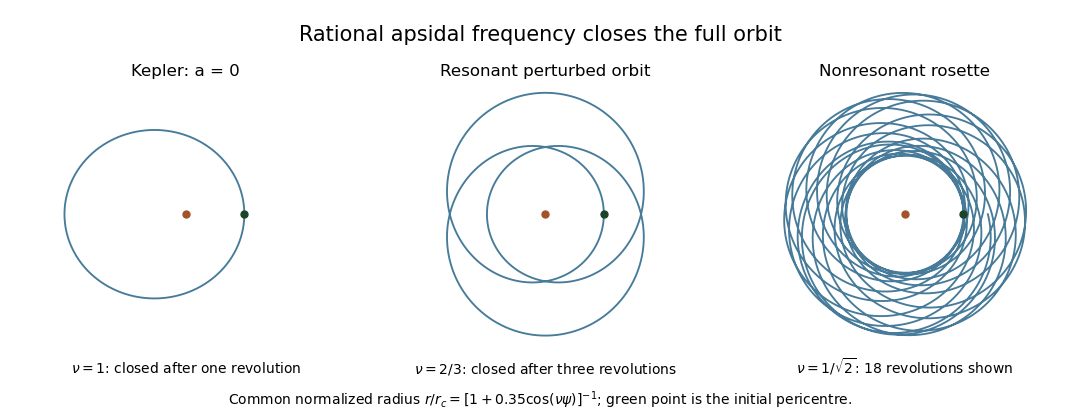
Closed rational-frequency orbits and a nonclosed irrational-frequency rosette in an inverse-cube-perturbed central force
. Details. 
To see the additional resonant label explicitly, let and . Then , so on a family with fixed resonant ,Its argument fixes the remaining apsidal phase modulo the symmetry of the closed curve; its magnitude is already determined by specific orbital energy and . Choosing reference axes in the fixed orbital plane makes this single-valued under . This is the fifth independent orbit label on the resonant family described by closed orbits with an inverse-cube perturbation.
For , varies with . The orbital resonance condition holds only on selected angular momentum surfaces, so this construction is not a fifth global smooth integral on an open set of arbitrary nearby . If the question asks for a maximally superintegrable Hamiltonian system on an open region of noncircular bound orbits, the required case is : then for every , and the conserved Laplace-Runge-Lenz vector fixes the apsidal direction globally. The relations and leave five independent constants. For the usual orbit-wise interpretation, noncircular bound orbits with rational have five isolating labels; irrational has four. Circular orbits are closed for any allowed but have no independent apsidal phase, so the generic noncircular count cannot simply be applied to them.
For completeness, regular unbound branches are different. When and , positive radius restricts the radial phase to . The apsidal invariant on an unbound central-force branch isThe principal argument is continuous on this scattering branch because it never reaches an apocentre across the negative-real-axis cut. Thus the periapsis direction can be a fifth single-valued scattering label for any positive , including irrational ; the rationality condition applies to the noncircular bound case. For plunging or collision branches with , local trajectory labels can still be defined away from the singular centre, but the preceding periodic-orbit criterion is inapplicable and no smooth continuation through is asserted.
Articles by others on the same topic
There are currently no matching articles.