Vary and independently, fixing the endpoint positions. Integration by parts givesThe boundary term vanishes, so arbitrary interior variations implyIn the Lagrangian principle only is varied independently, and ; here positions and momenta are independent paths in phase space. The extremality condition is stationarity of the action, not necessarily a minimum. Along Hamiltonian motion,so an explicitly time-independent Hamiltonian is conserved.
The invariant is phase-space volume, or area for one degree of freedom. It does not require an autonomous Hamiltonian. The flow vector has divergence whenever the mixed derivatives agree. If is the Jacobian of the flow with respect to initial coordinates, then . Differentiating its determinant givesThus the change-of-variables formula shows that any region carried by the flow retains its area. This proves Liouville theorem in Hamiltonian mechanics even when depends on time.
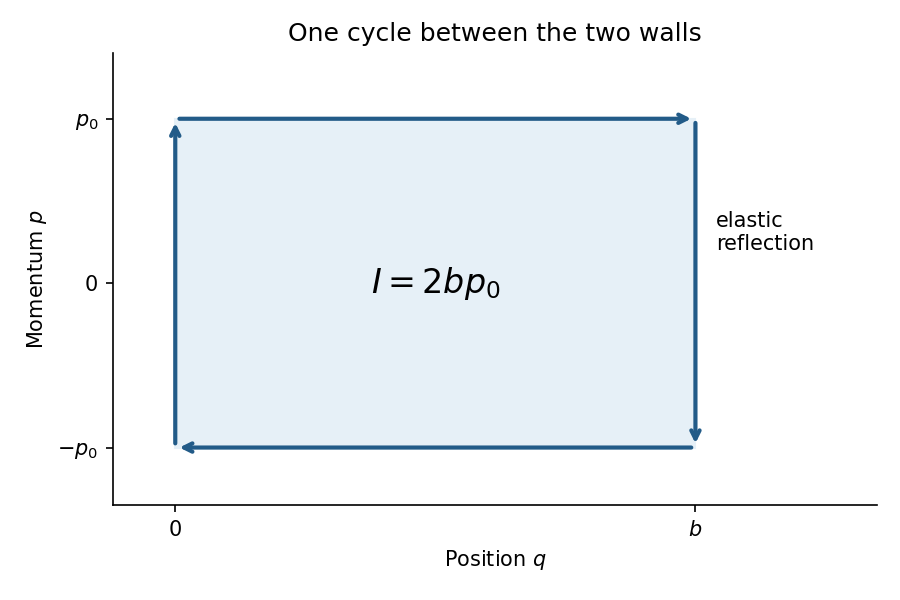
Between collisions the momentum is or . In phase space the cycle runs right along the upper horizontal segment from to , jumps vertically to at the right wall, runs left along the lower segment, and jumps back at the left wall. The jumps have . ThereforeDifferentiation gives , exactly the out-and-back period. Under slow wall motion the action is the adiabatic invariant; a convention using is equivalent. HenceCompression raises the energy and expansion lowers it, provided the wall speed is small compared with the particle speed and the change per cycle is small.

Articles by others on the same topic
There are currently no matching articles.