For every odd prime and , the group of units modulo an integer is a cyclic group, of order ; a generator is a primitive root.
Modulo seven, are , so three has order six. Moreover is divisible by seven exactly once. We prove the lifting needed here. If with and , the binomial expansion gives , so . Induction therefore givesAny exponent giving one modulo is divisible by six. The order also divides by Lagrange theorem, while the displayed valuation rules out each proper divisor of this form. Consequently three is a primitive root modulo every .
Since and two is not one, its order modulo seven is three. A generator modulo would reduce to a generator modulo seven, because reduction is a surjective group homomorphism. Thus two is never a primitive root modulo . Finally every unit modulo eight is odd, and . All unit orders are at most two, whereas the unit group has four elements. There is no primitive root modulo eight.
The Brouwer fixed-point theorem says that every continuous map from a closed Euclidean ball to itself has a fixed point. For the closed disc its equivalent no-retraction theorem says that there is no continuous satisfying on .
Assume the fixed-point theorem and suppose such a retraction exists. Then maps continuously into itself. A fixed point must lie on the boundary, where , giving , impossible on the unit circle.
Conversely suppose is continuous and has no fixed point. From draw the ray through and let be its exit point on the circle. To check continuity rather than merely relying on the picture, put . The exit point is , whereThis is continuous, lies on the circle and has . On the boundary the exit point is , so is a retraction, contradicting the assumed theorem. Hence the two disc formulations are equivalent; the same argument works for a ball in any dimension.
Under the open set condition there is a nonempty bounded open set such that the sets are pairwise disjoint and all contained in . The Hausdorff dimension of the nonempty compact invariant set is the unique satisfyingFor the carpet here the 24 retained sub-squares give Euclidean similarities for , . Their images of are disjoint and lie in , so the condition holds even though some closed images share boundary points. All contraction factors are . Thus
A binary linear-feedback shift register of length keeps bits and produces a sequence satisfying a recurrenceAfter each output it shifts its stored bits and inserts the feedback bit. Its connection polynomial is . This convention reverses the usual characteristic polynomial .
The Berlekamp-Massey algorithm recovers the shortest recurrence compatible with observed bits. Maintain the current , length , an earlier polynomial that last caused a length increase, and the offset since that increase. Initially . At position calculate the discrepancy . If , advance . If , save and replace by . If also , replace by , by and by one; otherwise increase . Over a general field the correction is , where is the saved nonzero discrepancy. The correction cancels the failed equation while retaining the previous successful ones; when it forces a length increase the smallest possible new length is .
Here, indexing the first bit by zero, the nonzero discrepancies occur at positions . The corresponding updates areEvery subsequent supplied discrepancy is zero. ThusEquivalently the characteristic feedback polynomial is . No length-three recurrence works: positions force , but position six then has nonzero discrepancy. The recovered length is therefore minimal. Observing at least twice the true linear complexity ordinarily identifies the recurrence, after which a known consecutive block determines all future key bits. This is why a bare register is unsuitable as a cryptographic keystream generator; a finite prefix alone does not exclude a longer generator that later diverges.
Put , . Orthogonal projections of the Gaussian error give independent variablesHence the exact confidence set is the ellipsoidHere denotes the quantile of the F-distribution.
Let be the fit with observation removed, when that reduced design retains full rank. Cook's distance iswhere is its residual and is its leverage. Thus measures the deleted estimate's distance from the full estimate in exactly the metric of the confidence ellipsoids. The deleted estimate lies on the confidence contour whose quantile equals ; this is a geometric influence diagnostic, not an assertion that itself has an law.
For , , so deletion moves the estimate outside the 50% confidence ellipsoid but inside the 90% one. The observation warrants investigation for influence: the shift is substantial, though the supplied figures do not justify calling it outside the 90% region. The reciprocal and the approximate chi-square figures are unnecessary.
The probability generating function encodes the population distribution in one analytic function. Its coefficients and derivative recoverprovided the mean is finite. Higher derivatives at one give factorial moments, and normalization says .
Interpret the supplied birth and death expressions as transition rates: over a small time their probabilities are and . Incoming probability from and , minus both outgoing rates, giveswith . Multiplying by and summing yieldsAt stationarity, , so integration and normalization giveAlternatively differentiating the evolution equation at one gives , so . If , the displayed power expression is understood in its limit: , a Poisson distribution with mean .
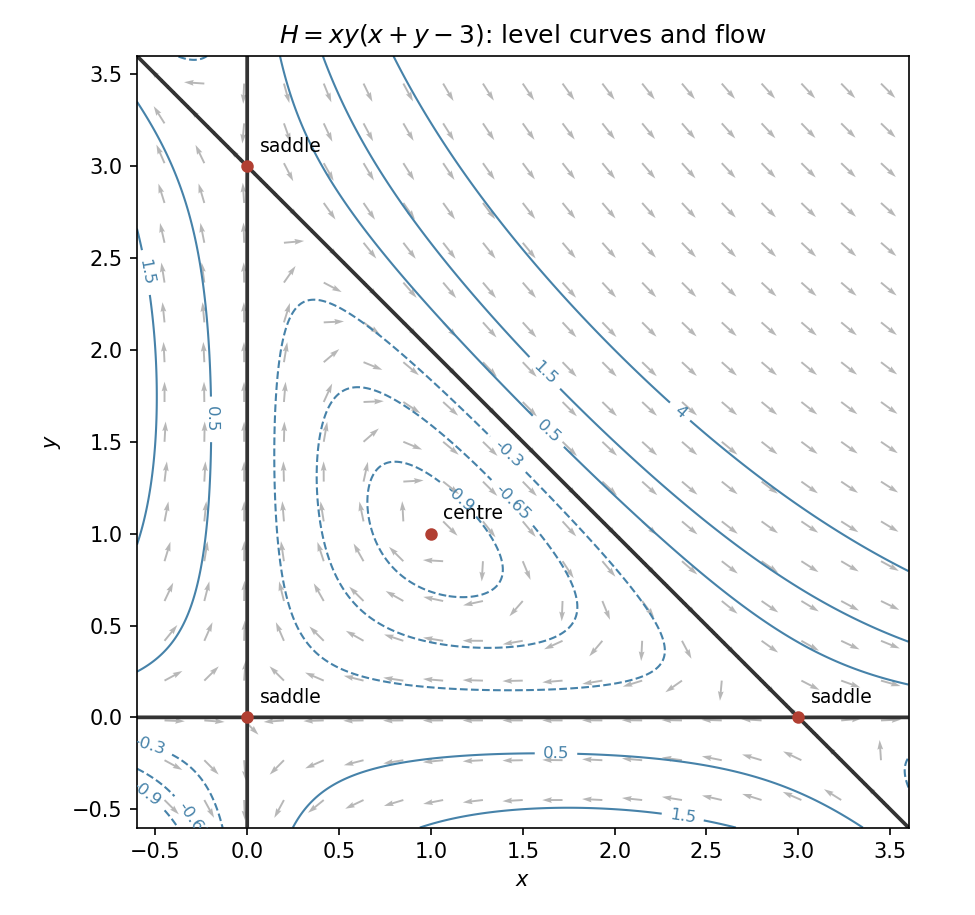
Solving the two factors in each equation gives . The Jacobian isAt the three boundary equilibria its eigenvalues are . These equilibria are hyperbolic fixed points; the Hartman-Grobman theorem gives local topological conjugacy to their saddle linearizations. At the matrix is , with eigenvalues . The linearization is a centre, but the hyperbolic theorem does not apply there.
The nonlinear classification follows from the actual HamiltonianAlong solutions . At , and its Hessian is , which is positive definite. Nearby regular level curves are closed ovals around this strict minimum. Their vector field is nonzero and tangent, so each is a periodic orbit. The nonlinear equilibrium is a centre.
The separatrix level consists of , , and . Within the triangle they connect the saddles as . The interior levels are nested clockwise periodic orbits; outside the triangle the remaining level branches are unbounded. On , flow is left for and right for or ; on , it is up for and down otherwise. These directions and the invariant levels determine the full phase portrait.
Use the one-sided Laplace transform . Since on , substitution gives . ThusIts poles are and , with residues of respectively two and . For close the Bromwich inversion formula to the left, using horizontal heights avoiding those poles. The left-side integrand decays like , and on the right-side horizontal ends like , so the added integrals vanish with the usual symmetric limiting contour. The residue theorem giveswhere the series is summed symmetrically and at jumps has the midpoint value.
For the vanishing can be checked directly in the inversion integral, rather than inferred from the recurrence. On any vertical line expand the denominator geometrically, uniformly there:Each inversion term is . If , close this contour to the right: the exponential decays, and the pole at zero is outside, so every term is zero. Equivalently the geometric expansion bounds the full closing contour by the same decaying factors. Thus for .
The same integral gives elsewhere. For with integer , this is , which directly verifies the difference equation. Neither a Laplace transform nor a Fourier series determines values at isolated jumps; the printed series fixes the standard convention , including .
Let be the Jacobian of an invertible change of phase coordinates, and set . The chain rule gives , whenceTherefore the necessary and sufficient condition to retain Hamilton's equations for arbitrary Hamiltonians isequivalently . In one degree of freedom this is the Poisson bracket condition .
Put . On a smooth branch of the angular coordinate,Consequently . The transformation is canonical for every real on each angular-coordinate chart. The origin is excluded and a single-valued arctangent cannot give a global chart on the punctured plane; using an angle modulo accounts for the usual branch qualification.
A comoving coordinate labels a galaxy carried by the homogeneous cosmological flow. Its physical separation at time is , where is the scale factor. Thus , the Hubble law, apart from peculiar velocities relative to this flow. In particular
Assume the present universe is expanding, . The stated energy inequality and the Raychaudhuri equation imply wherever . Therefore for in that positive branch, , andNonnegativity of forces . If the solution remains valid towards the past, its positive branch must thus end in within that time; a positive scale factor extending further would contradict the inequality. HenceThis argument presumes an expanding branch and the stated energy condition throughout it, rather than proving either assumption.
There are two relevant failures of the naive numerical bound. The supplied ten-billion-year Hubble time is an approximate observational input: a smaller inferred present expansion rate gives a larger Hubble time, and comparison with stellar ages must include these uncertainties. More decisively, a positive cosmological constant, or other dark energy with sufficiently negative pressure, has and permits accelerated expansion, so the concavity assumption fails. Observations of acceleration therefore remove this particular upper-bound argument. This is a discussion of the supplied historical estimate, not an assertion that its numerical value is a current measurement.
Parametrize the circle by , . Choose a continuous argument of , so . Its winding number about zero isThe two facts proved below determine the requested calculation without needing differentiability or contour integration. Put . On , , so adding one does not change its winding. The first and third factors have winding one, since their constant terms have modulus smaller than their linear terms; the second has winding zero, since its term has modulus smaller than its constant term. Nonzero constants have winding zero and has winding one. Thus
Choose continuous arguments along the parametrized circle. Their sum is a continuous argument of the product, because multiplication multiplies moduli and adds arguments. Subtracting endpoint values gives
Factor . The second factor has positive real part, since . It therefore has the continuous single-valued argument taking values in . Its values agree at the two ends of the parametrized circle, so its winding number is zero. Part (i) gives
In curvature-minus-one polar coordinates the hyperbolic metric is . Thus the area element is , givingIt is asymptotic to .
For a usual locally finite tessellation with compact congruent tiles of nonempty interior, let their diameter be at most and choose in each a congruently placed interior ball of radius . These balls have disjoint interiors. The number of tiles meeting a geodesic segment of length one is uniformly bounded: their ball centres lie in a ball of radius , and the disjoint -balls lie in the larger ball of radius . Comparing areas supplies a constant . A path of length , divided into at most such segments, therefore crosses at most tiles. A small generic perturbation avoids vertices if steps are defined by crossing sides.
Consequently the union of tiles at most steps from the initial tile contains a metric ball of radius for fixed . If is tile area, their number is at least , an exponential lower bound. Conversely any chain of adjacent tiles lies in about a point in the initial tile; the interiors are disjoint, so . Thus is bounded above and below by positive exponential functions of . No precise common growth exponent is claimed.
An explicit example is the regular right-angled pentagon tiling : reflect a regular hyperbolic pentagon with all angles in its sides. Four pentagons meet at each vertex, and their interiors tile the plane. Its tiles have area by the hyperbolic polygon area formula. The compactness and ordinary local finiteness assumptions exclude pathological decompositions with degenerate tiles.
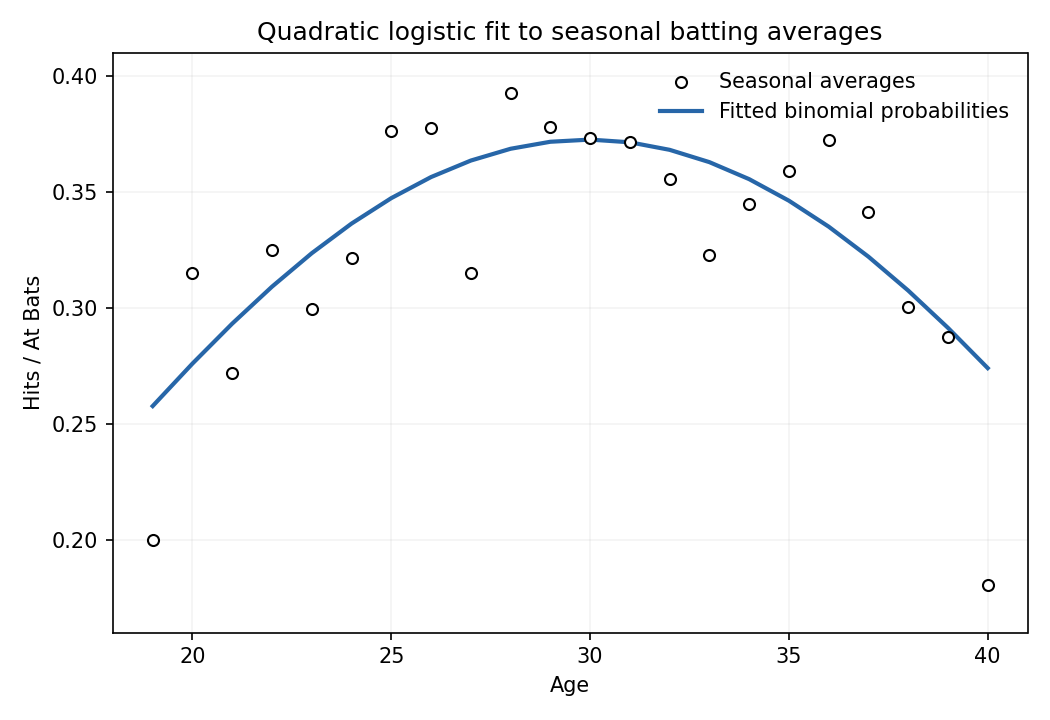
The fitted grouped-binomial logistic regression generalized linear model treats seasonal hits as independent variables, with andThus the response supplied to
glm is a proportion, and weights=AB supplies its binomial denominator; it is not a regression with equally precise seasonal averages. I(Age^2) forms the numerical square rather than using a formula operator. The estimates maximize up to a constant, where , .The observed negative Hessian is , . Expanding the score around the true parameter and applying a central-limit approximation gives . The reported standard errors are square roots of the diagonal entries of this inverse; the binomial dispersion is fixed at one. Each
z value divides the coefficient estimate by its standard error, and the reported two-sided Wald test uses a standard normal approximation under the corresponding zero-coefficient hypothesis.The last line reports the deviance against the saturated model,with . There are 22 seasonal observations and three fitted parameters, so 19 degrees of freedom. Under the quadratic-logit model, independent binomial sampling and sufficiently large expected counts, . The value 23.345 gives an upper-tail probability about 0.22, no evidence of lack of fit at conventional levels. This approximation and the independence assumption should not be confused with an exact test of a player's ability.
The final commands recover the coefficients, apply the inverse logit , plot the observed averages against age, and join the fitted probabilities at the observed ages. The fitted curve is smooth, rises towards its peak at , then falls. Its maximum is about 0.373; the early and late observed points include markedly lower averages. The plot uses equally sized points even though their binomial precisions differ.
Linearizing about the orbit gives , where . The fundamental matrix therefore satisfiesThe Floquet multipliers are the eigenvalues of the monodromy matrix . Differentiating the orbit equation shows that its tangent solves the variational equation. Since , one multiplier is one.
For an invertible fundamental matrix, differentiating the determinant gives . Integration from the identity yields . The determinant is the product of the two multipliers, so the other is
Write and . Along a trajectory,Use the unperturbed orbit to compute the leading energy change over one period:Zero averaged energy change gives the nonzero amplitudeThe supplied sign condition makes this real and nonzero. The averaged amplitude equation is , whose derivative at that root is . Its nonzero derivative also makes the root persist as an isolated periodic orbit for sufficiently small positive .
Directly, the planar divergence is . On the leading orbit its integral over is . ThusThe cycle is attracting for and repelling for . Both sign possibilities are allowed by .
Vary and independently, fixing the endpoint positions. Integration by parts givesThe boundary term vanishes, so arbitrary interior variations implyIn the Lagrangian principle only is varied independently, and ; here positions and momenta are independent paths in phase space. The extremality condition is stationarity of the action, not necessarily a minimum. Along Hamiltonian motion,so an explicitly time-independent Hamiltonian is conserved.
The invariant is phase-space volume, or area for one degree of freedom. It does not require an autonomous Hamiltonian. The flow vector has divergence whenever the mixed derivatives agree. If is the Jacobian of the flow with respect to initial coordinates, then . Differentiating its determinant givesThus the change-of-variables formula shows that any region carried by the flow retains its area. This proves Liouville theorem in Hamiltonian mechanics even when depends on time.
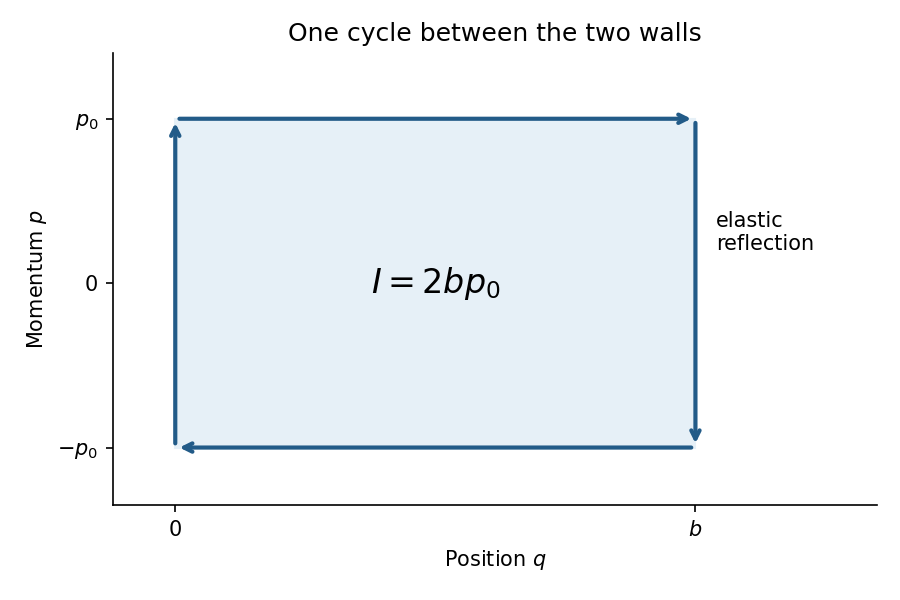
Between collisions the momentum is or . In phase space the cycle runs right along the upper horizontal segment from to , jumps vertically to at the right wall, runs left along the lower segment, and jumps back at the left wall. The jumps have . ThereforeDifferentiation gives , exactly the out-and-back period. Under slow wall motion the action is the adiabatic invariant; a convention using is equivalent. HenceCompression raises the energy and expansion lowers it, provided the wall speed is small compared with the particle speed and the change per cycle is small.
A chain-complete partially ordered set has a supremum for each chain (and a least element if the empty chain is included). The weaker condition needed for Zorn lemma is that every chain have an upper bound; some terminology also calls this chain-complete. Zorn's lemma says that a nonempty partially ordered set with this upper-bound property has a maximal element. We verify that exact hypothesis below.
Consider the lattice ideals containing but not , ordered by inclusion. The principal ideal belongs to this family because . The union of a nonempty chain of such ideals is an ideal: two of its elements lie together in one member of the chain, which contains their join and everything below it. The union still avoids . The empty chain has the initial principal ideal as an upper bound. Zorn supplies a maximal such ideal .
We prove that is a prime lattice ideal. If , maximality says that the ideals generated by adjoining and by adjoining both contain . Thus and for some : the first generated ideal consists of elements below , and similarly for . If , distributivity givesa contradiction. Consequently implies or .
Define on and one elsewhere. An ideal contains exactly when it contains both and , and its primeness says that it contains exactly when it contains at least one of them. Thus preserves both joins and meets, and as required.
For completeness, take the Lindenbaum algebra of classical propositional formulae modulo provable equivalence, including any given premises as axioms. It is a Boolean, hence distributive, lattice; provable implication is its order. If a formula is not provable from the premises, then . The separation just proved, with , gives a homomorphism of lattices sending to zero and one to one. It also sends zero to zero, since , and preserves complements because their meet is zero and join is one. Its values on atomic propositions form a Boolean valuation satisfying all premises and falsifying . Thus semantic consequence implies provability, the completeness theorem for propositional logic.
For a finite connected plane graph, with vertices, edges and faces including the unbounded face, Euler formula for a connected planar graph isIf the graph is a tree, and . Otherwise remove an edge on a cycle. This preserves connectivity and joins the two faces on its sides, so both and decrease by one. Repeating reaches a tree, preserving throughout and proving the formula.
For a simple connected graph with , each face boundary walk has length at least three, with bridges counted twice in the walk; the sum of lengths is . Hence , which with Euler gives . If it has no triangles in a graph, no face boundary walk can have length three, and every boundary length is at least four. Thus , givingFor a disconnected graph, add noncrossing bridges between its components; this preserves simplicity and creates no triangles, reducing to the connected bound.
Every triangle-free planar graph with at least three vertices has average degree , and therefore a vertex of degree at most three. Remove one such vertex. Its remaining graph is again triangle-free and planar. Induction, with graphs on at most two vertices as the base cases, provides a graph colouring with four colours of the remainder. At most three colours appear on the removed vertex's neighbours, so a fourth colour extends the graph colouring. This proves four-colourability without using the four-colour theorem.
Let be the splitting field of the separable polynomial. Its Galois group is , acting faithfully on its distinct roots, hence as a subgroup of . An automorphism preserves each root's minimal polynomial. Conversely an isomorphism for roots of the same irreducible factor extends to an embedding of in an algebraic closure, and normality of the splitting field makes the image itself. Thus the root orbits are precisely the irreducible factors' root sets. The action is transitive exactly when the polynomial is irreducible.
If is prime, a transitive action has by orbit-stabilizer, so Cauchy theorem for groups supplies an element of order . Its permutation must be a -cycle. Conversely a -cycle already acts transitively on all roots. This proves the stated equivalence for prime degree.
The factorization theorem modulo a good prime says that if an integer polynomial retains its degree and has square-free reduction modulo , and that reduction's irreducible factor degrees are , its Galois group over contains a permutation with disjoint cycle lengths . Equivalently the finite-field Galois group, generated by Frobenius on the roots, occurs as an unramified decomposition subgroup. The degree-retention qualification matters for nonmonic polynomials.
For the given quintic, Eisenstein criterion at three proves irreducibility. Modulo two it factors asNeither factor has a root in , so both are irreducible, and they are distinct; the reduction is separable. Thus contains an element of cycle type , whose cube is a transposition. It is also transitive of degree five.
To prove that this forces the full symmetric group here, form the graph on the five roots with an edge for each conjugate in of that transposition. The graph is -invariant, and transitivity makes its connected components all the same size. That size divides five; there is an edge, so the size cannot be one. Hence the graph is connected. Transpositions along the edges of a connected graph generate all transpositions (move along a path and conjugate successive swaps), and hence generate . They all belong to , giving
The permutation representation has basis , , with . Its matrix is a permutation matrix, whose diagonal entry is one exactly at fixed points. Therefore
The translation subgroup is normal and , via the upper-left entry . Thus the coset representation is the regular representation of that cyclic quotient. If runs through its complex one-dimensional characters, inflated to , thenEach occurs once: the regular character is at the quotient identity and zero elsewhere, which is also the sum of all quotient characters by finite character orthogonality.
Write for the affine map . Conjugation by sends translation by to translation by , so it permutes transitively the nontrivial characters of . Since is normal, the induced character is zero outside . On a translation by it is the sum of all conjugates of , henceFor the sum of the nontrivial additive characters is minus one, since the sum including the trivial character is zero. Its character norm isBy the irreducibility criterion for characters, is irreducible of dimension . All choices of nontrivial give the same representation.
There are the inflated quotient characters of dimension one and the single representation of dimension from part (ii). These are distinct: for their dimensions distinguish , and for its nontrivial value on distinguishes it from the trivial quotient character. Their dimension squares sum toThe sum-of-squares theorem for irreducible representations leaves no room for any further irreducible. This includes , when and both representations have dimension one.
There is an error in the printed request: the cubic is not irreducible at , and three elements cannot be a field basis in that case. The integral-basis assertion is valid under the necessary hypothesis .
Under that hypothesis, is an algebraic integer and has finite index . Change of basis in the trace pairing gives the discriminant-index identityThe field discriminant is an integer. If the left side is square-free, cannot divide it unless . Thus is an integral basis when the cubic is irreducible and its discriminant is square-free.
For any root, givesSince , and ,On the other hand, the product of is : the product of the roots is one, and each of the three unordered root pairs contributes a negative squared difference. Therefore, without needing irreducibility for this polynomial calculation,The three-root product is the field norm only when the cubic is the minimal polynomial.
At , the polynomial has no rational root (the only candidates are ), so it is irreducible, and its discriminant is . Hence is an integral basis.
At ,If , then with integral basis . If , then and is an integral basis, since this quadratic order has square-free discriminant five; also . In neither case is the three-element list a basis. Its discriminant five is instead that of the degree-three algebra ; a basis there does not repair the printed assertion about the field .
Use the usual cell structure on the torus: one vertex, two one-cells , and one two-cell attached by the word . Take the meridian being collapsed as . The quotient has one vertex, the surviving circle , and a two-cell whose attaching word reduces to and is null-homotopic. Attaching a two-cell to a circle by a null-homotopic loop gives a space homotopy equivalent to .
Alternatively its cellular chain groups are , and both boundary maps vanish: the two-cell traverses once in each direction, and the one-cell's endpoints coincide. Thus the integral homology groups areThe pinched torus is connected, so reduced is zero.
Two norms are Lipschitz equivalent norms if constants satisfy for every . On the vector space of finitely supported sequences, the norms and are not equivalent: a vector with entries equal to one has the two norms and one.
For dimension , choose a basis and write . Any norm satisfies . This also implies its continuity in the Euclidean coordinates, by . Its positive continuous values on the compact Euclidean unit sphere have a positive minimum . Homogeneity gives , proving equivalence with the Euclidean norm and hence between any two norms.
If a finite-dimensional subspace of a normed space contains a sequence converging in the ambient norm, its coefficient vectors are Cauchy by this equivalence. The coefficients converge in or , and the reconstructed vector lies in and is the ambient limit. Thus finite-dimensional subspaces are closed.
A finite-dimensional normed space has nonempty open balls with compact closures by equivalence and Heine-Borel. Conversely let an open set have compact closure. Choose and such that . Its closed ball of radius is a closed subset of the compact closure of and is therefore compact. Translation and scaling make the closed unit ball compact.
If the space were infinite-dimensional, construct unit vectors with . Here is the needed Riesz lemma: for a proper closed subspace , choose , put , and choose with ; then has distance greater than from . The finite spans are closed by the earlier argument, so this constructs the sequence. Its members are separated by more than , and have no convergent subsequence, contradicting compactness. Therefore the space is finite-dimensional exactly when it has a nonempty open set with compact closure.
Uniqueness in the defining characterization gives : the reflected function has the same poles, periodicity and prescribed principal part. Hence is odd and periodic. At each nonzero half-period , , so .
An elliptic function has equally many zeros and poles, counted with multiplicities, in a fundamental parallelogram. This standard property applies to , whose sole pole modulo the lattice has order three. The three distinct nonzero half-periods already supply three zeros, so these are all its zeros and each is simple. ThusEvenness and the prescribed expansion give . There is no constant term because the defining difference tends to zero, and only even powers occur. ConsequentlyAdding cancels the last pole. The resulting elliptic function is holomorphic everywhere and therefore constant, by boundedness on a fundamental parallelogram and Liouville theorem. Its value at zero is . ThusAt the three half-periods . Their values are distinct: if two such points had the same value , then would have a zero of multiplicity at least two at each, because its derivative vanishes there. That gives at least four zeros, contrary to its sole double pole and the zero-pole counting property. Hence the cubic has three distinct roots and leading coefficient four, provingAll properties specific to used here were derived from its defining characterization; only the general elliptic zero-pole count and holomorphic constancy were used as standard facts.
The manifold inverse function theorem states: if is smooth and is an isomorphism, there are open neighborhoods of and of such that is a diffeomorphism. In particular the manifolds have the same dimension at those points.
Choose charts around and around , shrinking the source chart so its image under lies in the target chart. The coordinate map has derivative , an invertible matrix. Apply the permitted Euclidean inverse function theorem to obtain open coordinate neighborhoods on which and are smooth. Pull them back through the charts. The resulting inverse is , smooth by composition. This proves the manifold statement.
Differentiate the homogeneity identity with respect to at one to obtain Euler's identityOn , its right side is , so . Thus is a regular value. The preimage theorem says that the nonempty inverse image of a regular value of a smooth map is a smooth submanifold of codimension . Applied to , it gives .
For , dilation by maps to , because . Its inverse is dilation by , so all nonempty positive level manifolds are diffeomorphic.
A negative level need not be diffeomorphic to a positive one, even when both are nonempty. For , is connected (parametrize it by ), whereas has two components, according to . Thus the answer for opposite signs is no. If is odd, the additional symmetry does interchange opposite levels up to scaling, but the question allows even degrees.
Events are independent events if for every finite list of distinct indices , . Random variables are independent random variables if for every such list and Borel sets , . This is equivalent to independence of their generated sigma-algebras; pairwise independence alone is insufficient.
The tail sigma-algebra isKolmogorov zero-one law states that if the random variables are mutually independent, every event in has probability zero or one. No identical-distribution assumption is needed.
Convergence of the partial sums is also a tail event. For any , subtracting the finite real sum shows that convergence is equivalent to convergence of . The Cauchy criterion expresses the latter using countable unions and intersections of inequalities involving these tail sums, so it belongs to every tail sigma-algebra.
The event that the partial sums are nonpositive infinitely often is not generally a tail event. For a counterexample let take values and one on a two-point probability space, each with positive probability, and let for . The event is then , while is trivial. The variables in this example are even independent. Its status can be different for particular sequences, but it is not tail-measurable in general.
Split the overlapping products into two nonoverlapping families:Within each sum the summands depend on disjoint independent pairs and are independent identically distributed Bernoulli variables of mean . The two families need not be independent of each other. The strong law of large numbers says that averages of independent identically distributed integrable random variables converge almost surely to their expectation. Applying it separately to each family and intersecting the two probability-one events gives
A conservative Q-matrix has for , finite exit rates , and hence row sums zero. It specifies the infinitesimal transition probabilities . For a finite state space,The first derivative at zero is the generator. On infinite state spaces one must additionally address nonexplosion and the domains needed for the forward and backward equations.
All four permitted hops have rate one: , , , and . Every state reaches every other, so the only communicating class is , and it is closed.
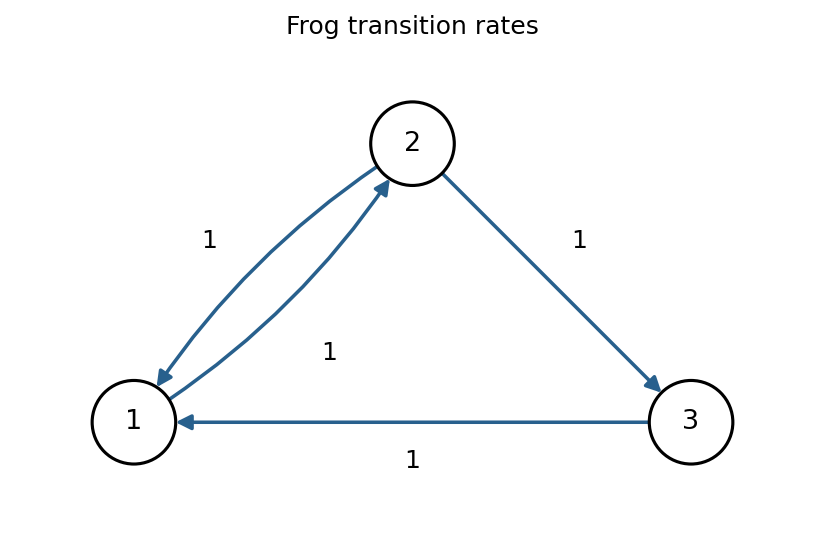


Solving , , gives and . ThusFor the transient probability, let . The forward equations and give , . From , . Integrating , with , yieldsIt has derivative one at zero and tends to , as required.
A loss function quantifies the cost of taking action when the parameter is . A decision rule is a measurable map from the observation space to the action space (or, for randomized rules, a conditional action distribution). Its risk function is . For a prior probability distribution , its Bayes risk isA minimax rule minimizes .
For any rule , the average risk is at most its supremum, and the specified Bayes-optimality property then givesTherefore is minimax.
Interpret the printed expression as . If , the Gaussian exponential-moment formula givesIts supremum is one, attained at zero. For every rule , , so and . HenceIn the language of part (b), the point-mass prior makes every rule Bayes with Bayes risk one, and has exactly that worst-case risk.
The diagram has common multipliers on every branch, with gross riskless return . The martingale condition givesSince , these probabilities lie strictly between zero and one at each node, and the market is arbitrage-free. All valuations below use discounted conditional expectations under this measure.
Articles were limited to the first 100 out of 140 total.
Articles by others on the same topic
There are currently no matching articles.