Work with real positive pulse envelopes and define . Then and . In the ordered basis , the candidate dark state of a driven Hamiltonian has coordinatesMultiplication by the given rotating-wave approximation matrix givesThusIts absence of an excited-state component is the destructive interference that makes it dark. The orthogonal bright ground-state combination is . Since and , the two remaining eigenstates are with eigenvalues .
For signed envelopes, use a continuous two-argument angle with and , rather than an ambiguous arctangent branch. When both fields vanish, every state has zero eigenvalue and this formula does not select a unique dark vector.
Start by turning on first, while . The dark state is then exactly , which is uncoupled even while the first pulse rises. Next turn on while remains appreciable, and then turn off while remains on. The ratio rises from zero to infinity, soThe final minus sign is an irrelevant global phase for level population transfer. This is the counter-intuitive sequence of stimulated Raman adiabatic passage: the laser coupling the target state to the excited state precedes the laser coupling the initial state to the excited state.
The quantum adiabatic theorem requires the dark state to rotate slowly compared with its separation from the bright states. Here , so its coupling to either bright eigenstate has magnitude . In the printed convention the entries are angular-frequency couplings, and the condition isIf one instead uses an energy-valued Quantum Hamiltonian, its spectral gap is and the same condition is . Maintain nonzero overlap and gap while the angle changes. The pulses can vanish at the beginning and end, where the dark state has stopped rotating and is an exactly decoupled basis state.
An explicit smooth sequence has on and zero otherwise, while on and zero otherwise. Choose . The first pulse comes earlier, both overlap during the rotation, and the second persists after the first has ended. The following original sketch shows the envelopes and instantaneous dark-state level populations.
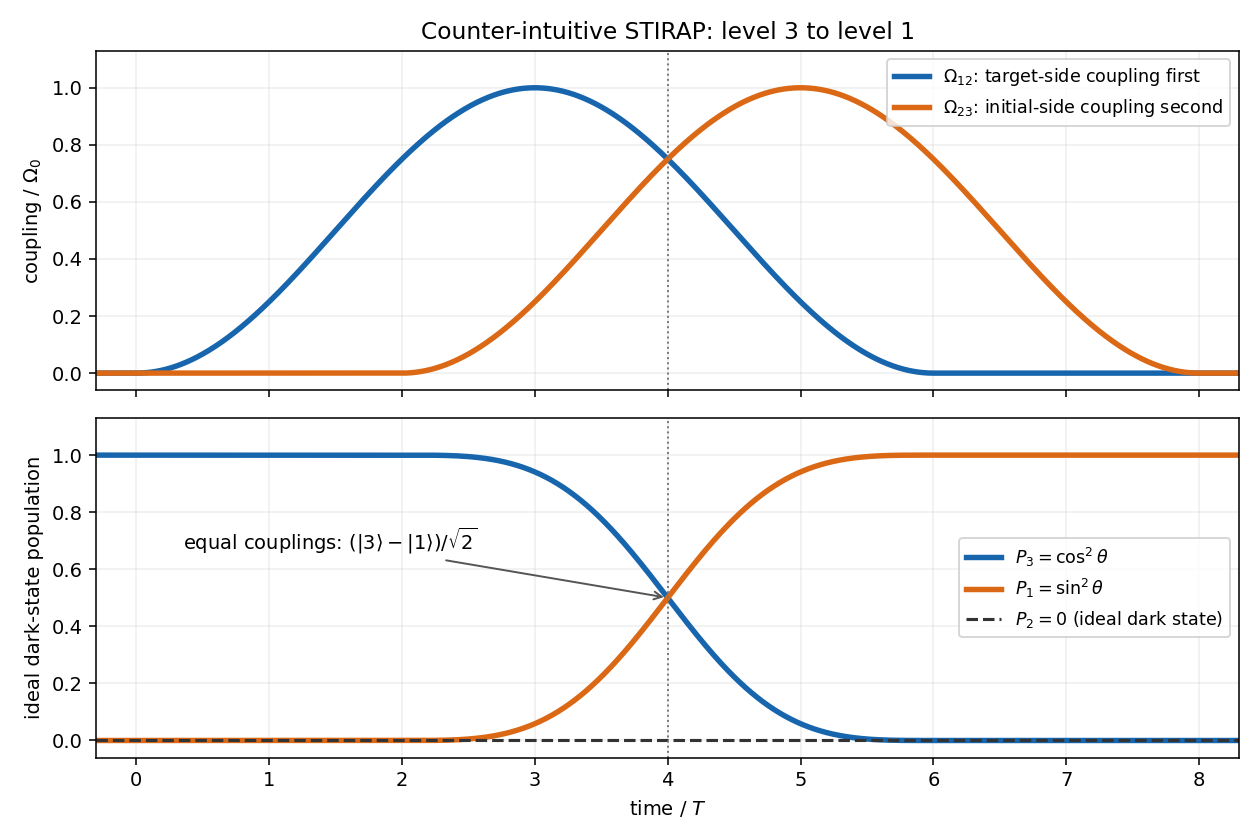
Counter-intuitive STIRAP pulses for transfer from level 3 to level 1, with ideal dark-state populations
. Details. 
Excited-state decay is suppressed in the ideal dark-state limit. The dark state has zero amplitude on , so a spontaneous-emission jump of the form annihilates it. There is consequently no excited-state level population to decay in perfect adiabatic following. Finite speed introduces bright-state admixture and a small excited level population; its integrated loss is of order . Thus robustness is conditional on good adiabaticity, not immunity to arbitrarily large decay at fixed pulse strength and duration. In a strongly overdamped regime the relevant relaxation gap can also limit following.
Moderate envelope perturbations are tolerated because this transfer is fixed by the endpoints of the dark-state path, not by an accurately calibrated resonant pulse area. Common amplitude changes do not change the angle, although reducing them too far closes the useful gap. Independent smooth changes still work if they preserve the counter-intuitive order, the endpoint ratios, resonance and a sufficiently large gap relative to . A wrong sequence, missing overlap, rapid fluctuations or unstable relative optical phase can spoil the transfer.
Ground-state decoherence is not suppressed by the dark-state mechanism. During the overlap, the dark orthogonal projector has quantum coherence . Dephasing of the – transition removes precisely this relative-phase information, even if initially. For example, with in a Lindblad equation, its dissipator gives . It therefore drives a nontrivial dark superposition away from its pure orthogonal projector. The transfer should be slow enough for adiabaticity but fast compared with the relevant ground-state quantum coherence lifetime. Ideal protection from excited-state spontaneous emission does not protect this ground-state quantum coherence.
With the principal arctangent in part (a), both coefficients must be . HenceFor the positive-envelope transfer this is the crossing at a positive coupling. If both couplings have the same negative sign, their ratio still gives the stated principal-angle vector; a continuous-angle representative can differ by an irrelevant overall minus sign. At this point the instantaneous dark state is . In the example sketch this occurs at , where the two effective couplings cross. Equality of the raw envelopes and is not enough if the dipole moments differ: the condition is , with the same effective relative phase. More generally the equality may occur once or several times, depending on the pulse shapes. Simultaneous zero couplings do not specify this superposition because the whole Quantum Hamiltonian is then degenerate.
Articles by others on the same topic
There are currently no matching articles.