Choose a fixed vertical datum so the physical free surface is at , with constant; its depth above the bottom is . The gradient of the constant datum does not enter the pressure force. With , the rotating shallow water equations areThe fluid is hydrostatic with depth-independent horizontal velocity at this order. The pressure-gradient force uses the free-surface slope, not the layer-depth slope: .
Let be relative vertical vorticity, the absolute vorticity, and . Taking the horizontal curl of the two momentum equations and expanding the advective derivatives givesMass conservation is . The two stretching factors cancel, proving the exact shallow-water potential vorticity conservation lawThe denominator is , the actual column thickness that changes under horizontal convergence; an arbitrary surface elevation does not obey that column mass equation. There is no term because the reduced layer quantities have no vertical dependence. The vertical motion has already supplied the layer-thickness equation, rather than remaining an independent coordinate of this model.
Now take and assume , . To first order,For a small Rossby number, leading geostrophic flow satisfies and . ThusFor , the barotropic deformation radius is . Multiplication of the first-order PV by givesThis is the required shallow-water quasi-geostrophic potential vorticity, including the bottom contribution.
Write and . The initial state has , so . The specified homogenization sets in and leaves it unchanged outside. Hence the requested change isFor this is a descending straight segment from to , with zero exterior values and jumps at the two edges. Endpoint values do not affect the inversion. It is the anomaly, not the full final PV profile, that appears as the source below.
For the zonal mean, , , and potential-vorticity inversion requireswith decaying disturbance at both infinities. The odd source makes the unique decaying solution odd. A particular interior solution is , so writeBoth and must be continuous at : a jump would introduce a delta function or its derivative into a source that has only finite jumps. Matching at givesand thereforeDifferentiate the interior streamfunction to obtainThe exterior profiles needed for the sketches are and .
For , put , , so . Uniform Taylor expansion givesConsequentlyFor the leading interior current is westward and approximately parabolic.
For and away from the edges, and : the surface follows the bottom slope centrally. Near , the exponentially thin corrections give positive edge jets of width and peak scale when . Those jets decay in the exterior. The elevation is odd, has opposite-sign extrema just inside the edges, and decays to zero outside; at the positive edge . The following sketch uses the full matched solution with . For negative , the current and PV-change signs reverse, while this elevation profile does not.
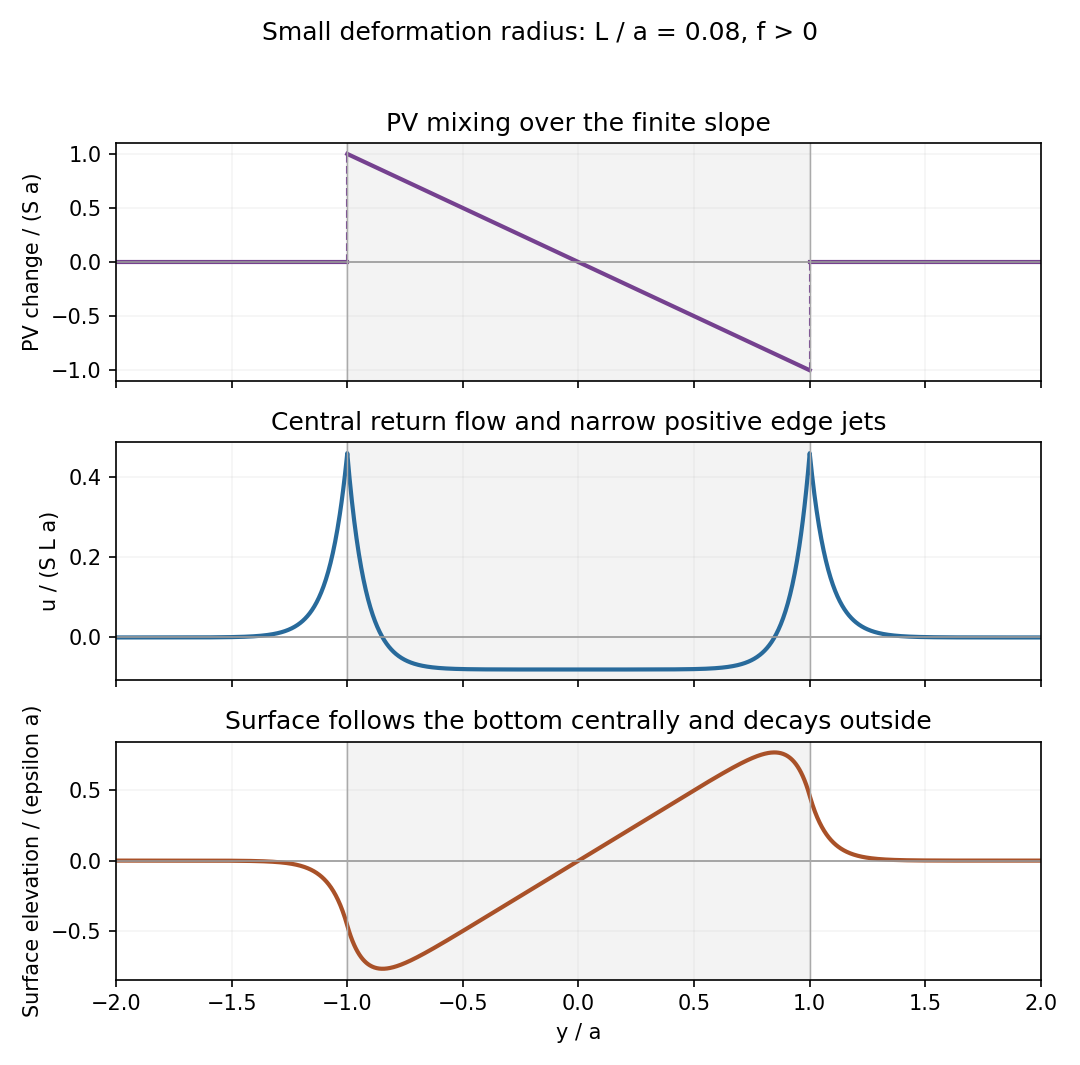
Potential-vorticity change, central current with edge jets, and free-surface elevation after mixing over a finite bottom slope
. Details. 
Articles by others on the same topic
There are currently no matching articles.