Use the induced square lattice rectangle with lattice spacings as its side lengths. An open left-to-right crossing and a top-to-bottom crossing of closed dual bonds are mutually exclusive: their embedded paths must intersect, and a primal open bond cannot have its crossing dual bond closed. They are exhaustive. Indeed, explore all vertices connected to the left side by open paths. If that exploration does not reach the right side, the interface separating the explored set from the right side supplies a top-to-bottom path of closed dual bonds. This is the planar crossing alternative for dual bond percolation.
For a primal rectangle of width and height , the dual crossing can be represented using the dual columns at and the exterior rows at . The terminal portions can be moved horizontally along the wired top and bottom boundary, so the random edges involved have exactly the law of a vertical crossing of a rectangle of width and height . ConsequentlyThis is why the boundary offset is needed; one cannot simply assert that a finite square has crossing probability exactly one half. For and , the second term is the same as the first after rotation and translation. ThereforeShortening a rectangle can only help a horizontal crossing, so as well.
We first derive the reflected attachment estimate for percolation. Put , , and . Let require an open vertical crossing of together with an open path in attaching it to the right side of . ThenTo prove this, explore the leftmost vertical open crossing of , revealing bonds on and to its left, but none strictly to its right. One can implement this exploration by following the boundary of the set accessible from the left using closed dual bonds; its right boundary is the extremal open crossing when that crossing exists. Thus fixing its outcome leaves right-side bonds in their original independent distribution.
For each possible explored , reflect its geometry in and join it to its reflection to obtain a bottom-to-top separator of . This reflected portion is only a geometrical separator and is not presumed open. Let and mean that an open path from the right boundary reaches, respectively, the lower or upper half of , staying to its right until its endpoint. Any horizontal open crossing of , followed from right to left until its first meeting with , witnesses at least one of these events. Reflection in swaps and and preserves the independent measure. HenceThe bonds tested by remain unexposed after specifying ; conditional on that exploration its probability is still the unconditional one for this deterministic separator. Its occurrence attaches the genuinely open lower crossing to the right side. Average over to obtain the attachment estimate.
Now take and , with common corner square . Use , its horizontal reflection in , and a horizontal open crossing of . The last crossing meets the vertical crossings of in both attachment events, so these three events give a horizontal crossing of . All three events are increasing events, so the Harris lemma gives
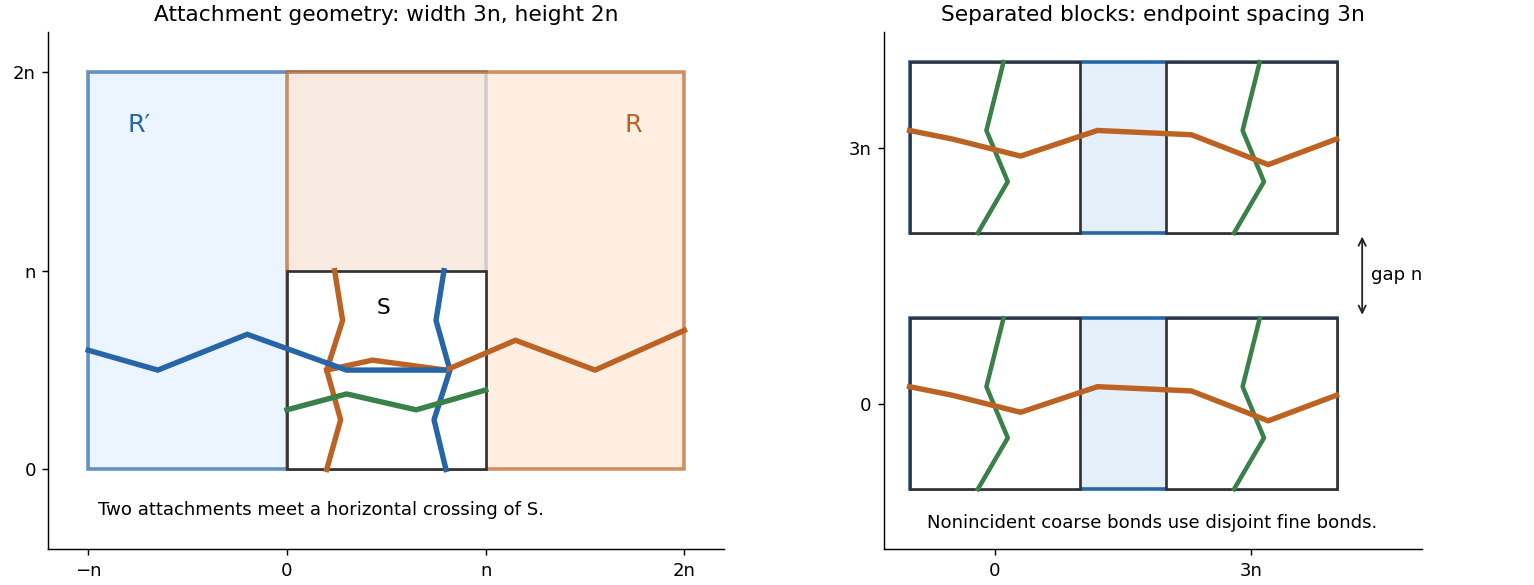

For all aspect ratios, glue a width-, height- rectangle to a width-, height- rectangle with an overlap square of side . Their horizontal crossings and an overlap vertical crossing imply a crossing of their union. Again the Harris lemma givesAdding a -wide rectangle therefore yieldsFor height , let , so and . Choose an integer . For , we have ; restricting to height and extracting a shorter horizontal crossing givesFor , the horizontal bottom-row path gives whenever the allowed integer exists. Thus one may take . This proves the requested uniform rectangle crossing in bond percolation bound, rather than assuming the Russo-Seymour-Welsh theorem.
The Harris theorem for square-lattice bond percolation asserts , and hence . Work in the dual square lattice, declaring a dual bond open precisely when its primal bond is closed. At this is again independent bond percolation of density one half.
Around a square centered at the origin place four dual rectangles of dimensions by , one on each side, with overlap squares at the corners. Long crossings of all four must meet in the corner squares and their union contains a dual circuit surrounding the central square. The fixed-aspect crossing bound and the Harris lemma give this dual barrier a probability at least , independent of .
Take geometrically increasing integer radii, for example with a factor of eight, and shift by half a lattice spacing to lie on the dual lattice. The four-rectangle annuli then have disjoint bond sets. Their barrier events are independent. An infinite primal open path from the origin would have to avoid every closed dual circuit, so the independent annular barriers for percolation giveLetting provesThe extension to smaller follows by the monotone coupling of Bernoulli percolation. Translation and a countable union also show that no infinite open cluster exists anywhere at .
Articles by others on the same topic
There are currently no matching articles.