Assign each edge an independent uniform distribution label on . At parameter , declare open exactly when . Each open/closed decision then has the required Bernoulli distribution, and different edge decisions are independent. The same construction applies to site percolation with labels on vertices.
Keep those labels fixed when increasing . For , every -open edge is also -open, so every -open graph path survives and each percolation cluster can only gain vertices. This coupling of probability distributions compares complete configurations on one probability space, rather than comparing two unrelated pictures. Any increasing event, such as an open path between specified vertices, consequently has a nondecreasing probability.
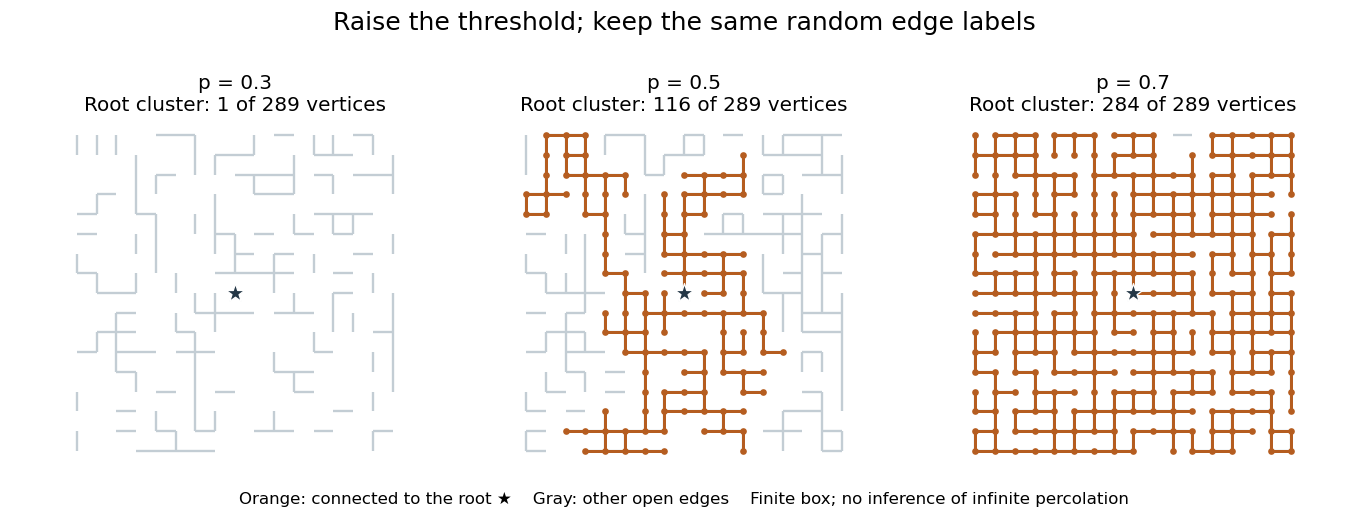

The three panels use one seeded collection of labels on a finite square lattice box. Colored edges and dots show the central root's percolation cluster; gray edges are open but disconnected from it. A percolation cluster can grow by many vertices when one newly opened edge joins it to another large percolation cluster. The panels illustrate a nested construction, not an estimate of or a proof of the Harris-Kesten theorem.
If an increasing event depends on sites or edges, the uniform-label monotone coupling of Bernoulli percolation and the union bound give for . A change of the event requires a coordinate with label in . For bond percolation from the origin to the boundary of , first-hit graph paths use the internal edges, so the same count bounds the parameter sensitivity.
In the uniform-label monotone coupling of Bernoulli percolation, let mean that the origin belongs to an infinite percolation cluster, and let . The occurrence parameters form an upper interval. Therefore and . Since , the jump is . Occurrence at the infimum is not presumed.
For , first sample Bernoulli percolation at parameter , then independently open each remaining closed coordinate with probability . Every coordinate is then open with probability , so the union has the parameter- law. This coupling separates existing -clusters from the additional sprinkled connections between them.
Articles by others on the same topic
There are currently no matching articles.