In the Boussinesq approximation, density departures from a constant reference density are small enough to neglect in inertia and mass continuity, but their gravitational effect is retained. Write the total buoyancy acceleration as , choose a hydrostatic background , and set . Thus is the buoyancy perturbation, positive for a parcel lighter than the background at its present height. The squared buoyancy frequency isStable stratification has . A small vertical displacement of a parcel conserving its buoyancy gives , explaining the restoring acceleration and the name of .
Let be pressure with the background hydrostatic pressure removed, , and the material derivative. The ideal, nonrotating Boussinesq equations areThe last equation is equivalent to . There is neither viscosity nor buoyancy diffusion. The reference density occurs in the pressure normalization, while the small density anomaly occurs only through buoyancy.
For the two-dimensional disturbance, linearization about rest givesA plane internal gravity wave proportional to therefore satisfiesThese internal-wave polarization relations and the dispersion relation determine the individual responses in parts i and ii. A radiating response has no incoming internal gravity wave from ; an evanescent response is bounded there. The harmonic solutions describe the response after excluding arbitrary initial transients.
For the localized oscillatory boundary, define and . Both signs of vertical wavenumber must radiate into . Their horizontal wavenumber is , so the positive- contribution involves and the negative- contribution involves . Consequently the complex horizontal velocity isTaking its real part provesThe positive- internal-wave polarization has and the negative- one has . HenceIn particular, , so the boundary condition is recovered exactly. This is two-beam radiation from a localized oscillating boundary.
Take a smooth localized profile, for example . Its effective support is a neighbourhood of width a few ; increasing that neighbourhood makes the tails arbitrarily small. The boundary displacement is to first order, so at it is flat and moving at maximum speed. At that instant,There are two narrow oblique beams centered on and . Away from their overlap, the velocity is parallel to the relevant beam, in the directions and . The figure uses and measures velocities in units of .
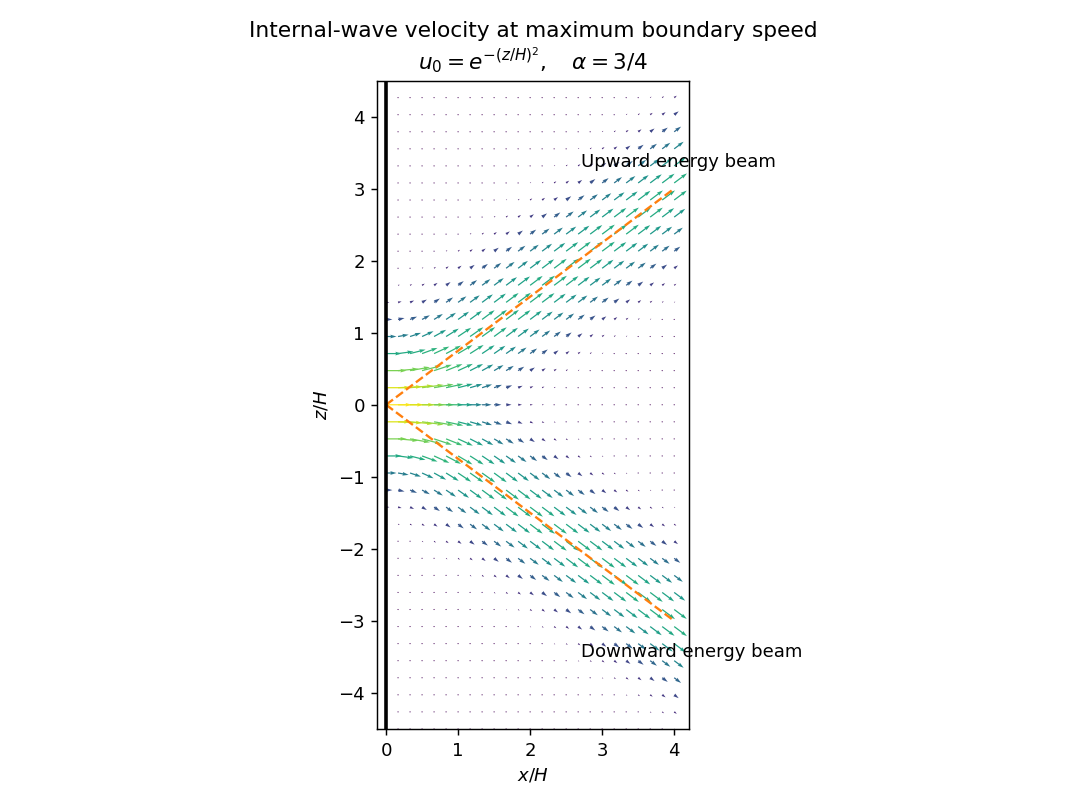
Velocity in two internal-wave beams when the oscillating boundary is flat and moving fastest
. Details. 
At other phases the terms contribute. For the positive-frequency convention above, is the Hilbert transform of ; it generally has longer tails than . Thus even when the boundary is nearly stationary, the interior need not be stationary or confined to the bright cores shown here. Half a period later all velocities reverse. The beam directions remain the same, but the instantaneous velocity profile and its quadrature component change.
A short pulse has a broad frequency spectrum. Frequencies below produce outgoing internal gravity wave packets with frequency-dependent ray slopes ; frequencies above contribute an evanescent near-boundary response. Moreover the group velocity depends on wavelength as well as direction. The radiated packet therefore spreads into a dispersive fan or wake, with different frequencies traveling at different angles and different scales separating along those directions. After the forcing ends the propagating packet travels away, rather than maintaining the two permanently driven monochromatic beams.
Articles by others on the same topic
There are currently no matching articles.