The bar's motion increases positive -directed magnetic flux at rate . By Lenz's law, induced current circulates clockwise as viewed from positive , producing a field into the page. Equivalently drives positive charge down the moving bar. The motional electromotive force has magnitude , soThe current flows downward in the bar, left along the lower rail, upward through the resistor, and right along the upper rail. The ideal circuit approximation neglects self-inductance and the bar's resistance.
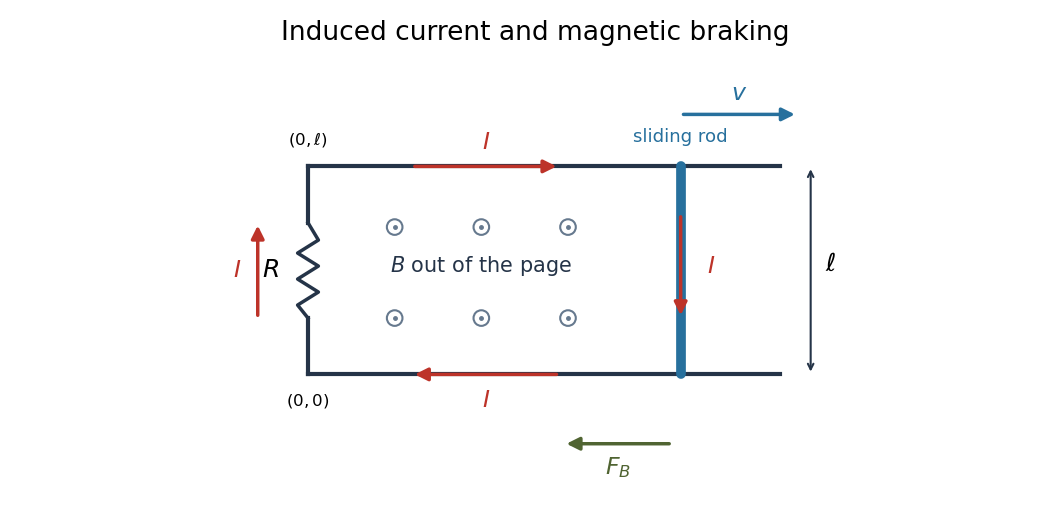
Clockwise induced current and magnetic braking for a rod moving right through an outward magnetic field
. Details. 
The current vector along the bar points downward. Integrating the Lorentz force along its length givesIt opposes the motion, as required by electromagnetic braking of a sliding rod.
Newton's second law with the computed Lorentz force gives . Separating variables and imposing yieldsThe velocity vector is this scalar times , and the characteristic decay time is positive for the stated parameters.
Articles by others on the same topic
There are currently no matching articles.