A linear map preserves linear combinations: for all vectors and real scalars. The rank-nullity theorem gives . For an endomorphism of the same finite-dimensional vector space, surjectivity means rank , equivalent to zero kernel and hence injectivity.
If , then every lies in the image, so is surjective and consequently injective. Now ; injectivity implies for every . Thus the right inverse is also a left inverse: . This is the one-sided inverses of finite-dimensional endomorphisms property.
Apply it to the linear maps on represented by and : implies . Equal finite dimensions are essential to the argument.
A complex number is an algebraic number over when it is a root of a nonzero rational polynomial. Its minimal polynomial of an algebraic element is the unique monic polynomial in of smallest degree annihilating it; polynomial division shows that it divides every rational polynomial annihilating the element, and it is irreducible.
Consider the surjective evaluation ring homomorphism . Certainly . Because the nonconstant is irreducible over , its content is a unit: otherwise its content and its nonconstant primitive part give a factorization into nonunits. By the Gauss lemma for polynomials, is irreducible in and is a scalar multiple of the minimal polynomial.
If vanishes at , then divides in . Primitive divisibility in Gauss lemma for polynomials implies division in as well. Explicitly, write the rational quotient as with primitive integral and ; the primitive product shows that integrality of forces . Thus the kernel is precisely , and the first isomorphism theorem for rings yieldsNo monicity of is needed; this is an isomorphism of rings, not an assertion that either ring is a field.
The sequence has uniform convergence to when, for every , there is an independent of such that for every and every . Fix and choose a single with . By continuity of , sufficiently small within the interval gives . The triangle inequality then givesThis proves continuity at every point, including endpoints with the relative topology.
For the moving points, use the just-proved continuity of :This is uniform convergence at moving evaluation points: uniform control is what allows the evaluation point to vary with .
Use three compactness facts: a closed subset of a compact space is compact; a continuous image of a compact space is compact; and a compact subset of a Hausdorff space is closed. For a closed , these facts show that is closed in . Therefore the bijection is a closed map, and proves continuity of its inverse. Thus is a homeomorphism. This proves the compact-to-Hausdorff continuous bijection theorem without requiring itself to be Hausdorff.
Let be the quotient map and . The map is continuous and identifies precisely the equal parameters and the endpoint pair. Hence it induces a bijection from the quotient space to the unit circle, with ; the definition of the quotient topology makes continuous. The quotient is compact as a continuous image of , while the circle is Hausdorff as a subspace of . Applying the preceding theorem gives
For a regular smooth constraint , meaning at the point, constrained stationarity requires . Solve these Lagrange multiplier equations together with the constraint, then compare candidate values and possible boundary or singular cases.
Let and be cylinder radius and height. Its volume is and the surface-area constraint is . The multiplier equations areThe second gives , and substituting into the first gives . Consequently . To check global maximality, eliminate and obtain on ; it tends to zero at both ends and has exactly this one stationary point. The largest volume is
Take the electric dipole moment along the polar axis, . The electric field is minus the gradient of the electric potential; in spherical polar coordinates,Since and , the radial and angular components combine asThe origin is excluded because the point-dipole potential is singular there.
Choose the incident photon along the direction. Conservation of four-momentum preserves the squared total energy invariant . Initially,In the centre-of-momentum frame let the outgoing photon energy be ; the larger particle has opposite momentum magnitude and energy . ThusConversely, whenever , the positive value constructs a final state with the required invariant, which can be boosted to the laboratory frame. The limiting photon excitation threshold with a soft final photon is thereforeStrictly, an outgoing physical photon requires ; the printed minimum is the threshold infimum approached as the final photon becomes soft.
For the stated incompressible planar flow, use the stream function convention , . It gives and the vorticity isThus , where the Laplacian is the two-dimensional one.
Because the velocity is independent of , the vortex-stretching term is . Substituting , and into the vorticity equation and cancelling a minus sign givesThe planar vorticity is transported by the flow without vortex stretching under these inviscid assumptions.
Let be shipped amounts, with column sums equal to shop demand and row sums at most 15. Total demand is 42, so three units of warehouse stock need not be shipped. A feasible transportation problem allocation isIts row sums are and its column sums meet every demand. The cost is .
For a transportation dual certificate with capacity inequalities, choose warehouse potentials and shop potentials . They have and for every cell. Any feasible allocation therefore hasThe second inequality has this direction because and warehouse use is at most 15. The exhibited allocation attains the lower bound, so the minimum cost is .
The determinant isEquivalently it is the alternating multilinear function of the columns with value one on the identity matrix. To prove multiplicativity, write column of as , where is column of . Multilinear expansion gives a sum over choices ; terms with repeated choices vanish by alternation. The remaining permutations contributeIf is invertible, , so multiplicativity makes and . For arbitrary , put . Its determinant is a nonzero polynomial in , so it is invertible except for finitely many values. Thus for all other ,For each fixed both sides are polynomials in , and equality at infinitely many makes them identical. Setting proves the Characteristic polynomials of AB and BA identity without an invertibility assumption on .
In the convention , the coefficient of is : in the determinant expansion such a term chooses one diagonal entry of and factors ; nonidentity permutations have at least two nonfixed positions and contribute lower degree. Therefore .
This assertion is false in general. In dimension two take , and . Then , whereas . Their characteristic polynomials are and , respectively, so .
This assertion is true. Apply the proved Characteristic polynomials of AB and BA identity to the two matrices and :It holds whether or not any of the three matrices is invertible.
We prove the needed Hilbert basis theorem step rather than assuming it. Suppose is a commutative Noetherian ring and is an ideal. The set of leading coefficients of elements of , together with zero, is an ideal of : align degrees with powers of before addition, and use scalar multiplication. Choose finitely many generators of , represented by polynomials , and let be the maximum of their degrees. If then and there is nothing to prove.
For each , let consist of the coefficients of of elements of of degree at most . This is also an ideal of ; choose finitely many generating coefficients and representing polynomials of degree at most . The finite collection of all and generates : for any of degree , express its leading coefficient using those of and subtract the matching combination of to lower degree. When the degree becomes , use the representatives of to lower it again. Induction on degree eventually leaves zero.
A field is Noetherian because its only ideals are zero and the whole field. Repeatedly applying the proved step gives every ideal of finitely generated.
The coefficient restriction in the second ring says preciselyIt contains one and is closed under addition, additive inverses and multiplication: . To show it is not Noetherian, consider the ideals in They form an ascending chain. In any with , the coefficient of is a polynomial in of degree at most , since the nonconstant part of introduces at least . It cannot equal ; hence . If the union ideal were finitely generated, all its generators would lie in one , forcing the chain to stabilize. This contradiction proves , the constant-plus-ideal non-Noetherian subring example.
Work on the unit sphere with geodesic edges. A spherical lune of angle has area . The three great circles through the sides of a spherical triangle partition the sphere into four antipodal pairs of triangles. If the original triangle has area and the other pair representatives have areas , then . The three lunes at its vertices have areas , soThis proves the spherical excess formula . Triangulate a convex spherical -gon from one vertex into triangles; summing areas and vertex angles givesFor a decomposition of the whole sphere, angles around every vertex sum to and each edge belongs to two faces. Summing the polygon area formula over all faces therefore givesNow , , and , since three edges meet at each vertex. Substituting into Euler's formula yields . Nonnegative integer solutions therefore give at most seven pairs:At least three distinct pairs are realized: a dodecahedron gives , a pentagonal prism gives , and a cube gives . Center each convex polyhedron around an interior origin and radially project its faces onto the sphere; edges become great-circle arcs and the resulting spherical faces are convex, preserving the incidence counts. This supplies the required actual decompositions.
Because and the numerical series converges, its tails can be made arbitrarily small independently of :Thus the partial sums satisfy the uniform Cauchy criterion; completeness of the real numbers supplies the pointwise limit, and the same tail bound proves uniform convergence. This is the Weierstrass M-test.
For with , choose an integer . If and , then , so . The tail is therefore uniformly convergent by the M-test; adding its finitely many earlier terms preserves uniform convergence, even though those earlier terms can be unbounded near excluded integers. For the set is empty and the claim is vacuous.
Each summand is continuous on . Around any , choose an interval containing , avoiding integers and lying in some . The uniform-limit continuity theorem then proves .
The series is not uniformly convergent on all of . Uniform convergence would require uniformly, but for every . These evaluation points belong to , contradicting that necessary condition.
Near zero, expand and invert the parenthesized series. The first three nonzero Laurent series terms areThe zero quadratic coefficient also follows from , which makes odd. The nearest other singularities are at .
All poles of occur at , , and have residue one, since the derivative of equals one at those zeros. AlsoThus subtracts the complete principal part at zero and at every pole with . These are all the poles in the stated open disk; each singularity of there is removable.
For , expanding each rational summand in inverse powers givesThis contributes no constant or positive-power term. To find the first Taylor coefficients of the analytic , expand near zero as and subtract it from the already calculated local series of . Combining its Taylor series with the exterior series above yields the three requested annular coefficients:Both series converge on , so this combination is a valid Laurent expansion there.
For the Basel sum from exponential poles, let . The Laurent coefficient formula givesThe function is bounded on these circles by one constant independent of . Indeed, if , use ; if , use . In the remaining strip , the imaginary part has magnitude , within of the odd multiple of . Its cosine is negative, so .
Substitute the power series into . The coefficient of is , soStarting from determines the even and odd coefficient sequences separately. Unless a sequence terminates, the ratio of successive same-parity coefficients has absolute value tending to one, so its series converges for and solves the Legendre differential equation there.
With , choose the parity matching and set the other starting coefficient to zero. All factors before index are nonzero, whereas the factor at vanishes. Thus the chosen series is a nonzero polynomial of exactly degree . Its value at one cannot vanish: a zero of multiplicity there would give a nonzero leading term , times its local leading coefficient, in the differential equation. We can therefore scale it to .
For , , , and all later coefficients vanish. Normalization gives , yieldingFor even degree this scale is fixed by as in the question; for odd degree by parity and the scale is fixed by .
The axis-regular separation of variables expansion for an axisymmetric harmonic potential isThe radial powers solve , while the regular angular solutions are Legendre polynomials. For an exterior solution tending to zero at infinity, retain only the negative radial powers. The boundary polynomial decomposes as . ThereforeIt has the required boundary value and decay. Uniqueness follows from the maximum principle for harmonic functions for a harmonic difference, using its zero boundary values and vanishing limit at infinity.
For a normalized wavefunction, is the statistical mean of measurements of the quantum observable over identically prepared systems, not necessarily the outcome of one measurement. Assume the state is in the required operator domains and the second moments are finite. Hermiticity givesThe commutator expectation is purely imaginary, so is real. A real quadratic nonnegative for every has nonpositive discriminant; if its quadratic coefficient vanishes, its linear coefficient must also vanish. ConsequentlyApply the same inequality to and . Their commutator is unchanged and their second moments are the variances, yielding the quantum uncertainty relationFor the harmonic oscillator, gives by the product rule. The uncentered inequality above therefore implies . The arithmetic-geometric mean inequality now givesNo assumption that the position or momentum means vanish is needed.
The bar's motion increases positive -directed magnetic flux at rate . By Lenz's law, induced current circulates clockwise as viewed from positive , producing a field into the page. Equivalently drives positive charge down the moving bar. The motional electromotive force has magnitude , soThe current flows downward in the bar, left along the lower rail, upward through the resistor, and right along the upper rail. The ideal circuit approximation neglects self-inductance and the bar's resistance.
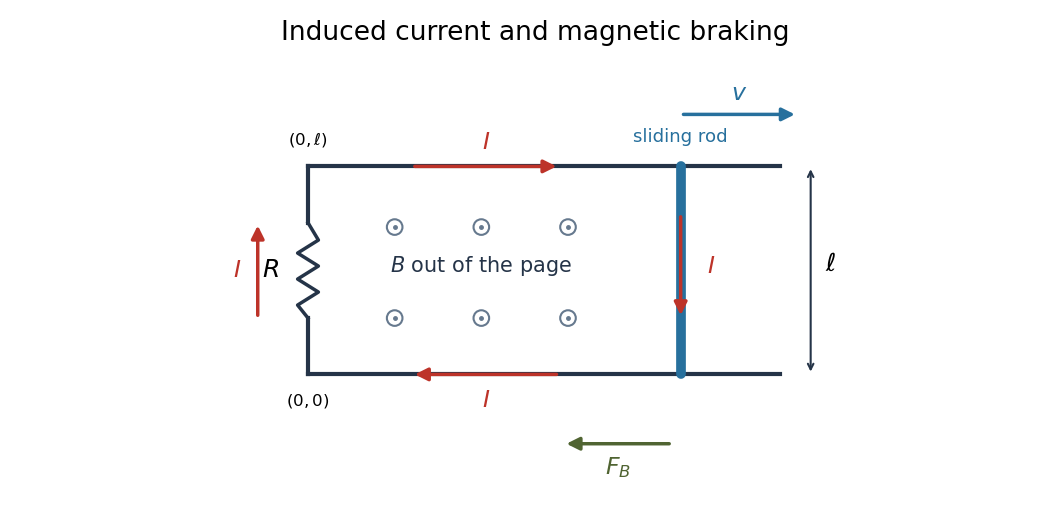
Clockwise induced current and magnetic braking for a rod moving right through an outward magnetic field
. Details. 
The current vector along the bar points downward. Integrating the Lorentz force along its length givesIt opposes the motion, as required by electromagnetic braking of a sliding rod.
Newton's second law with the computed Lorentz force gives . Separating variables and imposing yieldsThe velocity vector is this scalar times , and the characteristic decay time is positive for the stated parameters.
The resistor's Joule heating power is . Integrating up to time givesThe remaining kinetic energy is , so at every time. In particular : all initial kinetic energy becomes heat. The magnetic force's mechanical power is , consistent with this energy balance.
Let , well defined because . It is symmetric and satisfies , so for the Householder reflection ,Thus is orthogonal; it reverses the component parallel to and fixes the perpendicular hyperplane.
An orthogonal matrix preserves the Euclidean norm: . For every candidate ,The two objective functions agree pointwise, so their minimizers coincide, whether or not the minimizer is unique.
The first column already has zeros below the top entry. In the last three rows of the second column, reflect to using . Since , the Householder reflection isWith , direct multiplication givesThe transformed least-squares objective is . Its first two squares can both vanish, so the unique answer isUniqueness follows because the triangular leading block is invertible; this calculation implements Householder QR decomposition without squaring the condition number through normal equations.
Write . Differentiating the probability generating function at givesExpanding its denominator as a geometric series and then applying the binomial theorem givesCoefficient identification proves , a one-stop negative multinomial distribution.
For an independent identically distributed sample let and . Ignoring parameter-independent factors, the log-likelihood is . When both sums are positive, its stationary equations are and . Together with , these giveThe Hessian is , negative definite in this case, so the stationary point is the unique global maximum.
There is an important boundary qualification: if , the derivative with respect to is , so the likelihood increases as decreases to zero. The displayed formula then gives a boundary estimator, not an attained MLE in the stated open parameter space . The analogous issue holds for . The formulas are MLEs on the extension allowing zero category probabilities, and interior MLEs when both counts are positive.
For bias, put and . Then and with . Its second derivative is , and is nondegenerate. Strict Jensen's inequality givesIn fact both estimates are downward biased. Conditional on , the first count is binomial with success probability ; hence conditional on , is also binomial with that probability. ThereforeThis proves the finite-sample bias in a negative multinomial probability estimator, using the boundary-extended formulas whenever necessary.
Finally, the strong law of large numbers applies because the nonnegative variables have finite means: almost surely and . Continuity of the estimator function then givesand similarly for . Thus the estimates are strongly consistent despite finite-sample bias. Almost surely both sample sums eventually become positive, so the open-parameter MLE issue affects finite samples rather than this asymptotic conclusion.
All specified nearest-neighbour probabilities are positive, making the birth-death chain irreducible. The row sums give and for . Write for the hitting time of , and on let . The first-step equations giveDefine and . The successive increments are proportional to , and normalization at yieldsThe chain cannot remain forever in a fixed finite set avoiding zero: from every state in that set there is a uniformly positive chance to leave or hit zero within finitely many steps, so iterating the Markov property makes indefinite confinement have probability zero. Thus avoiding zero is the limit event of hitting every upper boundary before zero. Sending shows that the probability of never hitting zero from one vanishes exactly when . At zero, return is immediate with probability and otherwise begins an excursion from one; irreducibility then givesFor positive recurrence define and . First assume recurrence and let be the first return from zero. For each fixed , the expected number of visits to before is finite: each visit to has a positive chance of following the successive downward steps to zero before another visit, so its visit count has a geometric tail. Also .
Each finite excursion starts and ends below every edge , so its upward and downward crossing counts of that edge are equal. Their expectations, by the Markov property, are and . Hence and . Tonelli's theorem applied to the nonnegative occupation counts gives the excursion weights of a reflected birth-death chain formulaConsequently positive recurrence implies the requested finite sum. Conversely, if , then . But , so and the already proved recurrence criterion holds. The occupation calculation is therefore valid and gives a finite mean return time. ThusAdding the finite term does not change convergence.
Articles by others on the same topic
There are currently no matching articles.