If the primed frame moves at speed in the positive direction relative to the unprimed frame, the one-dimensional Lorentz transformation isFor a trajectory with velocity , differentiating these expressions gives . Solving for , when the particle has primed-frame speed , proves the relativistic velocity-addition formulaFor the train problem the sign of the frame velocity reverses: the train frame moves at relative to the station frame . Put . The transformation appropriate to the subsequent parts is therefore
The world lines in the train frame are , and . In the station frame, length contraction givesThe emission event is in both frames. The signal world lines in are and ; their intersections with the train endpoints define the reception events . Their velocities in , from the relativistic velocity-addition formula, are and .
The two platform-alignment events occur at in . The Lorentz transformation puts them at in , on the tilted simultaneity line . The spacetime diagrams show all three observers, both signals, their receptions, and these distinct endpoint-alignment events:
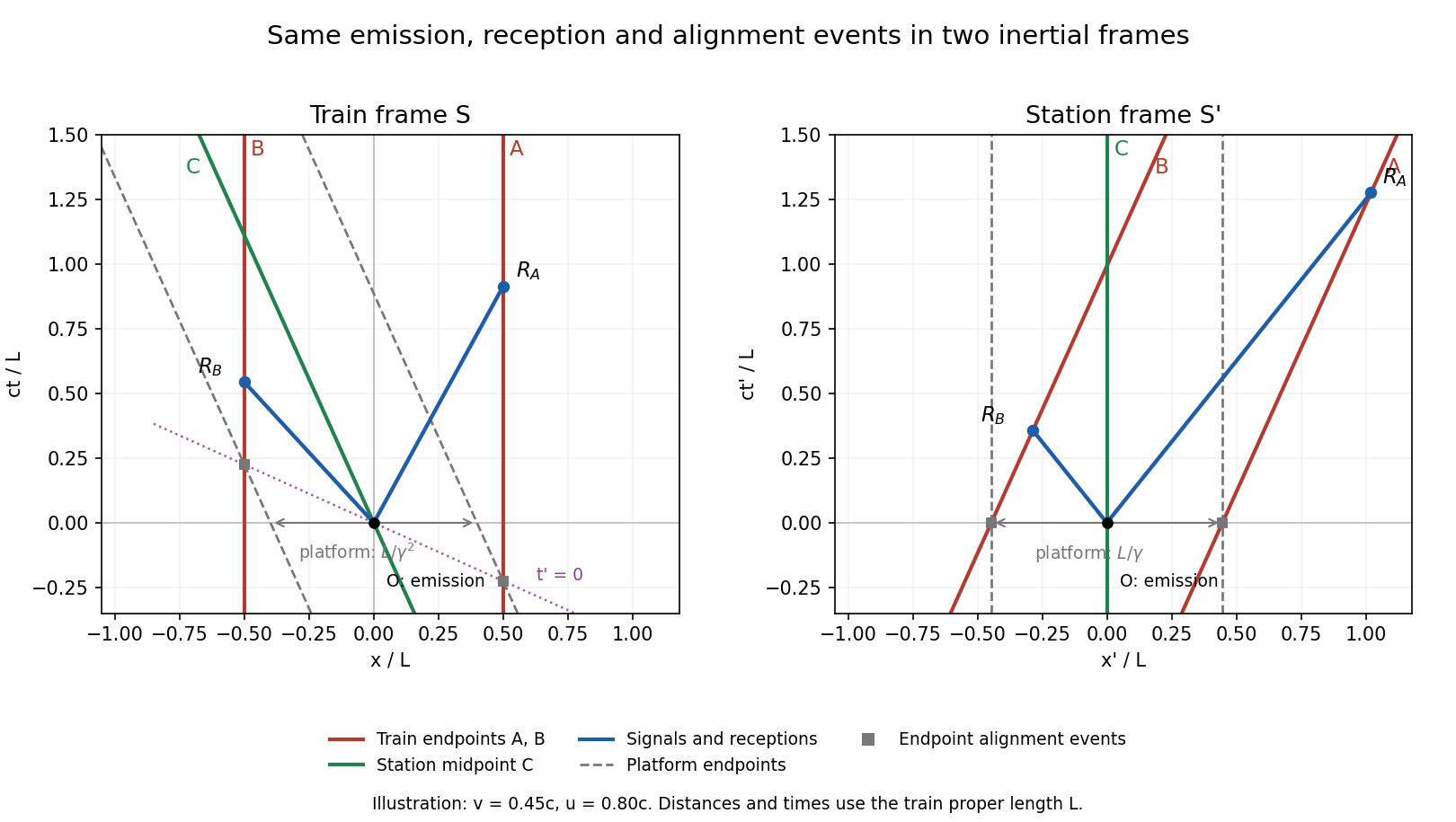

Let be the platform's proper length, measured in its rest frame . At the single station-frame time , its ends coincide with train endpoints whose simultaneous station-frame separation is . ThusThe platform endpoint world lines are vertical at in the station spacetime diagram. In the train frame they are , so their separation at a common train-frame time is . The two alignment events lie on the tilted line in the train diagram and are not simultaneous there; their separation cannot be used as the platform length measured at one train-frame time. This is the distinction enforced by length contraction.
In the station frame, intersecting the signal trajectories with the endpoint world lines givesSince , both receptions occur at positive times,The inverse Lorentz transformation then givesSubtracting and simplifying yieldsFor , both differences are negative: the rear receives first in both frames, but by different time intervals.
With light signals, , the train-frame relativistic velocity-addition formula gives signal velocities . The endpoints are equally distant from the source in that frame, andThe two reception events are simultaneous in but not in : in the station frame the rear moves toward its light signal while the front moves away. Directly, and , so the Lorentz transformation gives . This is relativity of simultaneity, concerning spatially separated events; it does not contradict the invariant light speed or the causal ordering of events on a single observer's world line.
Articles by others on the same topic
There are currently no matching articles.