A phase diagram locates stable pure thermodynamic phases and their phase coexistence boundaries in a space of control parameters. For a concrete three-dimensional example, take the temperature, crystal-field parameter, and magnetic field of the Blume–Capel model. Its spins take values ; changing the cost of the zero-spin state can turn a continuous ordering transition into a discontinuous one. A local scalar description near the resulting tricritical point is the Landau-Ginzburg theoryThe three local control coordinates are , with varying linearly with the thermal scaling field. For , , the transition at is continuous. For , zero-field coexistence is at , and the magnetization jumps between zero and . The two loci meet at , the tricritical point.
The full three-dimensional phase diagram has an ordered coexistence sheet at , where the two opposite magnetizations exchange stability when changes sign. On its three-phase line it meets two nonzero-field tricritical wings. These wings are first-order phase transition surfaces between minima of the same sign but different magnitude, terminating at ordinary thermodynamic critical points. Their tricritical wing critical edges are found by :Indeed fixes , and substituting into and gives ; ensures a stable critical quartic minimum. The two signs give the two wings. All transition surfaces and critical edges end together at the tricritical point. The following plot uses ; its wing surfaces come from the exact tricritical wing coexistence factorization, rather than schematic unconstrained surfaces.
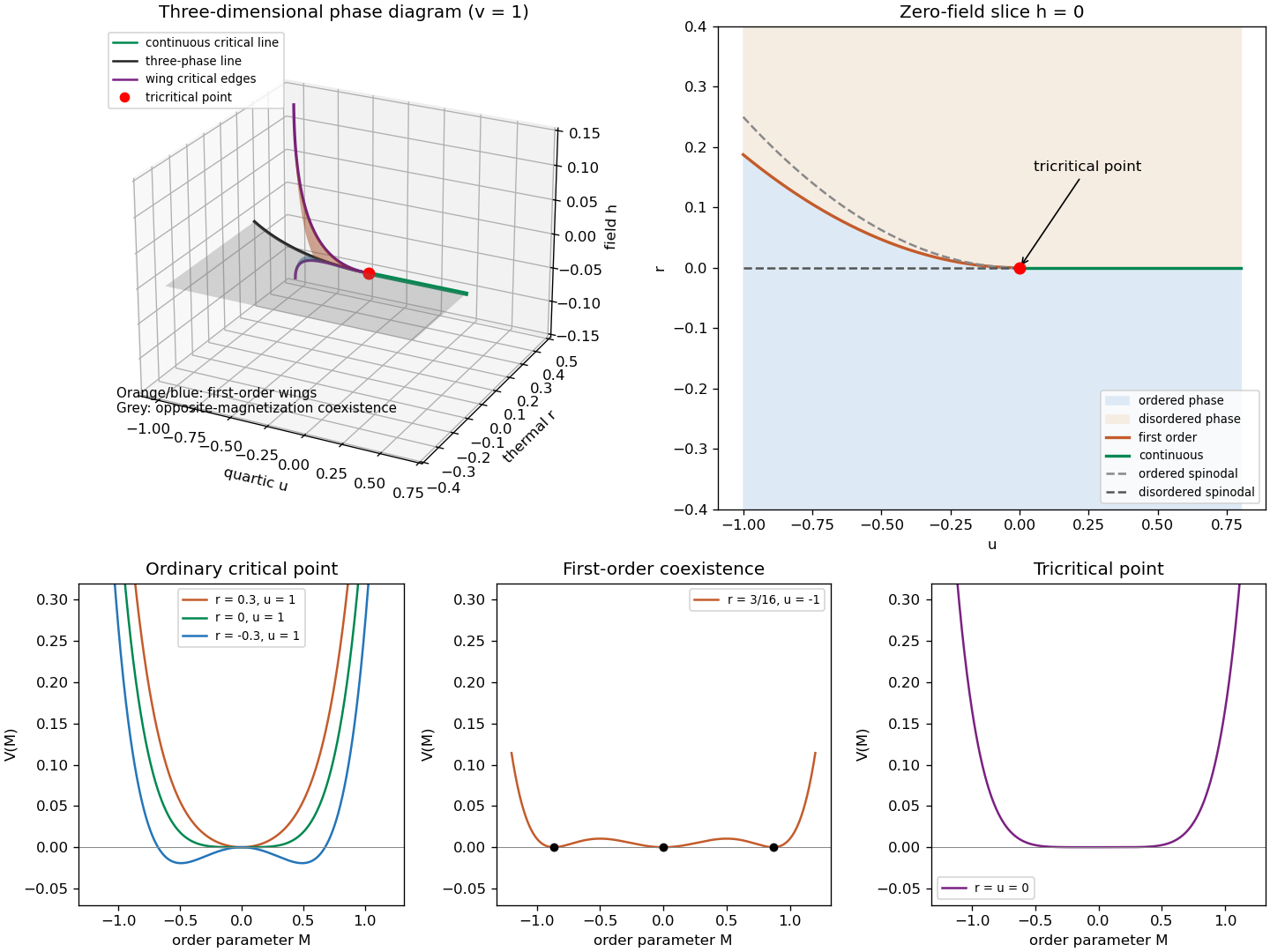
Tricritical coexistence surfaces, the zero-field phase diagram, and ordinary, first-order and tricritical Landau potentials
. Details. 
The unheaded requests for critical exponents follow from the uniform equation of stateFor an ordinary thermodynamic critical point, is fixed and , . At , , the small ordered minimum obeys , so the order-parameter critical exponent is . Above the transition , giving the magnetic-susceptibility critical exponent . At , , so the critical-isotherm exponent is . At the tuned tricritical point, , instead below the transition and on its critical isotherm, while the disordered susceptibility remains . ThereforeBelow the transition the inverse susceptibility is , giving in the ordinary limit and in the tricritical limit. Thus both sides give the same susceptibility power, with different amplitudes.
To derive the general Ginzburg criterion, tune away all lower even nonlinearities and let the leading stabilizer be , . The equation of state gives , and its curvature at the ordered saddle is , so . The fluctuations of the order parameter averaged over a correlation volume are estimated by its long-wavelength quadratic covariance:The integral has a fixed dimensionless upper limit after ; this is a coarse-volume fluctuation estimate, not the ultraviolet-dominated point variance. Consequently the multicritical Ginzburg ratio isThe Landau approximation is asymptotically controlled by this test only when the ratio tends to zero. This gives the upper critical dimensionThe same threshold follows by giving its Gaussian engineering dimension : the coupling to has scaling exponent , which becomes relevant below .
For , the fluctuation ratio diverges and the saddle calculation cannot predict the generic interacting critical exponents. At the test is marginal, not a proof of changed power exponents: the ratio has zero thermal power and marginal interactions can produce logarithmic corrections. Thus the PDF's inclusion of equality in a blanket claim about wrong power exponents needs this qualification. The Landau-Ginzburg theory as a fluctuating field theory remains useful; what loses validity is its fluctuation-free Landau approximation.
Articles by others on the same topic
There are currently no matching articles.