The filament bending modulus has units force times length squared. The perpendicular drag coefficient in this equation is drag per unit length divided by velocity, so its units are force times time per length squared. Hence has units length to the fourth power. Balancing oscillatory viscous drag against elastic force density gives the elastohydrodynamic penetration lengthIncreasing frequency confines the response nearer the actuator. The chosen coefficient one in this characteristic length is a convention; the exact decay lengths acquire the root-dependent factors found below.
The overdamped filament bending equation is linear, so sinusoidal forcing has a sinusoidal steady response at the same frequency. Write with . Substitution givesUsing the elastohydrodynamic penetration length from the previous part reduces this ordinary differential equation toThe boundary conditions become , , and decay of and its derivatives at infinity. The derivative condition expresses zero bending moment at the driven end, rather than a clamped slope. This separation of variables constructs the periodic response; an unspecified initial shape can add a transient solution of the homogeneous evolution problem.
Set . The characteristic polynomial is , whose roots have arguments , , , and . Only the last two have negative real part and decay at infinity. Write and ; the admissible roots areThus . Since , the boundary equations are and . ThereforeTaking real parts gives the oscillatory bending of a moment-free semi-infinite filamentThe first phase is constant along paths with , so that contribution travels left. The second has and travels right. Both are forced, attenuating patterns in an overdamped medium; they are not undamped inertial waves. Their amplitudes are equal at the driven end, but gives decay lengths and . Hence the right-travelling contribution dominates away from the end, because it decays more slowly; its amplitude relative to the left-travelling one grows as .
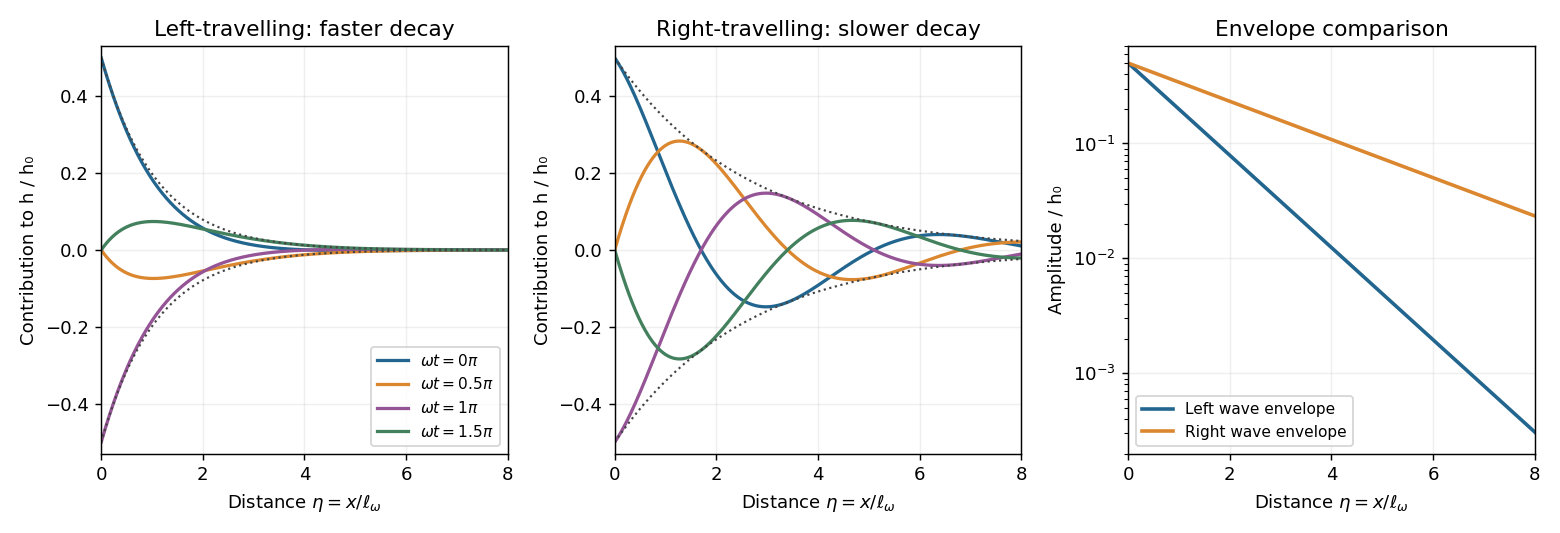
Counter-propagating contributions to a driven filament, with faster attenuation of the left-travelling wave
. Details. 
Articles by others on the same topic
There are currently no matching articles.