Use Minkowski metric signature and natural units. With no lepton mixing, choose the weak charged current conventionIts conjugate convention exchanges and without changing the interaction. The relevant four-fermion interaction gives the muon decay amplitude, up to an overall phase,Here is the Fermi constant; the factors are twice the left chiral projector, so there is no additional factor of two to insert.
For the final-spin sum let , where . It already describes the specified initial polarization; there is no further initial-spin average. The two gamma matrix traces areThe electron-mass term vanishes in its chiral trace. In the muon trace, anticommutation with givesFor the chiral fermion trace contraction, defineThe supplied trace conventions imply and , where . The factor four in the second trace follows from the polarization projector. The symmetric parts contract to . The Levi-Civita symbol contraction, including , contributes . Mixed symmetric-antisymmetric contractions vanish. Thus , and
Now neglect as well. Put and . The given moment integral over two-neutrino relativistic two-body phase space yieldsIn the muon rest frame, , , and . Substitution givesCombining this with the Lorentz-invariant phase-space measure, whose one-particle denominator is , and , gives the polarized muon decay distributionConsequently , , . Integration over the electron direction removes the polarization term, and , recovering .
The spin vector is axial and the momentum direction is polar: under parity, stays unchanged while reverses. Their scalar product therefore changes sign. Its nonzero coefficient demonstrates parity violation in polarized muon decay, arising from the left-chiral weak charged current. At the upper endpoint the negative muon's electron is preferentially emitted opposite the spin, providing a sign check on the result.
Set . The angular integral of the electron-positron annihilation into a muon pair differential cross-section isThereforeThe printed comparison of with a quantity in has inconsistent units: the high-energy condition means an energy large compared with particle masses, or equivalently an energy-squared large compared with their squared masses.
At leading order, inclusive electron-positron annihilation into hadrons proceeds through , as in the first panel below. The photon couples to each quark with strength ; the corresponding contribution is times the muon-pair rate per colour. Summing over the three orthogonal final colours and active flavours gives the hadronic R ratioFor massless flavours this gives , with charm included , and with bottom as well .
The approximation assumes unpolarized beams and negligible electron mass; active quark masses are small relative to , and heavy flavours below threshold are excluded. Photon exchange dominates, so exchange and photon- interference are neglected; this is appropriate sufficiently below the Z boson scale, not at arbitrary high energy. The coupling must be evaluated consistently in numerator and reference rate. We also neglect higher-order QED radiation. Relating the inclusive partonic calculation to hadrons invokes quark-hadron duality: the energy should be in a perturbative continuum region, away from thresholds and narrow resonances, with power-suppressed nonperturbative effects neglected. An exclusive hadron channel cannot be obtained merely by multiplying the parton rate by the colour count.
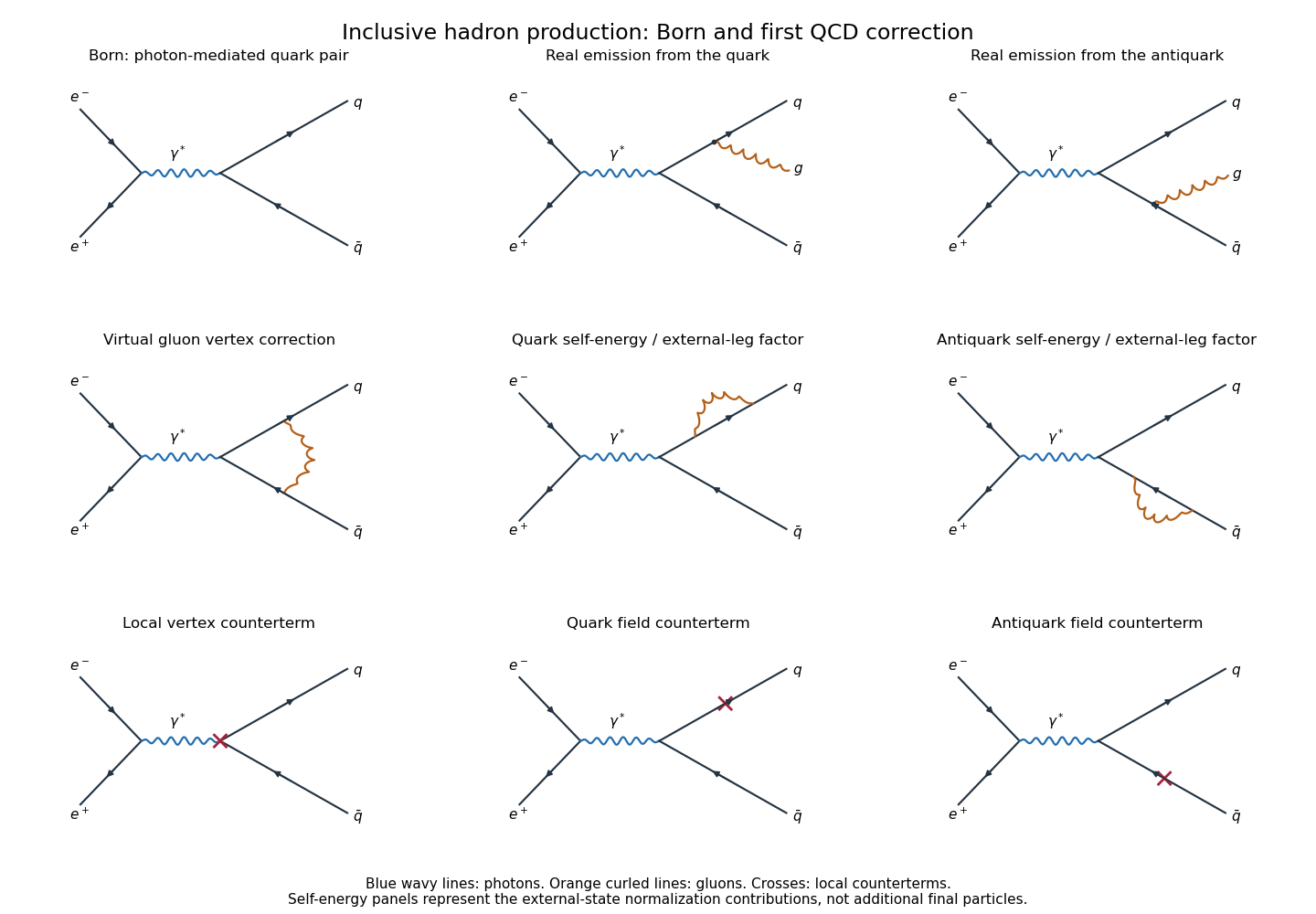
Born hadronic production, real and virtual first-order QCD corrections, and their local counterterms
. Details. 
At next order in QCD, the real-emission amplitudes are the two distinct diagrams for , with the gluon emitted from the quark or antiquark. They must be added before squaring, including their interference. Each amplitude is order at the hadronic current vertex and gives a relative order- contribution to the rate.
The virtual order- amplitudes consist of the gluon correction to the photon-quark vertex and the quark and antiquark self-energy/external-state normalization contributions. The figure also shows the corresponding local vertex and field counterterms. In an amputated on-shell calculation the external-leg terms are represented by wave-function factors, rather than counted as extra final states. There is no gluon attachment to an electron, since it carries no colour. Gluon self-energy insertions and additional non-Abelian vertices enter at higher orders here. The rate correction is the Born-virtual interference plus the integrated squared real-emission amplitude, not the square of the one-loop amplitude.
Use dimensional regularization, , to keep ultraviolet and infrared singularities in a common scheme. Ultraviolet divergences in the virtual quark and vertex contributions are removed by consistent wave-function renormalization and local counterterms; the conserved electromagnetic-current identity relates the vertex and field renormalizations. One uses a renormalized QCD coupling ; its running changes this first correction only at the next perturbative order. In the massless on-shell scheme some external self-energy integrals are scaleless and vanish, but that statement combines ultraviolet and infrared poles and must not be used to discard the associated normalization terms inconsistently.
The remaining infrared divergences occur when a gluon is soft, and collinear divergences occur when it is parallel to a massless quark. They appear in both virtual diagrams and the real-emission phase-space integral. For the fully inclusive total rate, unresolved final states are summed and real-virtual infrared cancellation in inclusive QCD removes their poles. A resolved jet rate instead needs an infrared-safe observable and a resolution prescription. An isolated real or virtual correction is not a finite physical inclusive cross-section.
Define the dimensionless constant with the conventional loop factor extracted. Then the requested form isFixed numerical and colour factors are contained in ; choosing another extracted prefactor simply redefines that constant. No explicit loop coefficient is required to establish the form.
The Born and virtual processes give two energetic particle jets. Hard, well-separated real radiation gives a three-jet event; unresolved radiation changes jet widths and event-shape distributions, while the combined terms correct the inclusive rate. Resolved three-jet events in electron-positron annihilation provided the direct gluon signature, observed at PETRA in 1979. Their interpretation is energetic quark, antiquark and gluon fragmentation, with approximately planar three-body momentum balance. The primary institutional account is www.desy.de/news/news_search/index_eng.html?openDirectAnchor=1643&printversion=1 .
Write and use . The renormalization-group beta function impliesIntegrating the one-loop running coupling equation givesHere the sign of is the sign convention in the question: a negative coefficient makes the inverse coupling increase towards high energy.
For gauge coupling unification, let and let be the common inverse coupling at the unification scale. The normalized hypercharge coupling is , soSubtract the second relation from the first to determine , then subtract it from the third. Provided , this provesThe factors belong to the inverse normalized coupling; dropping them changes the prediction.
Use the Standard Model gauge group and convention . One fermion family and one complex Higgs doublet have the following Standard Model representations. The left-handed quark and lepton doublets contain two Weyl spinors each; the right-handed fields are single Weyl species.The row denotes the right-handed up quark. Equivalently an all-left-handed table replaces the three right-handed fields by , , and ; these are alternative descriptions, not extra fermions. The minimal model has no right-handed neutrino. For completeness, the family-independent gauge fields are the spin-one gluons , weak gauge bosons , and hypercharge gauge boson ; they are not counted once per family.
For the Standard Model one-loop gauge coefficients, include three fermion families and one Higgs doublet. With , the colour Dynkin index sum in one family isThe first factor two counts the two members of ; the colour trace is already included in the Dynkin index. There is no coloured scalar. HenceFor , the three colours of and the lepton doublet give per family. The Higgs contributes . ThusFor , sum squared hypercharges over every colour and doublet component. One family contributesThe two complex Higgs components contribute . There is no Abelian gauge self-interaction term, soThis is for the unnormalized coupling used in the question. For , the corresponding coefficient is . This distinction is required for a consistent unification calculation.
Define and . In a conventional intrinsic-phase choice, the charged W boson transforms under CP symmetry asThus its time component maps to minus the conjugate time component, and its spatial components map to plus the conjugate spatial components. Charge is exchanged, the Lorentz index undergoes parity, and the overall minus sign is a consistent phase convention shared with the charged-current transformation. The analogous formula exchanges with .
Here is the Dirac field's adjoint, not a second independently defined charge-conjugate field. Charge conjugation of a Dirac field gives and ; parity gives and . With the product convention , therefore,Reversing the convention for the operator product changes an overall intrinsic phase, which does not change the bilinear transformations when used consistently. The transpose also exchanges the fundamental colour index with its conjugate.
In the usual real-vacuum phase convention the complex scalar Higgs doublet obeysCharge conjugation complex-conjugates the doublet, while parity changes its argument without a Lorentz-index factor because it has spin zero. A fixed gauge rotation or intrinsic scalar phase may be included in an equivalent convention; the displayed choice leaves the standard real neutral Higgs expectation value invariant.
An experimentally observed example of CP violation is the long-lived neutral kaon decay . The two-pion spin-zero final state is CP even, whereas would be the CP-odd neutral-kaon state in the CP-conserving limit. Its two-pion decay reveals CP violation. The historical experimental account is cern-courier.web.cern.ch/a/cp-violations-early-days/ .
For the CKM matrix, diagonalize the up- and down-quark mass matrices independently by biunitary transformations. Writewith and positive diagonal matrices. Only the left transformations enter the weak charged current, because its chiral projector removes the right-handed fields. Substitution givesThe matrix is unitary but need not be diagonal: the two left mass diagonalizations generally differ.
Using the field transformations in the subparts and reordering the anticommuting Dirac fields, the charged bilinear transforms aswhere the fields on the right are both evaluated at . The W boson contributes its second minus sign and Lorentz parity factor, so the product maps into its Hermitian-conjugate product. Crucially CP symmetry acts unitarily: it does not separately complex-conjugate the numerical coefficient . Thus the transformed interaction isComparing with the original interaction requires in this canonical CP convention. The physical condition is quark rephasing and CP conservation:A merely complex-looking matrix in an arbitrary mass-eigenstate phase convention is not itself proof of CP violation.
For CKM parameter counting, a unitary matrix has real parameters: mixing angles and phases. Rephasing the up and down mass eigenfields removes phases, since their common phase cancels out of . For generic nondegenerate masses this leavesThere is one physical phase for three families and none for one or two. Degenerate masses would permit additional transformations, so the generic count need not apply unchanged.
For the QCD part of the gauge covariant derivative, define the Hermitian colour matrix and chooseThis sign convention agrees with the field-strength definition in the source. The kinetic term contains . A vector bilinear under CP changes sign, gains the Lorentz parity matrix, and transposes its colour matrix upon exchanging quark and antiquark. Invariance of this interaction therefore requires the CP transformation of a non-Abelian gauge connection:Both the time/spatial distinction and the colour transpose are essential; individual colour components need not all share one charge-conjugation sign.
The same gauge covariant derivative givesApply the transformation above and the chain rule . The transpose reverses commutator order, , so the nonlinear term transforms with the same overall minus sign as the derivatives. This proves the CP transformation of non-Abelian field strength:Finally rewrites the theta density as . The two minus signs cancel, and transposition followed by cyclicity leaves the colour trace unchanged. But the four parity matrices acting on the Levi-Civita symbol contribute . HenceThe density is C even and P odd, therefore CP odd. A generic fixed nonzero theta coefficient violates CP symmetry. This is the source of the Strong CP problem, separate from the charged-current phase in the CKM matrix.
Articles by others on the same topic
There are currently no matching articles.