Use hypercharge normalized by , and express all matter fermions as left-handed Weyl spinors. Thus denote the charge conjugates of the right-handed Standard Model fermions; the superscript is unrelated to the antiparticle marker . Each chiral superfield contains a complex scalar field and a Weyl spinor, while each vector superfield contains a gauge boson and a gaugino. The complete propagating content of the Minimal supersymmetric Standard Model before electroweak symmetry breaking is:
Table 1.
Propagating MSSM fields before electroweak symmetry breaking
. | Sector | Component field | representation | Spin | Families or copies |
|---|---|---|---|---|
| , quark Weyl spinors | ||||
| , squarks | ||||
| , quark Weyl spinor | ||||
| , squark | ||||
| , quark Weyl spinor | ||||
| , squark | ||||
| , lepton Weyl spinors | ||||
| , sleptons | ||||
| , lepton Weyl spinor | ||||
| , slepton | ||||
| , Higgs complex scalar fields | ||||
| , higgsinos | ||||
| , Higgs complex scalar fields | ||||
| , higgsinos | ||||
| Color vector multiplet | , gluons | adjoint, | ||
| Color vector multiplet | , gluinos | adjoint, | ||
| Weak vector multiplet | , weak gauge bosons | adjoint, | ||
| Weak vector multiplet | , winos | adjoint, | ||
| Hypercharge vector multiplet | , hypercharge gauge boson | |||
| Hypercharge vector multiplet | , bino |
The marker means that conjugate antiparticle states must also be counted: a charged Weyl spinor has a particle helicity and a distinct antiparticle helicity, and a complex scalar field has particle and antiparticle excitations. The real adjoint gauge bosons and adjoint Majorana fermions already contain their conjugate states, so no extra marker is attached to them. For example, the charged combinations are both contained in the one real weak triplet. There are no right-handed-neutrino chiral superfields, no gravitino, and no propagating auxiliary fields in this field table. The matter sector has gauge components; the two Higgs chiral doublets add four. Thus the count is , before mass effects are considered.
R-parity is the multiplicative discrete quantum number , with baryon number , lepton number and spin . Ordinary quarks, leptons, Higgs scalars and gauge bosons have ; their sparticles have . For superfields the equivalent rule is matter parity : are odd, and and the gauge superfields are even. With contracting weak indices and implicit color contractions, the renormalizable R-parity-conserving MSSM superpotential isSigns of the three Yukawa couplings can be absorbed into their matrices. Every term has even matter parity and zero hypercharge; holomorphy requires the two independent Higgs chiral doublets, rather than using in a superpotential.
Conserved R-parity forces an even number of odd particles in a process whose incoming particles are all ordinary particles, so colliders produce sparticles in pairs or another even multiplicity. Their decay chains end in the stable lightest supersymmetric particle. A neutral, weakly interacting lightest supersymmetric particle, commonly a neutralino after electroweak symmetry breaking, escapes the detector and gives missing transverse momentum; it is also a possible dark matter constituent. Stability alone does not establish its relic abundance, and a charged or colored stable lightest supersymmetric particle is not the usual viable dark matter candidate. Conserved R-parity forbids the renormalizable interactions responsible for the decay below. It does not by itself forbid higher-dimensional proton-decay operators: the superpotential operators and have even matter parity. Thus the renormalizable R-parity-conserving MSSM protects the proton, while ultraviolet physics can still induce its decay.
The gauge-invariant renormalizable R-parity-violating superpotential isHere and because of the weak and color antisymmetric contractions. The first two trilinear terms and the bilinear term violate lepton number, whereas the term violates baryon number. The are dimensionless and has mass dimension one.
For a concrete squark-mediated proton decay channel, take and nonzero. Antisymmetry allows these indices: the exchanged scalar is a strange squark, not a repeated down flavor in . Two quarks in the proton undergo ; the spectator combines with into the component of . The baryon-violating Feynman vertex and lepton-violating Feynman vertex give .
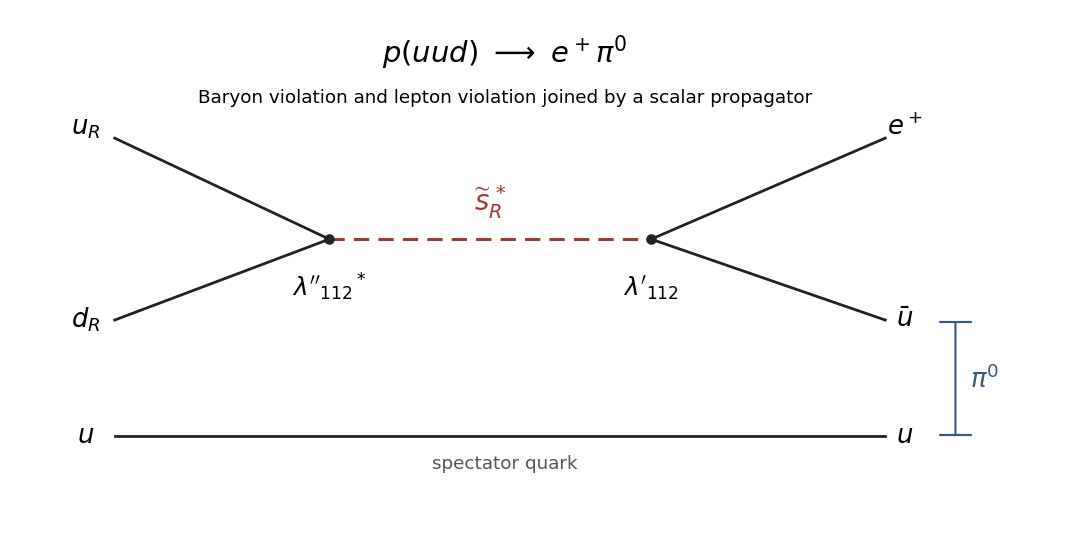
At momenta small compared with the squark mass , its scalar propagator is of order . Eliminating it generates a dimension-six four-fermion proton-decay operator, schematically , with coefficient . Consequently the dimensionless decay amplitude is of order , and phase space supplies one more power of to the width:This is a dimensional estimate; phase-space constants and hadronic matrix elements change its coefficient, not its fourth-power dependence on . For order-one couplings and , the stated lifetime limit is . Therefore , giving .
Such a mass is incompatible with the intended weak-scale MSSM explanation of the hierarchy problem: squarks that cancel the Higgs-sector sensitivity to high scales must not introduce a new enormous splitting from their light quark partners. For example, with order-one couplings would give only . The field content alone does not mathematically prohibit extremely heavy superpartners, but that choice sacrifices the weak-scale naturalness motivation. The usual resolution is conserved R-parity, or sufficiently suppressed simultaneous baryon number and lepton number violation, rather than making the exchanged squark this heavy.
A BPS state is a state whose mass saturates a lower bound set by conserved charges in the Super-Poincaré algebra. Saturation leaves some linear combinations of supercharges unbroken and produces a shortened massive supermultiplet. Both statements follow from the positivity of the physical Hilbert-space norm, rather than from an assumed classical field configuration.
For four-dimensional extended supersymmetry, choose the normalizationThe conjugate algebra is obtained by Hermitian conjugation. The antisymmetry of the central charge in supersymmetry matrix follows because the anticommutator is symmetric in the combined labels while is antisymmetric. These central charges commute with momentum and supercharges, so their eigenvalues are fixed in an irreducible massive representation. In the rest frame, and .
For any operator and physical state ,Apply this to , where is unitary. This is the rest-frame version of the positive operator constructed from . Summing over spinor and internal labels givesThe two diagonal terms each contribute , because ; each mixed term contains . For , write and choose . Then , so . The factor of one-half reflects the stated convention with , rather than , in the equal-chirality anticommutator.
To obtain the sharp general bound and exhibit the shortening, use unitary skew-diagonalization of an antisymmetric matrix to put into two-by-two blocks , with a possible zero row and column for odd . In one block, relabel its two internal indices and write . DefineDirect substitution, using , givesand all annihilator-annihilator anticommutators vanish. The minus operators must have nonnegative norm in every block, hence the BPS bound in supersymmetry isEquivalently, defining gives . Applying the positive construction to each block gives the same bound; applying only its full trace need not isolate the largest block. For and no central charge saturation, each operator can be normalized by to an ordinary fermionic annihilation operator. The unmatched internal index, if any, contributes two more such operators.
There are consequently complex creation operators in a generic massive supermultiplet. Starting with a spin- Clifford vacuum, each creation operator can be occupied zero or one times, so the long representation contains states. If precisely central-charge blocks saturate , then the two and their adjoints have zero anticommutator. The norm identity forces each of them to annihilate every physical state in that representation. Removing these complex oscillators givesThus a massive BPS supermultiplet is half-BPS. For , its four states consist of two spin-zero states and a spin-one-half doublet, instead of the sixteen states of a long representation. A charged representation generally needs its conjugate for CPT completion of a supermultiplet, doubling this four-state count; this yields the eight states of a full charged hypermultiplet. For , one saturated block gives a quarter-BPS representation and two give a half-BPS representation. This rest-frame argument assumes ; massless multiplets follow instead from the null-momentum algebra.
The same bound has a geometric realization for solitons. Consider a static magnetic monopole in an gauge theory with an adjoint Higgs field , asymptotic magnitude , vanishing scalar potential and magnetic field . For magnetic charge , the energy can be writtenThe second equality uses the covariant magnetic Bianchi identity to turn the cross term into the surface integral . Choosing its sign proves the Bogomolny bound . Equality gives the first-order Bogomolny equations . In a suitable supersymmetric embedding, the surface charge is the appropriate central charge and the soliton obeys precisely the algebraic BPS bound in supersymmetry. Its fermionic variation vanishes for the preserved supersymmetry parameters, while the broken supercharges supply its fermionic zero modes.
Shortening is useful because an isolated short multiplet cannot continuously acquire the additional states of a long representation. While the state exists and stays short, its exact mass is determined by the exact central charge, so masses of strongly interacting solitons can be found without computing a generic interacting-particle self-energy. This does not mean that its numerical mass is independent of coupling or vacuum expectation values: those can enter the central charge itself. Supersymmetric indices and the reduced fermionic state content provide ways to count protected states, subject to possible recombination or continuum effects.
For example, in rank-one Seiberg–Witten theory the electric and magnetic charges enter through periods . In the normalization above, , so a BPS state has . A magnetic monopole can become massless where , even though the original electric description is strongly coupled. Including this light magnetic hypermultiplet supplies a useful local description there; states with both electric and magnetic charge are dyons. Thus the protected spectrum identifies important singularities of the vacuum space and tests electric-magnetic dual descriptions.
The charge bound also controls stability. For any proposed decay with additive complex charges , each daughter satisfies . A BPS parent satisfiesEnergy conservation permits decay only if both inequalities are equalities: all daughters must be BPS and their nonzero complex charges must have the same phase. With nonaligned phases the parent lies strictly below the multiparticle threshold. A wall of marginal stability is a locus where such phases align, and a short bound state can disappear across it. Therefore BPS saturation protects a mass-charge relation and short representation, while stability and existence still depend on the spectrum and parameters.
The chiral superfield condition is for both dotted components. Use left Grassmann derivatives with the displayed supersymmetric covariant derivatives. The odd product rule gives , soThe chirality constraint therefore says that is independent of at fixed . The Grassmann algebra has only two independent components, so every cubic product of them vanishes. Its general even scalar superfield consequently has a scalar coefficient, a term linear in with a Weyl spinor coefficient, and one quadratic term. Choosing the conventional component normalization gives the chiral-superfield component expansionHere is a complex scalar field, an odd Weyl spinor and a complex nonpropagating auxiliary field. Conversely this expansion is annihilated by because and are. At fixed ordinary , the same result is the terminating translation ; this retains the printed contraction convention without changing the order in the barred square.
For a local function of scalar superfields, initially allow . The chain rule givesFor arbitrary chiral component fields the last factor is not constrained to vanish, so chirality requires . Thus on its domain, with no generic conjugate-field dependence. Its ordinary holomorphic derivatives must exist where its nilpotent expansion is evaluated; a pole or branch point there does not define a regular local superfield. Using gives the explicit holomorphic closure of chiral superfields:All three component coefficients are evaluated at . For several chiral superfields, replace by and by . This requirement concerns a function that is to be chiral for arbitrary field configurations; a special constant field configuration does not impose the same functional constraint.
The ungauged two-derivative supersymmetric action is obtained from a real Kähler potential and a holomorphic superpotential:The first integral is a D-term; the second is an F-term. The Kähler metric must be positive for positive scalar kinetic energy. The auxiliary part is , so eliminating it gives the scalar potential in the bosonic sector.
For the single-field Wess–Zumino model, take the canonical Kähler potential and spacetime signature . Component superspace integration givesSince and , the auxiliary equation is . Completing its square leaves in the Lagrangian. Hence the tree-level effective potential isFor nonzero , its two zero-energy supersymmetric vacua are and . The potential is nonnegative because it is an absolute square.
The Trilinear scalar vertices in the Wess–Zumino model come fromWith all field legs incoming, expanding and differentiating each cubic monomial givesThe factor counts the two identical legs; there is no in to cancel it. A factor enforcing four-momentum conservation is implicit. These labels specify fields in an all-incoming Feynman rule; physical outgoing particles are assigned by crossing. There are no or scalar vertices from this on-shell potential.
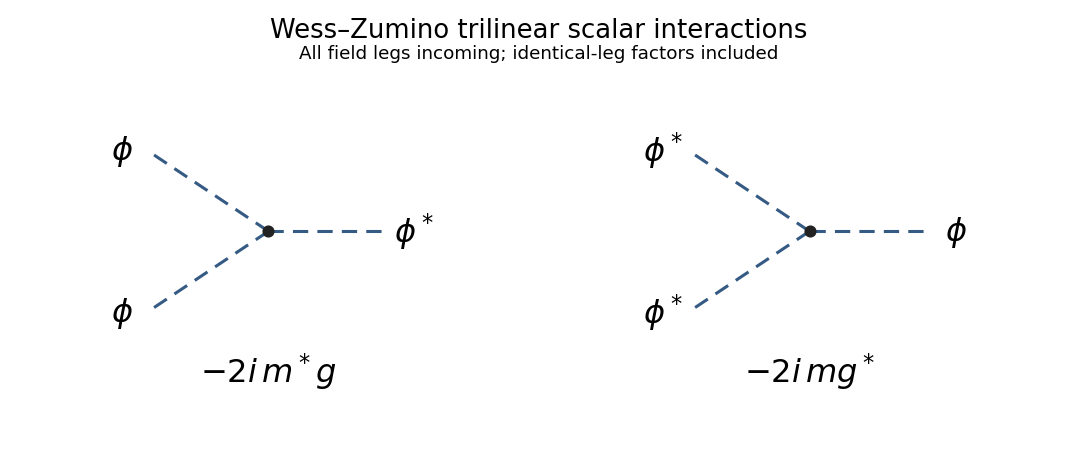


Equivalently, if are real and with canonically normalized real scalars , then . Differentiation gives , with vanishing and vertices. This is the same pair of complex-field interactions in a real basis.
For the non-renormalization argument, promote to nondynamical chiral spurions. Define one ordinary and one R-symmetry by the Wess–Zumino spurion charge assignment:
Table 1.
Ordinary and R-symmetry spurion charges
. | Quantity | Ordinary charge | R-charge |
|---|---|---|
Each superpotential term is neutral under the ordinary symmetry. Under the R-symmetry, both terms have charge two, which is canceled by the charge of . In particular, is R-neutral as required. The scalar, spinor and auxiliary components of have R-charges . These are formal symmetries when the couplings transform as spurions; replacing them by fixed nonzero numbers need not leave an actual continuous field symmetry.
A local loop-corrected Wilsonian effective action superpotential must be holomorphic in all three chiral variables and obey the same charges. The ratio is neutral under both symmetries, while has the required charges and mass dimension three. Therefore, on a patch with , the most general symmetry-allowed form iswith holomorphic on its domain. This form follows directly for a monomial : ordinary charge gives and R-charge gives , hence , . Each allowed monomial is and already has mass dimension three. Charge symmetry alone leaves undetermined.
To constrain perturbative loops, retain the original elementary chiral superfield and a nonzero infrared cutoff, rather than integrating out the entire field. A regular perturbative superpotential can be expanded about , so andTerms with have poles at . They are excluded by regularity of the local Wilsonian coefficients in the massless limit with the infrared cutoff fixed. At the theory is Gaussian, so the quadratic coefficient remains . The term linear in is the single original cubic vertex: a diagram with three external fields and only that one interaction vertex has no internal loop. Holomorphy disallows coefficients involving or , so it cannot conceal the usual nonholomorphic wave-function corrections in . Matching the one-vertex term gives . Thus the holomorphy argument for superpotential non-renormalization givesThe infrared qualification matters: a singular one-particle-irreducible expression or the action after eliminating an entire massive multiplet is not the same local Wilsonian effective action for the retained field.
Consequently the holomorphic superpotential and its parameters m and g receive no perturbative vertex renormalization. The Kähler potential does undergo wave-function renormalization. If its quadratic term is , then canonical normalization gives andThese canonically normalized running couplings can therefore be renormalized despite the non-renormalization theorem for the holomorphic superpotential. Loop corrections can also change the effective scalar potential through the corrected Kähler metric. The distinction between holomorphic coefficients and canonically normalized couplings is essential to answering the renormalization question.
Articles by others on the same topic
There are currently no matching articles.