An order parameter distinguishes phases through a macroscopic observable, such as the mean spin of a ferromagnet. Its vanishing can reflect an unbroken symmetry, while choosing one of several nonzero equilibrium values gives spontaneous symmetry breaking. Landau-Ginzburg theory treats it as a slowly varying field and expands the free energy in terms allowed by symmetry:Here penalizes spatial variation, is the conjugate field, and the highest retained even coefficient must stabilize large . For a spin-flip-symmetric system, odd powers are forbidden at . Equilibrium in the Landau approximation minimizes this functional; near an ordinary continuous transition with and .
For , the quartic Landau free energy at minimizes at for and at for . The order parameter changes continuously at , giving a continuous phase transition and a divergent response. The minimized potential is above the transition and below it, so its first temperature derivative is continuous while its second derivative jumps.
For , retain . A first-order phase transition occurs when the minimum and a nonzero minimum have equal free energy. Combining stationarity with equality of potential values givesThe order parameter jumps at a positive before the disordered minimum loses local stability. Generic temperature dependence then also produces a jump in entropy and a latent heat. Equality of global minima locates coexistence; the disappearance of a metastable minimum instead defines a spinodal point.
At fixed average order parameter, a nonconvex local potential need not describe the equilibrium free energy. A mixture of two phases can lower it to the common-tangent convex envelope. If their magnetizations are , the coexistence field satisfiesEquivalently, , the equal-area Maxwell construction. An average between and is obtained by choosing their volume fractions according to the lever rule. The gradient term in Landau-Ginzburg theory gives a finite interfacial energy and smooth domain walls; in the thermodynamic limit the bulk gain dominates the interface cost. Domains are therefore especially natural under a constrained mean magnetization or suitable boundary conditions. Without such a constraint, one pure phase is also an equilibrium state at coexistence.
Critical exponents describe singular behavior near a continuous phase transition. Define below , susceptibility , singular heat capacity , and critical isotherm . The ordinary quartic Landau free energy gives the equation of stateAt zero field its ordered minimum is proportional to . Differentiating the equation of state gives , proportional to on either side. At , , and the minimized free energy below the transition is proportional to . ThusHere denotes a finite heat-capacity jump, rather than a power divergence. Including gradients gives the Landau scalar correlation length and correlation-length exponent .
A tricritical point occurs at with : tuning changes a continuous transition into a first-order one. At , the equation of state is . It gives at , at , and a minimized free energy proportional to below the transition. The mean-field tricritical exponents areIn the three-dimensional parameter space , the zero-field disordered-to-ordered continuous line meets the first-order line at the tricritical point. The zero-field surface also contains coexistence of positive and negative ordered phases. For negative , tilting with produces two symmetric tricritical wings of first-order coexistence, each bounded by a line of ordinary critical endpoints. Those wings and their critical edges meet at the tricritical point. The upper critical dimension of tricritical sextic theory is three, so mean-field values can acquire logarithmic corrections there.
The scaling hypothesis for critical phenomena says that the singular equilibrium free-energy density is a generalized homogeneous function of the thermal and field variables, after analytic backgrounds are removed. To derive the ordinary mean-field form, put , and neglect the higher powers near the transition. Rescale . Minimizing the quartic potential becomesThis is the mean-field scalar free-energy scaling form with , . The two functions correspond to and ; the latter has two pure-phase branches and a cusp at zero field. The question's and subscripts distinguish these temperatures above and below .
Differentiating with respect to gives on an ordered pure branch, and differentiating again gives . Thus the displayed scaling form independently yields and .
To allow anomalous powers, replace it byThen and . Taking at fixed small gives , so . Eliminating proves the Rushbrooke scaling relation and Widom scaling relation:These power-law relations assume the simple scaling form; marginal corrections or dangerously irrelevant couplings can require additional scaling variables.
Use the connected correlation function . Away from criticality its large-distance envelope decays exponentially on the correlation length , often with an algebraic prefactor. At criticality diverges and a short-range scalar model instead has the power law , with anomalous dimension .
A blocking kernel assigns coarse spins to each block of side lattice spacings, with . Define the coarse Hamiltonian byThe operator basis must be sufficiently complete to include interactions generated by blocking. Summing over coarse spins preserves the partition function, while the physical lattice spacing and site count change to , . After steps they are and . Exact blocking preserves the long-distance predictions; truncating the generated interaction space introduces an approximation.
Define the dimensionless free energy per site . Preservation of gives . For one step, removing the explicitly additive constant givesThe function records the additive free-energy density generated by eliminated degrees of freedom; it is usually regular near a finite blocking step's critical point. Iteration provesThis is the additive free-energy recursion under blocking. After removing regular backgrounds, its singular part obeys homogeneous scaling.
A renormalization-group fixed point satisfies . Linearizing the map gives scaling coordinates . A relevant operator has , an irrelevant operator has , and a marginal operator has and needs nonlinear analysis. The critical surface consists of points flowing into the critical fixed point after all relevant directions are tuned. An outgoing or repulsive trajectory lies in the unstable manifold and describes perturbations that grow under coarse-graining.
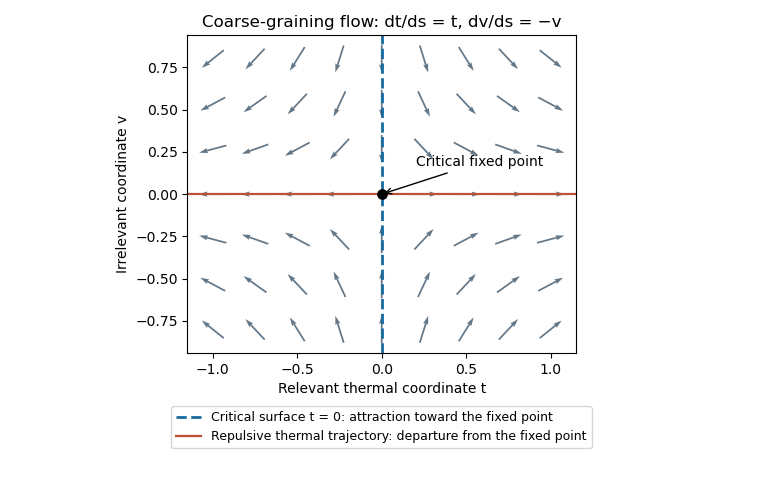

With relevant thermal and magnetic coordinates , the singular free-energy density obeys . Choose to obtainHere are the positive scaling eigenvalues, and refer to the signs of . Since , the correlation-length exponent is . Two temperature derivatives of give , establishing the hyperscaling relationThe magnetization exponent similarly is . These expressions assume no additional dangerous scaling variables.
For the Gaussian field theory, decompose the field into low and high Fourier modes, integrate out , and restore the cutoff using and . The gradient coefficient remains fixed, the mass coefficient transforms as , and the uniform source as . Hence , , and the Gaussian momentum-shell scaling givesThe sign convention reverses the magnetization's sign but not these exponents. For , these are Gaussian scaling predictions, not the exponents of a generic interacting scalar critical point: the quartic interaction is relevant there. The free quadratic Hamiltonian also has no stable ordered phase at negative , so the quoted is its formal order-parameter scaling index, not a spontaneously magnetized state of the unstabilized Gaussian integral. The relevance distinction is also explained in Tong's renormalization-group lecture notes.
The ultraviolet cutoff specifies which fluctuations remain explicit. Changing it integrates out some modes; to preserve long-distance predictions, their effect must be absorbed into the mass, interactions, and other couplings. Thus bare coefficients depend on . The long-distance inverse connected correlation function has the form . After fixing the gradient normalization, the infrared mass is an inverse correlation length. With the question's unrescaled gradient coefficient, at Gaussian level, so proportionality rather than literal equality is appropriate until that normalization is chosen.
As a concrete momentum-shell renormalization group step, split into modes below and in the shell , and defineThen rescale coordinates and the field to restore the cutoff and gradient coefficient. A local derivative expansion of gives new quadratic, quartic, and higher even couplings. If the system has short-range interactions, the field varies slowly, the effective potential is analytic, and remaining fluctuations are small, retaining the leading gradient and lowest stabilizing powers and minimizing the resulting functional gives Landau-Ginzburg theory. Suppressing the omitted fluctuations is the substantive Landau approximation; it is justified sufficiently far from the narrow fluctuation region or above the appropriate upper critical dimension.
The truncated two-point function in this question is the one-particle-irreducible two-point vertex, . It is the Hessian of the Legendre effective action, not merely the connected two-point function. In perturbation theory,Here is the Gaussian propagator about the chosen reference mass, is the mass counterterm or bare-to-reference mass shift, and is the interaction self-energy, computed from proper diagrams. Fix the gradient normalization so , and choose the infrared reference mass . Then at this order. The mass renormalization condition is .
At one loop the only two-point diagram is the quartic tadpole diagram. There are choices for attaching its two external lines, leaving the other pair contracted; dividing by gives its factor . It is independent of external momentum, soThe renormalization condition therefore gives the self-consistent one-loop equationUsing inside the loop is a self-consistent resummation; replacing it by the bare mass gives the same formal first-order expansion away from infrared problems.
Subtract the equation at , where , and absorb regular temperature dependence of into the thermal coefficient. Let and . ThenFor , the integral divided by tends to a finite cutoff-dependent constant, since its small-momentum radial integrand is . Thus is proportional to , consistent with the Landau prediction. For , set : the correction instead scales as and dominates . At it is proportional to . Hence a pure linear Landau mass law without logarithmic modification is consistent only aboveFor , the massless integral itself is infrared divergent, so the subtraction already needs additional care. The sub-four-dimensional self-consistent approximation locates the breakdown of mean-field behavior; it is not an exact calculation of interacting critical exponents.
At a tricritical point the quartic coupling is tuned away and the leading stabilizing interaction is . At the Gaussian fixed point, the field has engineering dimension , so the sextic coefficient rescales as . It changes from irrelevant to relevant atThis is the sextic case of the upper critical dimension of an even scalar interaction; marginality at three dimensions allows logarithmic corrections.
Articles by others on the same topic
There are currently no matching articles.