The Gibbs free energy is G=U−TS+pV. For an extensive thermodynamic system, scaling the amount of matter at fixed pressure, temperature and composition scales G by the same factor, hence G(T,p,N)=Nμ(T,p). Euler's relation U=TS−pV+μN gives the same conclusion. This uses the ordinary thermodynamic-limit extensivity assumption, rather than a universal claim about finite-size or long-range-interacting systems.
The fundamental thermodynamic identity gives dG=−SdT+Vdp+μdN. Comparing with d(Nμ) at fixed N yields
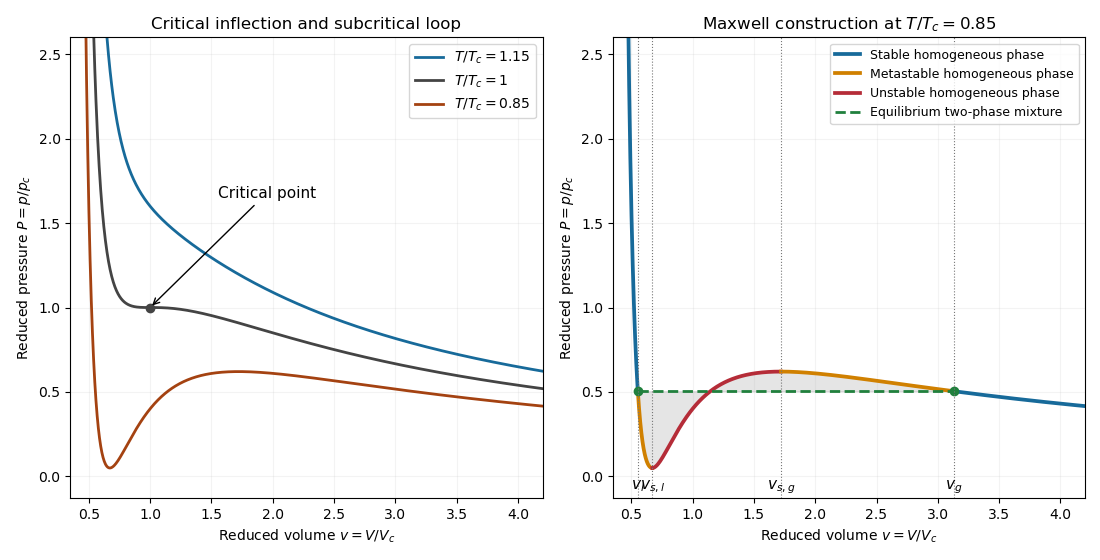
Above Tc the isotherms decrease monotonically; at Tc there is a horizontal inflection; below Tc the formal curve develops alocal minimum and maximum. The physically equilibrated isotherm replaces part of that loop by a constant-pressure coexistence segment.
Let Vs,l<Vs,g be the two spinodalvolumes where p′(V)=0. A homogeneous phase is mechanically unstable on Vs,l<V<Vs,g, since p′>0 gives negative compressibility. The negative-slope branches Vl<V<Vs,l and Vs,g<V<Vg are metastable homogeneous liquid and gas respectively: they resist small perturbations but a two-phase state has lower freeenergy. The single-phase stable branches are V<Vl and V>Vg. Throughout the coexistence interval [Vl,Vg], the equilibrium state is amixture at pressure p0 with its phase fractions chosen to produce the total volume. The preceding figure labels both the formal homogeneous branches and the equilibrium coexistence segment.
Set s=τz. The leading departure from the coexistence pressure is τ3/2(6z−3z3/2). Equal pressure at the two outer endpoints together with the Maxwell equal-area condition selects the symmetric pair zl=−2, zg=2, with coexistence pressure 1−4τ+O(τ2). To see why, a horizontal line through the odd cubic has zero signed area between its outer equal-heightroots only at zero height: the signed area is strictly decreasing with line height, and symmetry makes it zero there. Thus
The cubic scaling therefore has exponent three, with a negative coefficient. A fixed noncritical isotherm does not pass through the critical point, so that qualification is essential.