The Van der Waals equation is a simple real gas equation of state that can also describe a liquid-gas critical point. With particle count fixed, write the volume per particle as :or equivalently . Here is pressure, is absolute temperature, and is the Boltzmann constant. In SI, and have units per particle, has units , and has units ; the particle count is dimensionless. The pole at excludes smaller volume values from this model.
The correction represents excluded volume; the attraction term lowers pressure at fixed temperature and particle number density . This is a mean-field theory, replacing detailed intermolecular structure by two parameters. At with , it approaches the ideal gas law . It supplies a useful qualitative route from a dilute gas to phase coexistence, without a claim of quantitative accuracy for every fluid.[ref]
Van der Waals Gas. opening explanation and equation 6.156: excluded volume and attractive pressure correction; Fitzpatrick uses molar volume
Do not mix this particle convention with the molar volume convention elsewhere in this article. With amount of substance , Avogadro constant , and molar gas constant , one has , , and , so . The molar parameters have units and , respectively.
Johannes Diderik van der Waals introduced this equation of state in 1873, connecting molecular attraction with departures from the dilute ideal gas law. Its historical significance is the unified treatment of gases and liquids, rather than a universally exact fit.[ref]
Johannes Diderik van der Waals, Facts by Nobel Prize Outreach. Nobel Prize Outreach, Johannes Diderik van der Waals, Work: equation introduced in 1873 and molecular attraction
A mean-field fluid model with excluded-volume and attractive-interaction parameters, described by the Van der Waals equation. Its pressure law alone does not fix every thermal property: the caloric closure of the van der Waals equation supplies the additional internal-energy assumption.
For the one-mole Van der Waals equation with constant parameters, integrate along an isotherm to obtain the displayed difference. The attractive contribution has a positive change on expansion, whereas the translational term lowers free energy. Thermodynamic consistency independently gives and . These homogeneous-branch expressions are not a substitute for equilibrium convexification through a subcritical coexistence region.
The thermodynamic identity fixes the volume-dependent term but leaves an arbitrary function of temperature. Classical monatomic mean-field modelling adds , giving .
For fixed amount of substance, thermodynamic consistency givesIndeed, the first law of thermodynamics gives , and the Helmholtz free energy Maxwell relation gives . For the fixed-amount convention with temperature-independent , substitution gives . Integration yields . If the dilute-limit reference is as for every , then .
The same formula may be interpreted molarly if all use that convention. Mixing molar and total quantities changes the amount factors. The attraction controls the volume correction to internal energy, while excluded volume alone does not contribute to this derivative when are independent of temperature.
For one mole with temperature-independent parameters , the equation of state is . A Maxwell relation gives , so the volume dependence is . Matching the ideal gas entropy at infinite volume fixes the excess at the same to . The attraction contributes to the Helmholtz free energy but no excess entropy when is independent of temperature. A temperature-dependent attraction parameter would change this conclusion.
The molar volume is the volume per amount of substance, not the total container volume or the volume per particle. In the molar convention of the Van der Waals equation, take constant positive parametersThenor, for any fixed amount of substance,Both terms in the first equation are pressures. The total excluded volume is : using would subtract quantities with different units. Changing the sample size at fixed molar volume and temperature changes and proportionally, while leaving pressure unchanged. This is a useful unit and extensivity check before fitting a real gas.
For the molar Van der Waals critical point, differentiate with respect to molar volume at fixed temperature:Setting both to zero gives and . Equating them and dividing by the nonzero factors yields , soHere has units , has units , and has units . This is the molar version of the particle derivation below: , with the same physical and . If one writes , and without subscripts, then all of in those formulas must be molar quantities.
Now define the dimensionless reduced variables explicitly as , and . Substituting the three critical values cancels and givesBecause , these are exactly the reduced variables in the Van der Waals isotherm discussion. The Van der Waals law of corresponding states is therefore independent of whether one starts with particle or molar units. It predicts a critical ratio , providing a third check on any proposed parameter fit.
Choose a hypothetical fluid with molar constants and , using . These stipulated constants are not a fit to carbon dioxide. The molar critical formulas giveAt and , first convert to . The repulsive-volume term and attractive correction areso . The ideal gas law would instead give . The excluded volume raises pressure relative to that ideal value, but attraction more than offsets the increase here. Neither correction alone describes this example.
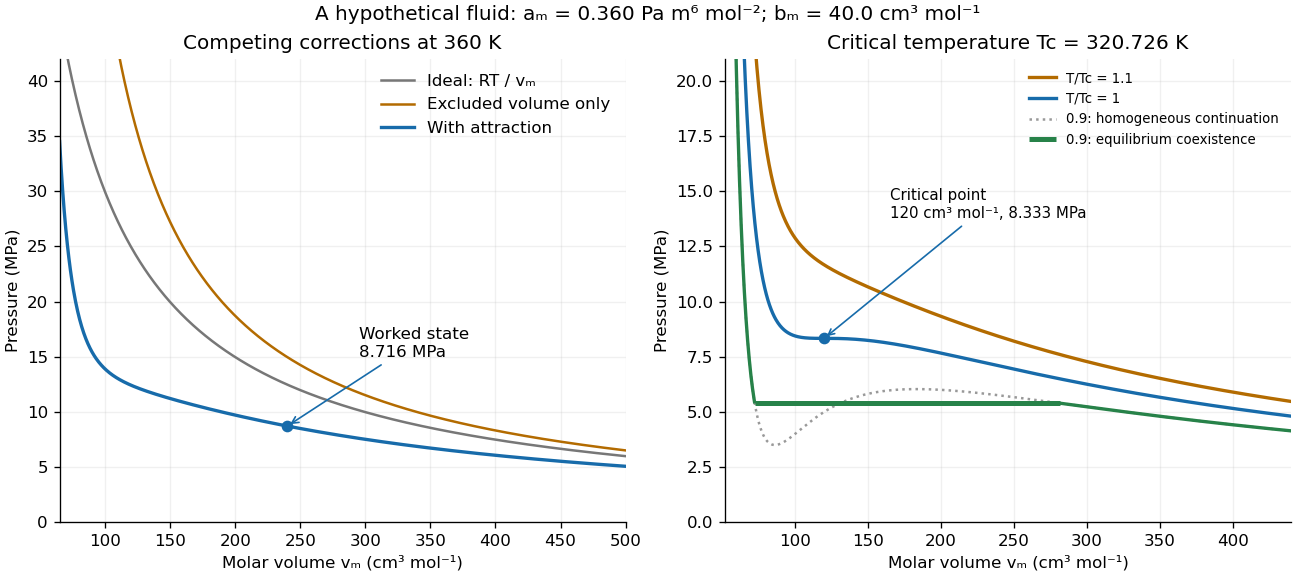
For , the same state occupies . The total-volume formula gives and the same . Halving the sample has halved both its physical volume and its excluded volume, while retaining its pressure. Conversely, if the two critical measurements are used to determine model constants, inversion givesAn independent critical molar volume then tests the prediction ; agreement with two fitted numbers does not ensure agreement with the third.
At , the Van der Waals liquid-gas coexistence example below becomes , , and . For a mean molar volume of , the lever rule gives gas mole fraction . Its volume fraction is instead : less than one quarter of the molecules occupy more than half the volume. The flat equilibrium pressure corresponds to changing these proportions. It does not describe a homogeneous sample sliding along the unstable loop.
The Van der Waals equation becomes independent of its material parameters when pressure, temperature and molecular volume are divided by their critical values: . This explains the common reduced isotherms within this model, without claiming exact agreement for all real fluids.
A Van der Waals isotherm is the pressure–particle volume curve at a fixed temperature. Put , , and , using the Van der Waals critical point values below. Then the existing Van der Waals law of corresponding states becomesAll curves in the figure are calculations in this reduced model.
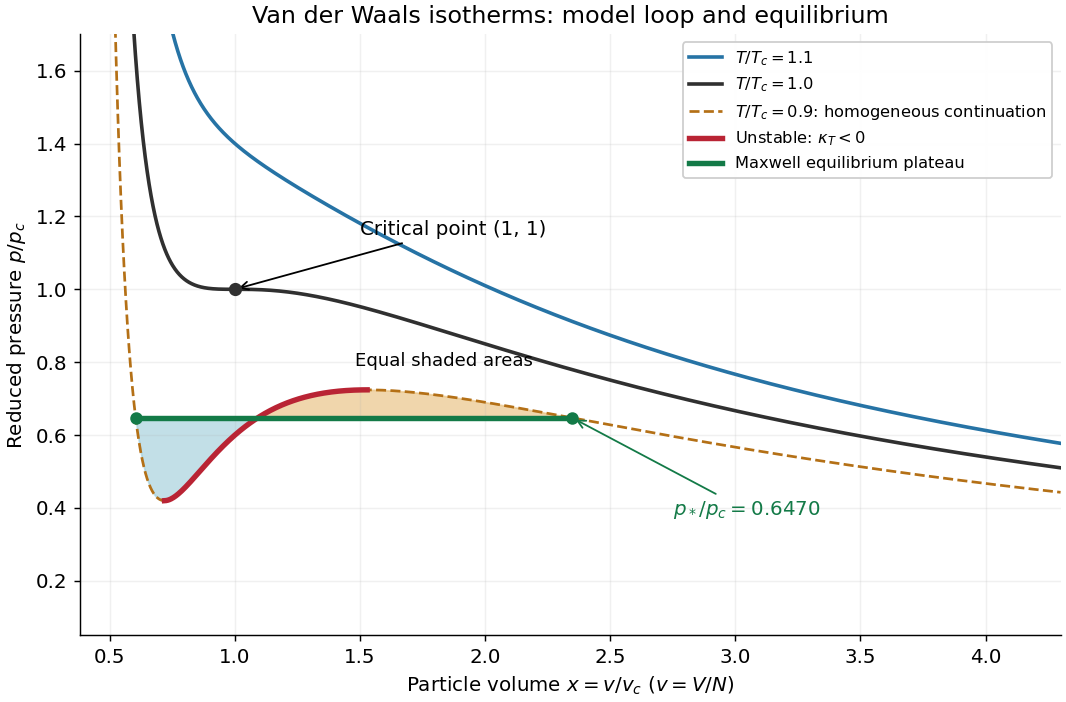
Van der Waals isotherms below, at and above the Van der Waals critical point
. The dashed subcritical homogeneous continuation contains an unstable red segment. The green Maxwell construction plateau describes equilibrium phase coexistence; the two shaded areas are equal. Curves are model calculations, not carbon dioxide measurements. Details.For a uniform thermodynamic phase, the isothermal compressibility isThus the upward-sloping portion of a subcritical Van der Waals isotherm has : compression would reduce pressure, allowing a density disturbance to grow. It is mechanically unstable. The spinodal points bound that portion; setting the derivative to zero gives their curve . Negative slope alone guarantees only local mechanical stability: portions between the spinodal and the phase coexistence endpoints have metastability. Equilibrium replaces the entire interval between those endpoints, including these metastable portions, by a Maxwell construction plateau.[ref]
Statistical Physics by David Tong. §5.1, equation 5.3 and §5.1.1, Maxwell Construction and Meta-Stable States: unstable middle branch and coexistence versus spinodal
The liquid-gas critical point of the Van der Waals equation occurs where its two subcritical stationary points merge into a horizontal inflection point. The conditions are . The short calculation isDividing these relations gives , henceSubstitution gives the Van der Waals law of corresponding states and the parameter-independent ratio . That ratio belongs to this equation of state; reducing a real fluid's variables does not enforce it.[ref]
Statistical Physics by David Tong. §5.1.3, equations 5.7–5.8: critical values, reduced equation and compressibility ratio
An exact rearrangement of the reduced critical Van der Waals isotherm makes its flatness visible:The first nonzero departure near is . On the critical particle volume approached from , andThe divergent isothermal compressibility and cubic flattening explain why the critical region is mechanically soft. These are mean-field theory predictions; thermal fluctuations limit their use for real fluids very close to a thermodynamic critical point.
For molar equation , the critical values are and . At , . Thus on the stable branch above . The mean-field compressibility exponent is one; the continuation below the critical temperature is unstable rather than an equilibrium negative compressibility.
Below , the equilibrium liquid and gas have the same temperature, pressure , and per-particle chemical potential. For macroscopic bulk thermodynamic phases, neglect interface contributions. The Maxwell equal-area construction determines and byIt expresses equality of chemical potentials, since at fixed temperature. Equivalently, the equilibrium Helmholtz free energy per particle follows a common tangent line between the two endpoint states, lying below the homogeneous continuation between them. The construction uses that mathematical continuation to compare endpoints; it is not a physical compression path through negative isothermal compressibility states.[ref]
Statistical Physics by David Tong. §5.1.1, equation 5.5, Maxwell Construction and figures 36–37: chemical-potential equality and flat coexistence intervals
Here is a reproducible calculated example at . With , the homogeneous intersections solve the cubic equationThe Maxwell construction givesAll three roots of a polynomial satisfy . Only the smallest and largest are the phase coexistence endpoints; the middle one has negative isothermal compressibility. Equal pressures at three admissible values of volume therefore do not imply three stable thermodynamic phases. An analytic area check isAt full numerical precision, the residual is below in reduced units; independent numerical integration gives the same cancellation. At , the spinodal points are instead and .
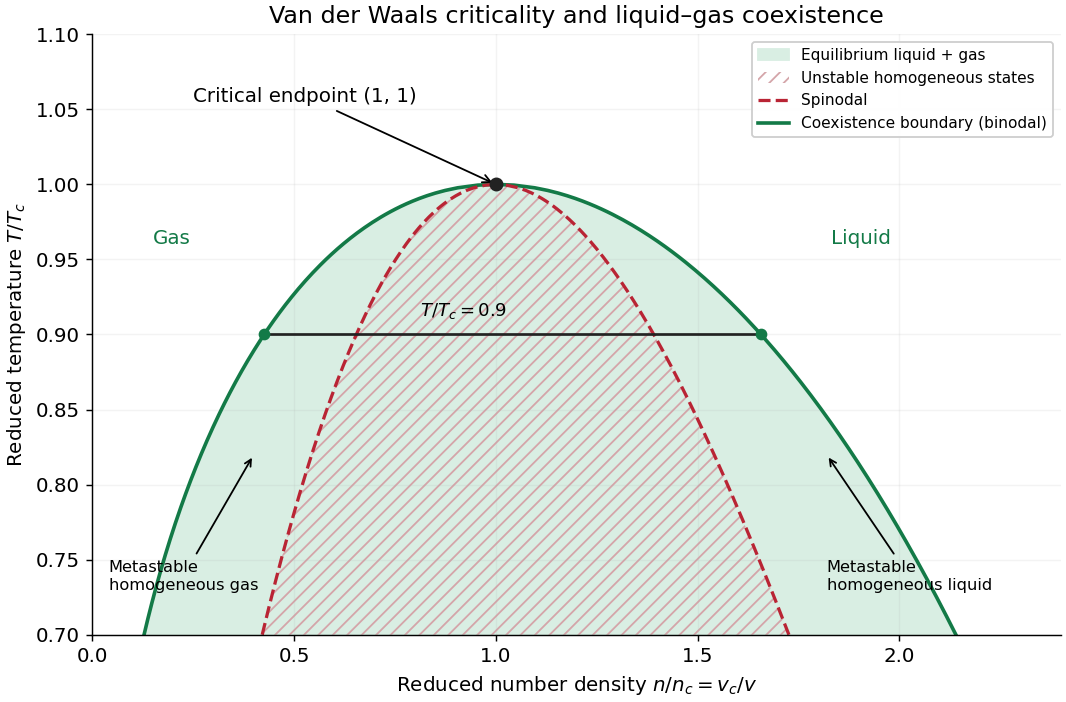
The equilibrium plateau changes the phase fraction rather than the endpoint densities. For a gas particle fraction and mean particle volume , the lever rule readsThus at gives : this is a particle fraction, not the volume fraction occupied by gas. Differentiating equality of chemical potentials along this model's phase coexistence curve yields the same Clapeyron equation explained below, , with latent heat per particle. Both endpoint differences vanish as the Van der Waals critical point is approached; the equation's critical limit must be taken as a ratio.
The Maxwell construction presumes a pure bulk fluid at thermodynamic equilibrium. Its endpoint equality does not specify how rapidly a real compression reaches equilibrium. A homogeneous metastable sample can persist while nucleation is delayed; the spinodal marks loss of local mechanical stability in this mean-field theory, rather than the equilibrium onset of condensation. Surface tension, finite sample size and impurities can affect the observed transition. These qualifications matter when comparing a mathematical Van der Waals isotherm with a visible liquid meniscus.
For one mole, liquid–vapour phase coexistence requires equal pressure and chemical potential. At , the saturation pressure is exponentially small. Neglecting it in the dense-phase equation of state gives . The root near the excluded volume isThis is an asymptotic low-temperature result, not an exact coexistence volume at every subcritical temperature. Away from that limit, solve equal pressure together with the Maxwell equal-area construction.
The 1869 The Bakerian Lecture: On the Continuity of the Gaseous and Liquid States of Matter by Thomas Andrews describes dried carbon dioxide trapped above mercury in a sealed capillary tube. A steel screw pressurized water in a strong copper tube; movable mercury transmitted the load. A second capillary tube held air as a pressure gauge. Flowing water around the visible capillary tubes controlled temperature; a thermometer read the bath. A cathetometer read column positions, converted to volume readings using weighed-mercury calibration.[ref]
The Bakerian Lecture: On the Continuity of the Gaseous and Liquid States of Matter by Thomas Andrews. Andrews, pp. 576–578 and Plate LXIII, figures 3 and 5–7: sample preparation, screw, coupled capillaries, water jackets and optical readout
Below the critical temperature, compression produced a visible liquid–gas boundary; above it, large density changes occurred without that boundary. Three trials gave as his critical temperature. Purity checks detected residual air; mercury height corrections accounted for unequal hydrostatic pressures. He explicitly left air nonideality and pressure-induced tube-capacity corrections unresolved, so his air-gauge pressures were approximate. These readouts support a liquid-gas critical point; they do not measure a homogeneous unstable loop or establish universal quantitative accuracy of the later Van der Waals equation.[ref]
The Bakerian Lecture: On the Continuity of the Gaseous and Liquid States of Matter by Thomas Andrews. Andrews, pp. 576, 578–580 and 583: residual air, approximate air-gauge pressure, hydrostatic corrections and three critical-temperature trials
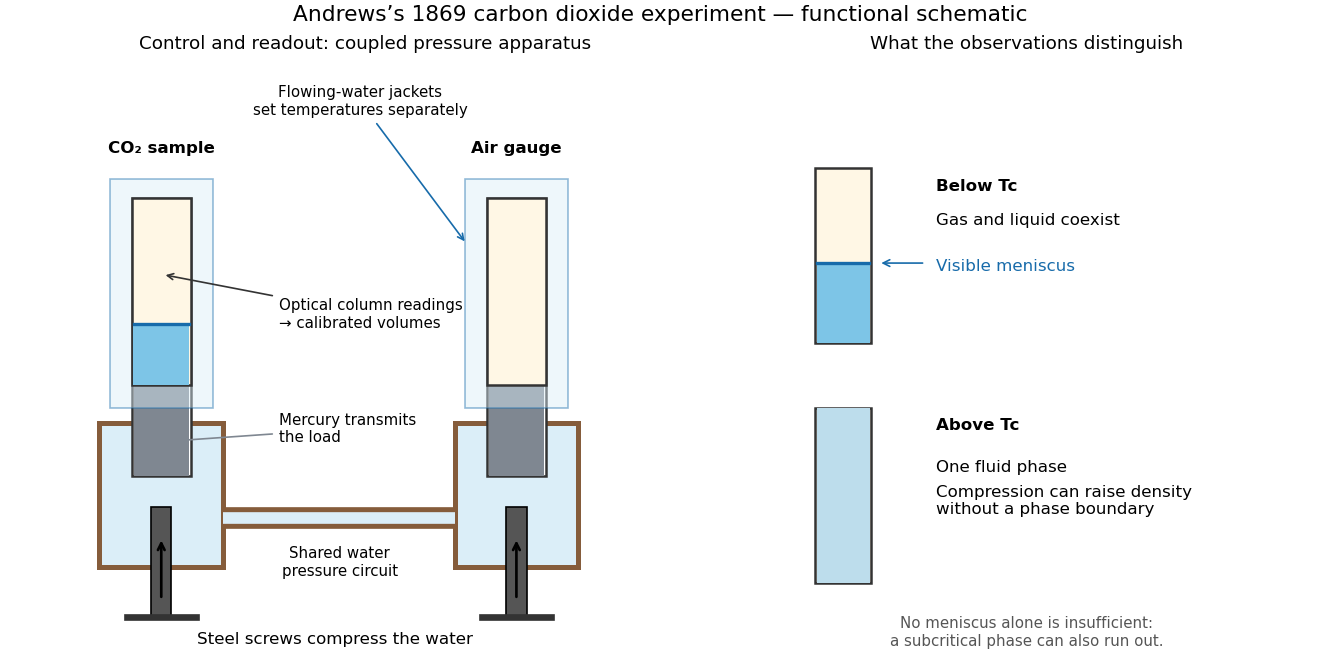
Andrews's carbon dioxide experiment: control, readout and the liquid-gas critical point
. Original functional schematic, not a scale reconstruction. The water circuit transmits compression through mercury to two samples; separate temperature jackets permit control of the sample and air gauge. The right panels distinguish a visible liquid–gas liquid meniscus from a single thermodynamic phase. Interpret alongside the experimental limitations above. Details.A disappearing liquid meniscus by itself has more than one possible explanation: in ordinary subcritical condensation or evaporation, one thermodynamic phase can simply run out. The stronger critical-point inference combines temperature control, compression readings and the existence of a continuous route around the endpoint of the phase coexistence curve. On that route a dilute gas can become dense without crossing a two-phase boundary. This is what continuity of liquid and gas means; it does not remove their distinct equilibrium number densities below .
In his 12 December 1910 Nobel lecture, Johannes Diderik van der Waals explained gases and liquids through the same moving molecules, with attraction and finite size modifying their pressure. He also rejected the idea that constant should give universal numerical agreement. His critical-volume discussion explicitly retained derivatives of a volume-dependent : the familiar follows only when those derivatives are neglected. Thus the elegant constant-parameter Van der Waals critical point is a model result whose limitations were already part of its author's account.[ref]
The Equation of State for Gases and Liquids by Johannes Diderik van der Waals. The equation of state for gases and liquids, Nobel lecture delivered 12 December 1910, pp. 254–257: molecular continuity, constant-parameter caveat and critical-volume derivatives
Articles by others on the same topic



The Van der Waals equation is an equation of state for real gases that modifies the ideal gas law to account for the volume occupied by gas molecules and the attractive forces between them.