Suppose the prime numbers were the finite list . The integer has a prime factor, by repeatedly factoring any composite factor until a prime is reached. But division by any leaves remainder one, so that prime factor is absent from the list. This contradiction proves there are infinitely many prime numbers. The argument does not require itself to be prime.
For any positive integer , put . Each of is composite, since is divisible by and larger than . Let be the largest prime number at most , and let be the smallest prime number at least . Such exists by part (i), and no prime lies strictly between and . Therefore these are consecutive prime numbers withSince is arbitrary, gaps between consecutive prime numbers are unbounded.
Normalize the nonvanishing loop to . A continuous argument lift is a continuous function such that . Such a lift exists on an interval; any two differ by a constant integer multiple of . The winding number isIts value is independent of the lift. This definition applies to continuous loops without assuming a differentiable contour.
The homotopy invariance of winding number states: if is continuous and for every , then is independent of . Neither the loops nor their moving basepoints may pass through zero. One may justify invariance by uniformly subdividing the homotopy into nearby loops whose normalized values have a continuous argument difference of magnitude less than ; that argument difference has equal endpoint values, so their winding numbers agree.
Put and use the straight homotopy . For , the triangle inequality givesAt it is nonzero by the hypothesis. Thus this is a homotopy of closed loops avoiding the origin, even though the given distance bound is non-strict. The homotopy invariance of winding number gives
If the boundary loop meets zero, the assertion already holds. Otherwise suppose, for contradiction, that has no zero anywhere in the disc. Then is a homotopy through nonvanishing closed loops from the boundary loop to the constant loop . Constant loops have winding number zero, whereas part (i) gives winding number one. This contradicts homotopy invariance of winding number. Hence .
An inversion in a circle on the Riemann sphere is the anti-Möbius involution fixing that generalized circle pointwise. For a Euclidean circle with centre and radius , it isIt reverses the argument relative to the centre and sends radius to , so exactly the points of the circle are fixed. For a straight line, regarded as a circle through infinity, inversion is the ordinary reflection in that line. These formulas prove existence. For uniqueness, the composition of two anti-Möbius transformations fixing the same circle pointwise is a Möbius transformation fixing at least three distinct points, hence the identity. Therefore the two inversions agree.
Every inversion has the form with . Composing two conjugate-linear fractional expressions cancels the complex conjugations and gives with nonzero determinant. Induction proves that an even number of inversions gives a Möbius transformation.
Conversely translations are compositions of reflections in parallel lines, rotations are compositions of reflections in two lines through their centre, and positive dilations are compositions of two concentric circle inversions: . Thus every nonconstant affine map is an even composition. The map is composed with reflection in the real axis, also an even composition. If , factor a general Möbius transformation asThis is a composition of affine maps and . If , it is already affine. Every Möbius transformation is therefore a composition of an even number of inversions, with the identity represented by zero inversions or by any inversion repeated twice.
Use the BB84 protocol to establish a secret random key, then encrypt the actual message with a one-time pad. Alice chooses independent random bits and independently chooses between the computational orthonormal basis and the diagonal basis , where . She sends one photon or other qubit in each corresponding state. Bob independently chooses one of the two bases for each measurement.
Over an authenticated public classical channel, they announce their bases but not their bit values. They retain only positions where their bases match; absent disturbance these sifted bits agree. They disclose and discard a randomly selected test sample to estimate the error rate. If it is too large they abort. Otherwise they perform information reconciliation and privacy amplification to produce a shared key about which an eavesdropper has negligible information. Authentication is essential: without it, an active attacker can impersonate the two parties. It may use a previously shared short authentication key, subsequently replenished from the new secret key.
The no-cloning theorem prevents an attacker from copying an unknown nonorthogonal state perfectly: preservation of inner products would require , impossible when its modulus is strictly between zero and one. In a simple intercept-and-resend attack, Eve chooses the wrong basis with probability , and then introduces a wrong sifted bit with probability . Thus the test error rate is , and the probability that independent tested bits show no error is . More general attacks are handled by bounding Eve's information from the observed statistics and shortening the reconciled key through privacy amplification.
Finally Alice sends , using a uniform independent key of the message's length exactly once. The one-time pad makes the ciphertext independent of the message. The security claim is secrecy with arbitrarily small failure probability after testing and privacy amplification, not that a finite quantum transmission can never be disturbed or intercepted. The scheme assumes trusted devices and an authenticated classical channel; it does not rely on a computational hardness assumption.
Model each person's infections over the fixed exposure period as an independent Poisson random variable with mean , conditional on the explanatory variables. The sum over people is then Poisson distributed with mean , because independent Poisson counts add. This is reasonable for repeatable events occurring at an approximately constant rate without substantial clustering; the count need not be at most , so a binomial model would not describe repeated infections.
The Poisson regression uses a log link and the known offset . The omitted factor levels are the reference categories under treatment contrasts: their effects are absorbed into the intercept. Including all levels together with an intercept would make the design matrix linearly dependent. For the proposed new group, the relevant predictor uses the intercept, the infrequent-swimmer coefficient and the age-20–24 coefficient; beach and female are reference levels. HenceTo add the age-by-sex interaction, one possible R command iswhere
glm(count ~ freq + loc + age * sex, family = poisson, offset = log(n), data = swimmers)swimmers denotes the data frame. The product expands to both main effects and their interaction. There are two additional interaction coefficients because age has three levels and sex has two.The nested-model comparison is a likelihood-ratio test. The reduction in Poisson deviance is , asymptotically under the null hypothesis that both interaction coefficients are zero. Its reported -value gives evidence for an age-by-sex interaction at the five-percent level, though not at the one-percent level.
Neither fitted Poisson model fits well in an absolute sense. Comparing residual deviances with and respectively gives small tail probabilities: the deviance-to-degree-of-freedom ratios are about and . Improvement relative to the simpler model does not establish goodness of fit. Omitted structure, dependence or overdispersion could account for the remaining lack of fit; if the Poisson variance assumption is false, the nominal interaction-test calibration also needs reconsideration. The age label in the introductory legend is inconsistent with the actual model levels; the prediction uses the unambiguous age-20–24 row.
The preceding summer supplies new seeds. After one winter, survive and the fraction germinates. Seeds from summer must survive two winters and fail to germinate after the first, so their germinating contribution is . Older seeds cannot contribute. Applying the density-dependent maturation function givesThis is a seed-bank population recurrence. Put . Its fixed points satisfy . The zero solution always exists. If , the graph of leaves the origin with slope , is concave because decreases, and is bounded above by ; it therefore crosses the straight line again at a positive value. Concavity makes this positive crossing unique: the ratio is nonincreasing, starts at one, tends to zero, and is strictly decreasing at any level below one that it attains after the initial slope has dropped. Thus there are exactly two nonnegative steady states when .
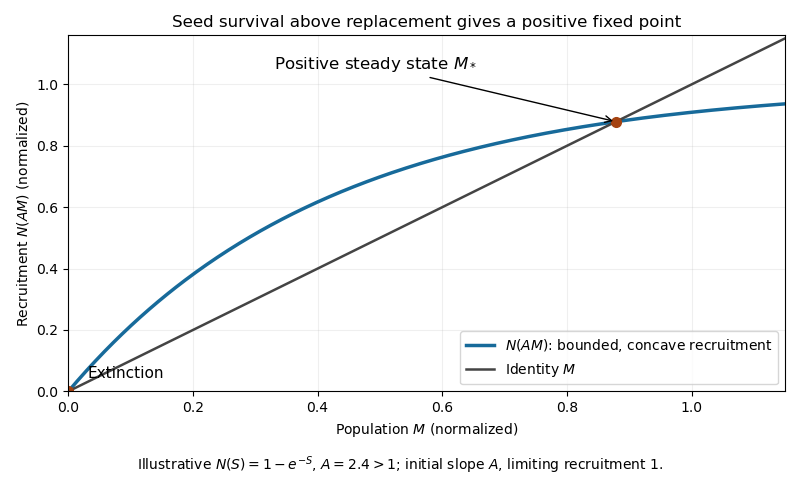
Linearization at extinction uses :The positive root is . Since the polynomial at is , and tends to positive infinity, . Its associated two-component perturbation can be chosen nonnegative, so the growing mode is physically admissible. Extinction is unstable whenever .
For a nearly Hamiltonian system, the unperturbed Hamiltonian is conserved and its level curves typically contain a family of periodic orbits. A weak perturbation changes the energy slowly. The energy balance method integrates over one unperturbed period to obtain the leading energy change . A zero of this change selects a possible persistent periodic orbit. A simple zero persists for sufficiently small perturbation by a Poincaré return map and the implicit function theorem. A negative slope of the averaged energy drift gives attraction; a positive slope gives repulsion. A multiple zero requires higher-order analysis, and a zero-free leading drift rules out periodic motion in the corresponding perturbative energy range.
Set . ThenOn an unperturbed circle write , . The supplied integrals giveEquivalently, the leading averaged amplitude equation isWith , its nonzero stationary amplitudes solve . If , both roots are positive and simple:The averaged drift is positive below , negative between and , and positive above . Thus the inner orbit is attracting and the outer orbit repelling, with leading displacement amplitudes and and period . The simple zeros of the Poincaré return map persist for sufficiently small .
If , the leading quadratic is strictly positive for all ; the energy increases on every nonzero unperturbed orbit, so the energy balance method yields no periodic orbits in any fixed compact range of nonzero amplitudes for sufficiently small . This perturbative calculation does not itself establish a uniform global exclusion at amplitudes growing as tends to zero. At equality, the leading drift has a double zero at . It is positive on both sides, with a semistable candidate at that amplitude. First-order averaging alone cannot decide whether the exact system has zero, one, or two nearby periodic orbits at equality: higher-order drift determines the unfolding of this degenerate zero. The original PDF has ; the extra exponent on in the converted TeX is an OCR error.
In the common sector , rotate the positive real contour clockwise to the negative imaginary axis. The large quarter-circle contributes zero because there. The rotated ray passes through the simple pole , whose residue isTake a small semicircular indentation into the right half-plane, excluding the pole from the clockwise contour. The downward ray traverses this semicircle clockwise, contributing in the limit. Thus the deformed downward integral is , and it equals the original integral. ConsequentlyThis half-residue, rather than a full residue, results from a pole lying on the rotated integration ray.
Parametrizing givesFor its tail decays exponentially. Near , subtract the pole coefficient before integrating; the remaining integrand is regular, and the principal-value pole term is explicit. This proves holomorphic dependence on throughout the upper half-plane, locally uniformly on compact subsets. Agreement in the overlap and the identity theorem therefore give the requested analytic continuation:
The Poisson bracket in canonical coordinates isUsing Hamilton's equations and in the chain rule yieldsThe partial time derivative holds phase-space coordinates fixed; the total derivative follows the actual trajectory.
The autonomous Hamiltonian is constant and positive on every trajectory, since . Hamilton's equations give , , and henceThus is conserved. Put . Multiplying the energy equation by gives . The full classical path is thereforeThe sign labels the two disconnected half-lines and is fixed by initial data. Differentiating verifies both Hamilton equations. The inverse-square potential prevents the path from crossing zero.
Expand the relativistic energy as . In the dilute nonrelativistic regime the occupation denominator is dominated by its exponential, so the Fermi-Dirac distribution reduces to the Maxwell-Boltzmann distribution. The number density is thenThe assumed low temperature makes the contributing momenta nonrelativistic; the large positive makes occupation numbers small.
For chemical equilibrium of hydrogen ionization, , and thermal photons have . Apply the same dilute-gas expression to protons, electrons and ground-state hydrogen. Their density ratio isAssume charge neutrality with no other important ionic species, so ; neglect the binding-energy mass correction in , so this ratio is approximately one. Including proton and electron spin gives and ground-state , hence . Equivalently one may consistently omit nuclear spin from both proton and hydrogen degeneracies. Thus the Saha equation isThe assumptions are thermal and chemical equilibrium at a common temperature, dilute nonrelativistic species, neutral total charge, predominantly ground-state hydrogen, and negligible interaction/partition-function corrections. The Maxwell-Boltzmann density formula applies to dilute hydrogen whether its composite spin makes it a boson or a fermion.
For odd coprime positive integers and , define the Jacobi symbol by multiplying Legendre symbols over the prime factorization of the denominator. Multiplicativity in the numerator givesBy quadratic reciprocity for the Legendre symbol, this is , where and . For odd , , since is even. Thus and . We obtainIf are not coprime, both symbols are zero and the equivalent identity still holds. The convention handles denominator one.
Factor . Since it is not a square, one exponent, say , is odd. Choose a nonzero quadratic nonresidue modulo ; one exists because the squaring map on the nonzero residues is two-to-one and hence has only images. The Chinese remainder theorem supplies a positive odd integer satisfyingThen and . The Jacobi reciprocity law proved in part (i), together with , gives . Factoring givesAll are odd and none divides . At least one factor must be negative, yielding an odd prime number . No theorem about primes in arithmetic progressions is needed.
A Euclidean lattice in is a discrete additive subgroup, equivalently the integer span of zero, one or two real-linearly independent vectors. Its rank is the number of these generators, or the dimension of its real span. Discreteness makes its intersection with any bounded set finite, so shortest nonzero vectors exist.
First . Otherwise an element with noninteger could be reduced by its nearest integer multiple of to a nonzero vector of length at most , contradicting minimality. Therefore is not parallel to .
Write any as with real coefficients. Subtract nearest integer multiples to obtain , with . If , it is not on the first axis, yetwith strict inequality because the independent vectors cannot achieve equality in the triangle inequality; if one coefficient vanishes the inequality is also strict. This contradicts minimality of . If and , then , contradicting minimality of . Thus and both original coefficients are integers. Hence .
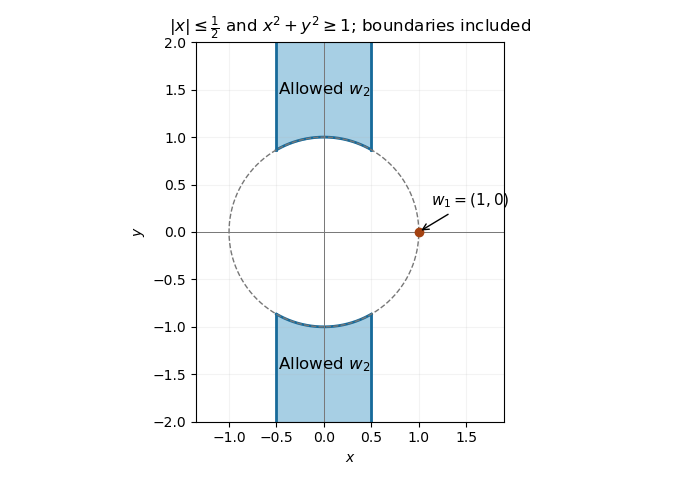
For and , minimality implies and , hence . The exact region isThese conditions are sufficient: in the generated lattice, vectors with second coefficient have smallest length when the first coefficient is zero, allowing ties at . A vector with second coefficient of magnitude at least two has length at least , since and . Vectors on the first axis have length at least one. Thus the shaded region includes exactly all allowable choices, including ties on its boundary.


For a second lattice basis, write , with integer coefficients, as just proved. Conversely each is an integer combination of the . The change-of-basis matrix and its inverse therefore both have integer entries. Their determinants are integers with product one, giving . Thus lattice bases are related by a unimodular matrix.
For , the Gaussian linear model has likelihood functionMaximizing over minimizes the residual sum of squares. Full column rank makes positive definite, and differentiating gives the unique least-squares estimatorPut and . If , differentiating the profile log-likelihood in givesThe denominator is , not the residual degrees of freedom ; the latter gives the unbiased estimator.
A linear transformation of the multivariate normal distribution remains normal, soIts covariance with the residual vector is . Jointly Gaussian vectors with zero cross-covariance are independent, hence is independent of , and therefore of , a function of that residual. Orthogonal coordinates also give .
The allowed boundary case needs qualification. Then , for every observation, and the likelihood increases without bound as after fitting exactly. There is no maximum in the positive-variance model; is only a formal boundary estimate. When , almost surely under a genuinely positive variance, and the displayed MLEs apply. A zero residual in any exceptional exact-fit sample has the same nonexistence issue. The estimator and its normal distribution remain well-defined in the square full-rank case.
The First Lyapunov theorem states that for a locally Lipschitz autonomous system with equilibrium zero, if a function is positive definite near zero and , then the equilibrium is Lyapunov stable. To prove it, choose a small sphere inside that neighborhood. Compactness and positivity give . Continuity at zero gives a smaller ball where . Since cannot increase along a trajectory, a trajectory starting there cannot first cross the sphere where . It stays within the sphere for all future time, with continuation justified by confinement in a compact subset of the vector field's domain. This proves stability for every sufficiently small .
The LaSalle invariance principle states that on a compact positively invariant set on which , every trajectory approaches the largest invariant subset of . If that subset is just the equilibrium, the trapping and stability argument proves asymptotic stability.
For example take , and . Then , which is not strictly negative on the punctured plane. Nevertheless its sublevel discs are compact and invariant, and a trajectory confined to must have , hence . LaSalle gives asymptotic stability despite the non-strict orbital derivative of this particular energy function.
The printed phrase about nonexistence of a strict Lyapunov function must be understood as a limitation of the chosen candidate. In this example a strict function actually exists:More generally the converse Lyapunov theorem supplies local strict functions for asymptotically stable sufficiently smooth systems. LaSalle avoids having to find such a function; it does not show that none exists.
Choose the ellipsoidal Lyapunov function . Direct substitution of the printed vector field givesThe weighted Cauchy-Schwarz inequality gives , soFor any initial point with , choose with . The compact ellipse is positively invariant, since on its boundary. Inside it,This establishes global forward existence for those trajectories and convergence to the origin, while the First Lyapunov theorem establishes stability. The origin is asymptotically stable and its basin contains . The PDF coefficient in the second equation is , with the entire linear term ; placing the factor on the linear term would destroy this factorization.
A canonical transformation is a differentiable invertible change of phase-space coordinates preserving the symplectic form, equivalently the canonical Poisson brackets. At each fixed time, let be its Jacobian in the ordering and put . The condition iswhich is equivalent to . Time dependence changes the Hamiltonian by a generating-function time derivative, but not this fixed-time symplectic condition.
The Hamilton-Jacobi equation is . Separating gives . On the positive-momentum branch, therefore,Choose the integration constant so that the given angle relation is obtained. For , yields , while on this branch. Continuing the angle across the turning points gives the full orbitThe square-root expression is locally the positive branch; the cosine formula correctly changes sign on the rest of the orbit.
The generating function has differential . At fixed time, taking an exterior derivative gives . Thus the canonical new coordinate is and its conjugate momentum is . Directly, and locally implyThe angle is a local chart or a periodic variable, and is undefined at the zero-energy point. The source's phrase “variables ” lists the new momentum before its coordinate: if interpreted instead as the conventional coordinate-then-momentum ordering, that ordered pair would have and be anti-canonical.
The cumulative hierarchy is defined by transfinite recursion:Prove transitivity and nesting together by transfinite induction. The empty set is transitive. If is transitive, each satisfies , so . If , then ; thus the successor stage is transitive. At a limit, if , choose an earlier stage containing and apply its transitivity. The union is transitive and contains every earlier stage. These observations also give for all .
By Axiom of foundation and well-founded recursion, define the rank of a set by . Axiom schema of replacement ensures this is an ordinal. Induction shows every element of lies in , soThus every set appears in the hierarchy; the argument uses foundation, not the existence of a set containing all sets.
If , every subset of has rank at most , while itself belongs to . ConsequentlyOnly successor ordinals occur. Conversely , so choosing realizes every successor . The exact answer is all successor ordinals, excluding zero and nonzero limit ordinals.
With one edge colour, . Suppose the assertion is known for colours, and take . At any vertex, among its incident edges some colour occurs on at least edges. Let be their other endpoints. If an edge within has that colour, it completes a monochromatic triangle with the chosen vertex. Otherwise uses only colours internally, and the inductive hypothesis gives a monochromatic triangle there. ThusInduction now yieldsTogether with the base case, for every positive . This is a constructive multicolour Ramsey bound.
In any two-colouring of , there is a monochromatic triangle because . Call its colour blue. If any edge from one of its vertices to an outside vertex is blue, the triangle and that edge give the required copy of . Otherwise all edges from that triangle to the four outside vertices are yellow. If any edge among those four is yellow, it makes a yellow triangle with a vertex of the original triangle, and another incident yellow edge supplies the pendant edge. If none is yellow, the four outside vertices form a blue , which also contains . Hence .
For the lower bound, divide six vertices into two triples. Colour edges inside each triple blue and all cross-edges yellow. Each blue component is only a triangle, and the yellow graph is bipartite, so neither colour contains . Therefore . Copies are not required to be induced: an additional edge in a monochromatic does not invalidate the copy of .
For three colours, supplies a triangle in . If it has no pendant edge of the same colour, each of its vertices has fourteen edges to outside vertices in the other two colours. Choose one vertex and a colour occurring on at least seven of those edges, with endpoint set . If an internal edge of has this colour, it creates a triangle with and a fourth neighbour supplies the pendant edge. Otherwise is internally two-coloured, and supplies . Thus . Conversely the definition ensures a three-colouring of without any monochromatic triangle, and therefore without . Hence .
The Klein four-group is normal in , and through the action on the three partitions into pairs. A subgroup containing is the full preimage of its image in this quotient. Up to conjugacy the subgroups of have orders . Their preimages give the complete listwith respective orders , where denotes the dihedral group of order eight. The order-eight preimage is a Sylow two-subgroup of , generated for example by a four-cycle and a reflection reversing it.
The three resolvent cubic roots correspond to the partitions , , . Permuting the four roots of the quartic permutes these three quantities and defines a homomorphism . They are distinct: because the quartic has zero cubic coefficient, their differences includesince characteristic zero and irreducibility imply separability. Thus the kernel of the action is exactly . The splitting field of the resolvent is the subfield generated by its roots; restriction from the quartic splitting field is surjective onto its Galois group, since automorphisms of a normal separable intermediate extension extend to the splitting field. HenceIn the four cases these groups are respectively the trivial group, , and . Computing the symmetric functions also gives with the source's root convention.
Factorization over gives the orbits of the Galois group on the three resolvent roots. If splits completely, the quotient is trivial and . If is a linear factor times an irreducible quadratic, the quotient is and .
If is irreducible, the quotient acts transitively on three roots, so it is or . The product of their pairwise differences is a square root of the nonzero discriminant and changes by the sign of the permutation. Thus is a square in exactly when the quotient contains only even permutations. The criterion isThe assumed containment of is essential to reconstruct from the quotient by this table.
Over , takeIts roots are . For , its inverse is , so both square roots belong to . Since has degree four, is irreducible and this field is its splitting field. Independently changing the signs of the two square roots gives its Galois group , which is abelian and satisfies the hypothesis.
The special unitary group is . The special orthogonal group is . Conjugation preserves trace and skew-Hermiticity: for unitary , . It therefore defines the representation on the real space described in the following parts. The bar over the transpose in the PDF is essential; the condition is , not ordinary antisymmetry over the complex numbers.
An orthonormal basis for the pairing proved below isPut , so . For any unit real vector , also squares to . Thus belongs to . Conjugation fixes and rotates its perpendicular plane by angle up to the orientation convention of this basis, as follows either by multiplying the displayed matrices or from their anticommutator relation . Since every three-dimensional proper rotation has an axis and an angle, this proves surjectivity onto .
If an element is in the kernel, it commutes with each . Commutation with forces it to be diagonal; commutation with forces its two diagonal entries to agree. Thus it is a scalar matrix, and determinant one and unitarity give exactly . Therefore .
The finite-dimensional complex irreducible representations of are , , of dimension . The central element acts by , so precisely the even ones descend. The irreducibles of are , viewed as representations of the quotient, with dimensions .
A traceless skew-Hermitian matrix has the unique formThis real-linear parametrization is bijective, proving as real vector spaces. It is not a complex vector space: multiplication by generally turns a skew-Hermitian matrix into a Hermitian one.
The pairing is real and symmetric: , and cyclicity of the trace exchanges . For the coordinates in part (i), , soThus it is a positive-definite real bilinear form, hence nondegenerate. Finallyproving invariance under conjugation.
The invariant positive-definite bilinear form makes every orthogonal in an orthonormal real basis. Every element of has the form with , so this group is homeomorphic to and connected. The continuous function takes values in and equals one at the identity. It is therefore identically one. Hence .
Embed the ring of integers into by its two real embeddings. Its image is a full Euclidean lattice of some covolume . Fix and consider the symmetric rectangle , . Its area is , so the Minkowski convex body theorem gives a nonzero algebraic integer in it. Its algebraic norm is a nonzero integer with .
As , infinitely many distinct must occur: a finite collection of nonzero elements has a positive minimum of , whereas here that coordinate tends to zero. The principal ideals have norm . There are only finitely many ideals of bounded norm: they are subgroups of bounded index in a rank-two free abelian group, and integer Hermite normal forms give finitely many possibilities at each such index. Thus infinitely many of these elements generate one ideal. Ratios of two generators of the same ideal are units, because inclusion in both directions supplies inverse algebraic integers. Among infinitely many distinct generators choose two whose ratio is not . This gives a non-trivial unit without assuming Dirichlet's theorem.
The Dirichlet unit theorem states that for a number field with real embeddings and conjugate pairs of nonreal embeddings,where is its finite cyclic group of roots of unity. Equivalently there exist multiplicatively independent fundamental units such that every unit is a unique product of a root of unity and integer powers of those units.
Since , the ring of integers is . A unit has norm . Norm minus one is impossible: it would give , whereas the squares modulo seven are . The element has norm one and exceeds one.
Suppose a positive unit in the chosen real embedding satisfies . Its conjugate is , soThis expression is strictly increasing in , and at it equals three. Thus the integer is one or two. But then is eight or twenty-nine, neither a square. Therefore there is no positive unit strictly between one and .
For any positive unit , choose an integer such that . The remaining unit must be one, so . Multiplication by minus one handles negative units. Hencewhich proves that is fundamental, using no continued fractions.
For an open cover , the Mayer–Vietoris theorem gives the long exact sequenceThe same sequence holds for a union of simplicial subcomplexes. All homology groups here have integer coefficients.
An explicit triangulation of is as follows. Take vertices forming a target circle, a circle of vertices , and a cone vertex . With subscripts on interpreted modulo and on modulo three, include trianglesfor every , together with all their faces. The first two types triangulate the mapping cylinder of the degree- covering ; the last type fills the inner circle by a disc. A filled disc with an attached annular collar is still a disc, and identifying the outer collar boundary by this covering gives exactly the source quotient. Distinct inner vertices ensure this is a genuine simplicial complex, not just a one-cell presentation.
Let be the mapping cylinder and the coned disc. Then retracts to the target circle, is contractible and is the inner circle. Its inclusion into induces multiplication by on . The exact sequence therefore reduces toConnectedness and the absence of higher-dimensional simplices giveThis is a two-dimensional Moore space with torsion in degree one.
The suspension of a connected complex is the union of two cones whose intersection retracts to the original complex. Reduced Mayer-Vietoris givesIn particular its vanishes. For the wedge of two connected polyhedra, choose neighborhoods retracting onto the two summands with contractible intersection at the wedge point. ThenDecompose each prescribed into cyclic summands. Realize each infinite cyclic summand in degree by , and each finite nontrivial summand by , meaning successive suspensions. Take their finite wedge, or a point if there are no summands. The suspension formula shifts the torsion to degree and creates no other positive-degree homology, while the wedge formula adds summands. Thus the resulting connected polyhedron satisfies . The finite triangulations above, their simplicial suspensions and wedges provide an actual polyhedron.
Urysohn's lemma states that disjoint closed subsets of a normal space admit a continuous with and . Using the usual convention, normal spaces are also .
The Tietze extension theorem states that a continuous real-valued function on a closed subset of a normal space extends continuously to the whole space. If its range lies in a closed bounded interval, the extension may be chosen in that same interval.
Prove first the interval version for . If a continuous residual on obeys , the sets and are disjoint closed subsets of . Urysohn's lemma gives a continuous taking the endpoint values on those two sets. On each of the three ranges of , it follows that on . Repeating with produces with and a residual bounded by . The series converges uniformly, has absolute value at most , is continuous and restricts to as the residual tends to zero. Rescaling proves every closed bounded interval version.
For unbounded , first extend to . The closed set is disjoint from . Urysohn's lemma gives with and . Then takes values strictly between minus one and one everywhere and equals on . Thus is a continuous real-valued extension of , proving the full theorem.
Statement 1 is true: metric spaces are normal, and the bounded interval form applies. Statement 2 is true: compact Hausdorff spaces are normal, and the unrestricted real-valued form applies. Statement 3 is false. For a counterexample, let have open sets . The subset is closed and discrete, so , is continuous on it. Every open neighborhood of or in contains . A continuous extension would pull back disjoint neighborhoods of minus one and one to disjoint open sets containing and , yet both would contain . This is impossible.
For a divisor on a smooth projective curve, let , and write . The Riemann-Roch theorem stateswhere is the genus, is a canonical divisor given by a nonzero rational differential, and the degree of a divisor is the sum of its coefficients since is algebraically closed.
For genus one, a nonzero regular differential has a nonnegative divisor of degree , hence no zeros; therefore . Negative-degree divisors have no nonzero sections. Thus for , , and for .
Choose and . Their unique poles have orders two and three respectively. Distinct pole orders prove linear independence in the following complete list:Since also lies in the last six-dimensional space, it satisfiesThe coefficient cannot vanish because only among the displayed basis has a sixth-order pole available to cancel the leading pole of . Homogenizing gives a plane cubic relation, valid also in characteristics two and three without completing squares or dividing by three.
It remains to prove that the map actually embeds the curve. For , Riemann-Roch gives , for every point , and , including . The first equality makes the linear system base-point-free; the second separates distinct points, and the double-point case separates tangent directions. Therefore is very ample and is a closed immersion into . Its pullback of a line has degree three, so its image has degree three. The displayed cubic equation consequently defines the image, which is smooth because it is isomorphic to . Thus . The affine expression extends across to by the pole orders.
A geodesic is a curve with zero covariant acceleration in an affine parameter. For a unit-speed curve on an oriented surface with unit normal , its geodesic curvature is : it measures the tangent-plane component of acceleration perpendicular to the tangent. A unit-speed curve is geodesic exactly when this component vanishes.
The exponential map follows for unit time the geodesic starting at with initial velocity , whenever it is defined. Since , its derivative at zero is . Choose an oriented orthonormal basis of and let be its unit circle. Geodesic polar coordinates are in a normal neighborhood, with the usual angular singularity at .
Put and . Radial curves are unit-speed geodesics, so and . The torsion-free connection gives , and thereforeSince , this proves , the radial form of the Gauss lemma. Moreover , with , by the derivative of the exponential map. Hence , givingThe last derivative is the one-sided radial limit.
The global Gauss-Bonnet theorem for a compact oriented surface with piecewise smooth boundary isHere is Gaussian curvature, the boundary is positively oriented with the surface on its left, are signed exterior turning angles at corners, and is the Euler characteristic. Smooth geodesic boundary components contribute neither curvature nor corner terms.
A contractible simple closed geodesic on the cylinder would bound a disc, giving , impossible when . Thus any such geodesic is an essential loop. If two distinct essential simple loops on an annulus intersect, the elementary bigon criterion gives two subarcs bounding an innermost disc: lifting the homotopic loops to the covering strip and choosing an innermost region supplies such a bigon. Distinct geodesics cannot have tangential intersections by uniqueness of the geodesic initial-value problem, so its two interior angles are positive. Gauss-Bonnet on this geodesic bigon gives , another contradiction. Therefore two distinct simple closed geodesics would be disjoint. They would then bound a compact annulus with geodesic boundary and Euler characteristic zero, forcing , again impossible. There is at most one simple closed geodesic. Completeness of the noncompact surface is not needed for these compact-region arguments.
Fatou's lemma states that for nonnegative measurable ,Indeed is measurable, increases to , and satisfies for every . The monotone convergence theorem gives , proving the claim, including infinite values.
The dominated convergence theorem states that if measurable almost everywhere and almost everywhere for one integrable nonnegative , then is integrable and ; in fact . Integrability follows from . For real functions, Fatou applied to gives , and applied to gives the reverse inequality against the upper limit. Thus the integrals converge. To obtain the stronger conclusion, Fatou applied to gives , forcing the latter limit to be zero. Complex functions may be treated through their real and imaginary parts or the same absolute-difference argument.
Write , , and . Almost-everywhere convergence gives , so Fatou's lemma gives and . The given norm condition is . Consequentlyand the symmetric argument bounds . Combining upper and lower limits provesNo common integrable dominating function for has been assumed.
Now almost everywhere. The functions converge almost everywhere to and are dominated by the integrable . The dominated convergence theorem gives . Using and the assumed convergence of the nonnegative integrals yieldsThis is the nonnegative form of Scheffé's lemma: almost-everywhere convergence together with convergence of total mass implies convergence in the L1 norm.
Let be the number of arrivals during the next customer's service. If , that service begins immediately and one of the waiting customers is served; if , the next arrival initiates the service, and it is not counted among arrivals during its own service. ThusConditional on a fresh service time , is Poisson with mean . Independence of service times and the independent-increment/strong Markov property of the Poisson arrival process make these mixed counts identically distributed and independent of the previous departure history. Hence the conditional law of depends only on , proving the Markov property of the departure-embedded queue.
Articles were limited to the first 100 out of 145 total.
Articles by others on the same topic
There are currently no matching articles.