The last lung-cancer failure before five years is at 4.85, where the displayed net survival estimate is 0.392. The other-death net survival estimate remains 0.498 from 4.096 until 5.065. Thus the two supplied curves imply net five-year death estimates of for lung cancer and for other causes. Their sum is 1.110, already showing that they cannot be probabilities of two disjoint actual causes of death.
In competing risks, let and be the cause-specific hazards while alive, with cumulative hazards . Treating the other cause as censored estimates the net survival . The actual probability of death from cause by time is the cumulative incidence functionSince , the net probability generally overstates the cumulative incidence function: death from the other cause prevents a later death of cause . This discrepancy exists even for independent latent cause-specific failure times. Moreover, Kaplan–Meier estimates are not generally exactly unbiased in finite samples even for their proper target. The plotted complements are not unbiased estimators of , and are not even consistent for that target in general.
For the desired probabilities, use the Aalen–Johansen estimator , with all-cause survival and independent study censoring. Removing competing deaths from subsequent risk sets is correct for estimating cause-specific hazards; the error is interpreting the separate net survival complements as cumulative incidence functions. A hypothetical elimination-of-a-cause interpretation of net survival would require additional causal assumptions.
Use the three-state competing risks model shown below. State 0 is alive after surgery, state 1 is dead from lung cancer, and state 2 is dead from other causes. Both death states are absorbing. Study censoring is an observation mechanism, not a biological transition to a fourth state.
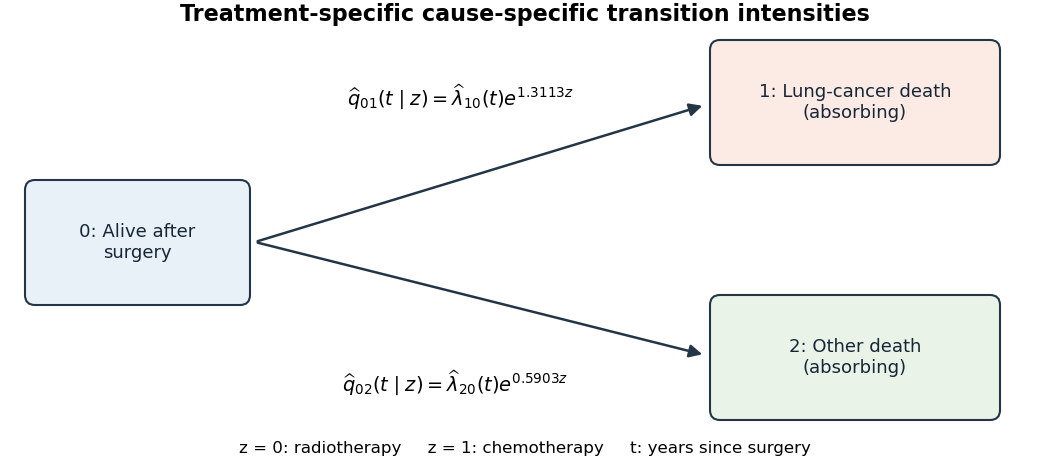

For treatment (radiotherapy) or (chemotherapy), define the transition intensityThe fitted Cox proportional-hazards models areHere and represent the estimated baseline cause-specific hazards for radiotherapy. More formally, the baseline estimates can be expressed as cumulative hazard measures with increments , rather than ordinary smooth functions. All outgoing intensities from states 1 and 2 vanish, and . The treatment hazard ratios are 3.7111 and 1.8045 respectively. This model describes the two observed causes of death, not identifiable latent failure times after death has already occurred.
Among patients still alive at the same time after surgery, chemotherapy has an estimated lung-cancer death rate 3.71 times that of radiotherapy, assuming proportional cause-specific hazards. The estimated 95% confidence interval for this hazard ratio is . Thus the fit suggests a higher instantaneous lung-cancer death rate on chemotherapy, with appreciable uncertainty in its size.
The null hypothesis of no treatment effect on that hazard is against . Its Wald test uses , approximately standard normal under the null hypothesis, with two-sided . This is evidence against equal lung-cancer death hazards in the fitted model. It is not a statement that five-year lung-cancer death probability is multiplied by 3.71 or that survival duration is divided by 3.71. The cumulative incidence function depends on both cause-specific hazards, and the model needs proportional-hazards and independent observation-censoring assumptions. In a randomised comparison the assigned treatment contrast is protected against baseline confounding, but the instantaneous comparison concerns the groups who have survived to the time in question; it does not identify a treatment effect within a common latent survivor subgroup.
Articles by others on the same topic
There are currently no matching articles.