Assume the standard canonical kinetic action . A constant field redefinition is invertible and preserves chirality. Its kinetic action differs by , whose full superspace integrals vanish up to a boundary term: a chiral or antichiral field has no independent full-superspace component. Equivalently, spacetime derivatives of a constant are zero. There is no nontrivial Jacobian for this translation of the field. Thus physical predictions are unchanged when all parameters and the coordinate of the vacuum are transformed together.
The transformed superpotential iswhere . Removing the linear term means choosing a critical point , not merely choosing while ignoring the cubic term. For ,The resulting superpotential is . Its constant term has no effect in global supersymmetry, since its chiral superspace integral is zero. It would matter in supergravity, which is not the model here.
A real shift is physically allowed, but it does not always suffice to remove the linear term. With real couplings it requires for . For example , , gives , which has no real root. A complex shift is still a valid redefinition of the complex chiral scalar and removes the term. Thus the printed instruction needs either the real-root hypothesis or permission for a complex shift.
If and , choose . If , no shift removes a nonzero ; if it is already absent. These exceptional branches will also distinguish the supersymmetry-breaking possibilities below.
Eliminating the auxiliary field gives and the nonnegative F-term scalar potentialUse after the critical-point shift, so thatThis notation keeps the original parameters distinct from the shifted mass coefficient . For real with , the real slice is . It has zero-energy minima at and , a maximum between them at with height , and grows quartically toward both ends. These statements follow by differentiating: .
When it becomes , with one degenerate zero minimum. When , it is after a permissible shift. For the real parameters with negative discriminant, the original real slice can have a positive minimum even though the full complex scalar potential has zero-energy vacua away from that slice. The sketch distinguishes these regimes:
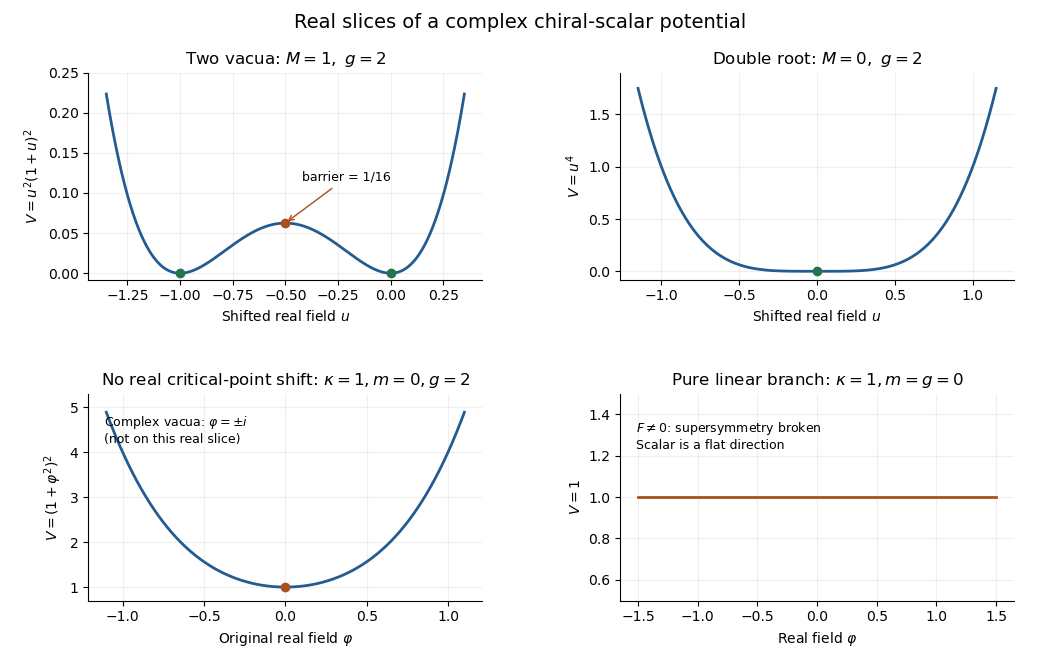
Real scalar-potential slices: two supersymmetric minima, a double root, complex vacua off the slice, and flat F-term breaking
. Details. 
The plots use illustrative normalized coefficients, not values fixed by the exam. A positive minimum on a chosen real slice is not evidence for supersymmetry breaking in the full complex field space.
A supersymmetric vacuum satisfies , equivalently , and has . For , the nonconstant quadratic has at least one complex root, including a double root when . Since the scalar is complex, these roots are admissible physical vacua whether or not they lie on the real slice. Thus supersymmetry is unbroken at either zero of . The same is true for , where is linear and has the root .
The exceptional pure-linear model has everywhere and . It exhibits flat F-term breaking with a linear superpotential: all scalar values are flat vacua but no state annihilates every supercharge. If also , the potential is identically zero and supersymmetry is unbroken on a flat moduli space.
Consequently the generic cubic or massive model does not spontaneously break supersymmetry; only the nonzero purely linear branch does in this single-field canonical model. The answer is independent of .
In the original coordinate, the possible zero-energy vacuum expectation values for areThey coincide when the discriminant vanishes. With real parameters and a nonnegative discriminant these are real; otherwise the allowed complex scalar values must be retained.
In the coordinate used to remove the linear term, the same vacua areThe nonzero branch exists in this shifted coordinate when . Let be that branch and write . Equivalently, in the original coordinate write with . The physical fluctuation field is the same. For there is the unique vacuum ; for the constant and pure-linear exceptional branches the scalar is a flat direction, with the supersymmetry status already distinguished in part (c).
Taylor expansion about any supersymmetric vacuum givesTherefore the fluctuation scalar potential isFor the nonzero vacuum in the shifted coordinate, . Thus it is also . The cubic interaction changes sign compared with expansion at the other root, whereas the quadratic mass term is the same.
The canonical complex-scalar kinetic term is . Write so that each have real canonical normalization. The quadratic potential is , giving equal squared masses for both real modes:The first equality is an algebraic square of the generally complex mass parameter; the physical squared mass is its modulus squared. In particular it is not a negative squared mass when real parameters have : the vacuum then lies off the original real slice. The constant does not enter. For this reduces to ; at a double critical point it is zero.
The remaining non-derivative component term in the Lagrangian is the Yukawa interactionEquivalently the interaction Hamiltonian has the opposite displayed sign. The first term is the two-component fermion mass, and the second its scalar-fermion interaction. A phase redefinition of makes the mass coefficient nonnegative, so the physical Weyl spinor mass isIt is again independent of , the choice of root and any sign of a real . This distinguishes the complex bilinear coefficient from the nonnegative physical mass. In the pure-linear supersymmetry-breaking branch , the fermion is the massless Goldstino.
For a nonzero common mass,This agrees with supersymmetric mass degeneracy in an unbroken chiral superfield multiplet. The two real scalar modes have the same mass as the two physical polarizations of the massive fermion, as the rest-frame multiplet construction predicts.
At both masses vanish; the numerical ratio is and is undefined, but the equality of masses still expresses the unbroken supersymmetry. Equal zero masses in the exceptional flat, pure-linear breaking model do not prove unbroken supersymmetry: there the nonzero auxiliary expectation and positive energy in part (c) are the decisive tests.
Articles by others on the same topic
There are currently no matching articles.