It is essential to distinguish a finite-dimensional spinor matrix from its action on a family of operator components. Take the Pauli matrices and in the supplied convention, with . They giveIf both displayed transformations are read literally as left multiplication on the column , expanding the operator conjugation and comparing its linear term gives the formal answer .
There is a sign inconsistency in that literal reading. With the usual angular momentum commutation relations, coefficient matrices in must satisfyIndeed, the Jacobi identity gives , whereas . The formal violates this identity. For example it would give , and ; the two sides of the Jacobi identity for are then and .
A consistent canonical column-operator convention uses the inverse adjoint action for the displayed spinor transformation, equivalently the contragredient operator-component prescription. It givesThis is the convention used for the physical states below. Reversing the adjoint action is the minimum needed sign correction in the literal column reading; a dual row notation can encode the same correction by its index contractions. The formal printed-sign coefficients are also recorded below, so the distinction is explicit rather than silently changing a convention. The representation matrices themselves remain and in Question 3: the minus sign here concerns commutators of operator components.
A supercharge is an odd Weyl spinor generator. The mixed anticommutator has one undotted and one dotted index, hence transforms as a Lorentz four-vector. In the minimal Super-Poincaré algebra, its only spacetime generator is the four-momentum, so covariance fixes it to . Normalizing the charges canonically fixes :The number two is a normalization, not something Lorentz covariance alone could fix under .
For an explicit closure calculation, use left Grassmann derivatives in superspace and the differential translation convention :Each of the two derivative-coordinate cross terms contributes ; the other terms cancel by anticommutativity. This proves the displayed coefficient. The same calculation gives and . There is no scalar central charge for a single supersymmetry label: symmetry of the anticommutator is incompatible with a term proportional only to the antisymmetric .
In the massive rest frame , the mixed relation is . These positive canonical anticommutation relations supply the input for the normalization and finite fermionic Fock space in the question-level continuation.
Write and . In the Jacobi-consistent convention just fixed,Applying the commutator product rule twice givesHere produces the constant term; moving the to the right accounts for it. ConsequentlyThus the physically consistent numerical coefficients areIf one mechanically retains the literal positive-sign column transformation instead, the coefficient tuple would be . It cannot describe a unitary multiplet with the supplied rotation algebra, by the explicit Jacobi counterexample in part (a).
Take the spin-zero Clifford vacuum , normalized to one and annihilated by the two annihilation charges. This is a lowest Fock state of a positive-mass representation, not a zero-energy vacuum annihilated by every charge. For the first one-charge state,The ladder commutators are , , , . Therefore these two states are the pair. A phase choice makes the usual positive ladder coefficient hold.
Raising the dotted index only changes the oscillator basis by the unitary antisymmetric epsilon matrix, so . Since ,The positive convention would formally label this state with while acts nontrivially on it, contradicting the highest-weight ladder rule. This supplies an independent state-level check of the needed sign correction.
The two-charge state is a rotation singlet. Indeed, using and , the product rule gives for every : only the sum of the two diagonal spinor coefficients survives, and their trace is zero. Hence the requested commutators and quantum numbers areIts squared norm is before multiplication by , by the two oscillator anticommutators.
The spin-zero massive N=1 supermultiplet therefore consists of , , and . Their spins are , all with the same mass . Starting with an even vacuum, the two spin-zero states are bosonic and the two one-charge states fermionic. They are the two real scalar degrees of freedom and the two on-shell fermion polarizations of a massive chiral multiplet. Any product of three creation charges repeats an index and vanishes; annihilation charges reduce to these four states by the canonical anticommutation relations. There are exactly four independent states.
Assume the standard canonical kinetic action . A constant field redefinition is invertible and preserves chirality. Its kinetic action differs by , whose full superspace integrals vanish up to a boundary term: a chiral or antichiral field has no independent full-superspace component. Equivalently, spacetime derivatives of a constant are zero. There is no nontrivial Jacobian for this translation of the field. Thus physical predictions are unchanged when all parameters and the coordinate of the vacuum are transformed together.
The transformed superpotential iswhere . Removing the linear term means choosing a critical point , not merely choosing while ignoring the cubic term. For ,The resulting superpotential is . Its constant term has no effect in global supersymmetry, since its chiral superspace integral is zero. It would matter in supergravity, which is not the model here.
A real shift is physically allowed, but it does not always suffice to remove the linear term. With real couplings it requires for . For example , , gives , which has no real root. A complex shift is still a valid redefinition of the complex chiral scalar and removes the term. Thus the printed instruction needs either the real-root hypothesis or permission for a complex shift.
If and , choose . If , no shift removes a nonzero ; if it is already absent. These exceptional branches will also distinguish the supersymmetry-breaking possibilities below.
Eliminating the auxiliary field gives and the nonnegative F-term scalar potentialUse after the critical-point shift, so thatThis notation keeps the original parameters distinct from the shifted mass coefficient . For real with , the real slice is . It has zero-energy minima at and , a maximum between them at with height , and grows quartically toward both ends. These statements follow by differentiating: .
When it becomes , with one degenerate zero minimum. When , it is after a permissible shift. For the real parameters with negative discriminant, the original real slice can have a positive minimum even though the full complex scalar potential has zero-energy vacua away from that slice. The sketch distinguishes these regimes:
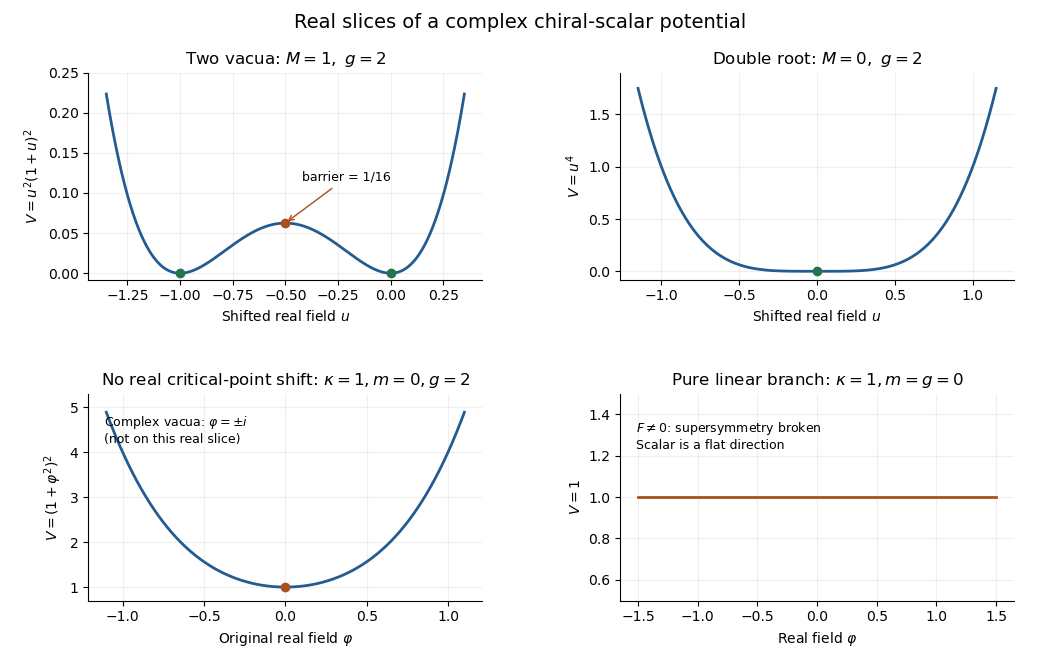
Real scalar-potential slices: two supersymmetric minima, a double root, complex vacua off the slice, and flat F-term breaking
. Details. 
The plots use illustrative normalized coefficients, not values fixed by the exam. A positive minimum on a chosen real slice is not evidence for supersymmetry breaking in the full complex field space.
A supersymmetric vacuum satisfies , equivalently , and has . For , the nonconstant quadratic has at least one complex root, including a double root when . Since the scalar is complex, these roots are admissible physical vacua whether or not they lie on the real slice. Thus supersymmetry is unbroken at either zero of . The same is true for , where is linear and has the root .
The exceptional pure-linear model has everywhere and . It exhibits flat F-term breaking with a linear superpotential: all scalar values are flat vacua but no state annihilates every supercharge. If also , the potential is identically zero and supersymmetry is unbroken on a flat moduli space.
Consequently the generic cubic or massive model does not spontaneously break supersymmetry; only the nonzero purely linear branch does in this single-field canonical model. The answer is independent of .
In the original coordinate, the possible zero-energy vacuum expectation values for areThey coincide when the discriminant vanishes. With real parameters and a nonnegative discriminant these are real; otherwise the allowed complex scalar values must be retained.
In the coordinate used to remove the linear term, the same vacua areThe nonzero branch exists in this shifted coordinate when . Let be that branch and write . Equivalently, in the original coordinate write with . The physical fluctuation field is the same. For there is the unique vacuum ; for the constant and pure-linear exceptional branches the scalar is a flat direction, with the supersymmetry status already distinguished in part (c).
Taylor expansion about any supersymmetric vacuum givesTherefore the fluctuation scalar potential isFor the nonzero vacuum in the shifted coordinate, . Thus it is also . The cubic interaction changes sign compared with expansion at the other root, whereas the quadratic mass term is the same.
The canonical complex-scalar kinetic term is . Write so that each have real canonical normalization. The quadratic potential is , giving equal squared masses for both real modes:The first equality is an algebraic square of the generally complex mass parameter; the physical squared mass is its modulus squared. In particular it is not a negative squared mass when real parameters have : the vacuum then lies off the original real slice. The constant does not enter. For this reduces to ; at a double critical point it is zero.
The remaining non-derivative component term in the Lagrangian is the Yukawa interactionEquivalently the interaction Hamiltonian has the opposite displayed sign. The first term is the two-component fermion mass, and the second its scalar-fermion interaction. A phase redefinition of makes the mass coefficient nonnegative, so the physical Weyl spinor mass isIt is again independent of , the choice of root and any sign of a real . This distinguishes the complex bilinear coefficient from the nonnegative physical mass. In the pure-linear supersymmetry-breaking branch , the fermion is the massless Goldstino.
For a nonzero common mass,This agrees with supersymmetric mass degeneracy in an unbroken chiral superfield multiplet. The two real scalar modes have the same mass as the two physical polarizations of the massive fermion, as the rest-frame multiplet construction predicts.
At both masses vanish; the numerical ratio is and is undefined, but the equality of masses still expresses the unbroken supersymmetry. Equal zero masses in the exceptional flat, pure-linear breaking model do not prove unbroken supersymmetry: there the nonzero auxiliary expectation and positive energy in part (c) are the decisive tests.
First use the actual PDF boost bracket ; replacing the final by , as the TeX transcription does, would be a different and incorrect algebra. Expanding the three brackets yieldsThusThe two sets have SU(2)-type brackets. Their compact real form exponentiates to , whereas their full complexification exponentiates to . This does not turn the physical real Lorentz group into a compact product. With Hermitian , , and the two factors are tied by the Lorentz reality condition; the connected physical spin cover is .
For the right-handed spinor representation, the supplied sigma formula gives and . ThereforeIt is the representation in this definition of . These are finite-dimensional representation matrices; the boosts are not Hermitian for a positive-definite spinor inner product, as expected for a noncompact group. They are distinct from the operator-component commutator coefficients discussed in Question 1.
For the group map, encode a real Minkowski vector by the Hermitian matrixThe trace identity recovers its contravariant components. For , is Hermitian and has the same determinant. Expanding in that basis givesThe coefficients are real because the trace of a product of Hermitian matrices is real. Equality of determinants for all proves . The action for is the composition of the two actions, proving the homomorphism law.
Since is connected and the identity maps to the identity, its image has determinant and preserves time orientation. More directly, positive-definite matrices representing future timelike vectors remain positive definite under . The kernel is : if every Hermitian is fixed, first makes unitary, and then commutation with all Hermitian matrices makes it a scalar with determinant one.
Conversely, gives every spatial rotation, and positive Hermitian determinant-one matrices give every pure boost. Rotation-boost decomposition yields every proper orthochronous Lorentz transformation. Thus the formula gives the Lorentz spinor double coverIt is a map into as asked, with precisely its identity component as image; it does not produce disconnected time-reversing transformations.
The Weyl fields have odd Grassmann parity. With the given epsilon convention, write and , where all four components anticommute. Raising an index gives and . HenceThe minus sign from the antisymmetric epsilon tensor is canceled by exchanging the two Grassmann-odd components. Therefore the Weyl spinor bilinear exchange identity isFor commuting numerical spinors the exchange sign would instead be negative. The answer here uses fermionic Weyl fields, as appropriate to the supersymmetric model.
Use the same four Grassmann generators and a fixed order . Their squares vanish, soMeanwhile the two self-contractions areand moving the pair past gives no sign, yielding . Thus the square of a Weyl spinor bilinear isThe order of individual odd components, rather than an informal commuting-spinor substitution, fixes this sign. For commuting spinors both self-contractions vanish, so no corresponding universal factorization of the generally nonzero mixed square is possible.
Articles by others on the same topic
There are currently no matching articles.