Use the metric signature , so , and the weight . The momentum-space Feynman rules for the massless Phi-fourth theory are: an internal scalar line contributes ; a quartic interaction vertex contributes with its momentum-conservation delta function; every independent loop is integrated with ; and each graph is multiplied by its Feynman-diagram symmetry factor. All external momenta can be taken incoming. These rules follow by expanding the interaction exponential and contracting free fields with the Wick theorem.
For a connected graph with internal lines, interaction vertices and loops,Here is the superficial degree of divergence. In four dimensions,Odd vanish by Z2 symmetry. Thus only the nonvacuum two-point and four-point one-particle-irreducible Feynman diagrams can have overall ultraviolet divergences: degree two for , degree zero for . Vacuum graphs with may also diverge but cancel from normalized correlators. This is an overall power-counting statement; subgraphs must be subtracted before using it to conclude finiteness for .
For the full one-particle-irreducible vertices, the tree-level quadratic kernel and quartic interaction giveIf is instead reserved for interaction-generated self-energy insertions, its tree value is zero and is displayed separately as the free inverse kernel. The distinction is only that convention; the loop insertions below are unchanged.
The requested one-loop diagrams are the two-point tadpole diagram and the three four-point bubble diagrams. Each has symmetry factor . The three bubble channels correspond to , , .
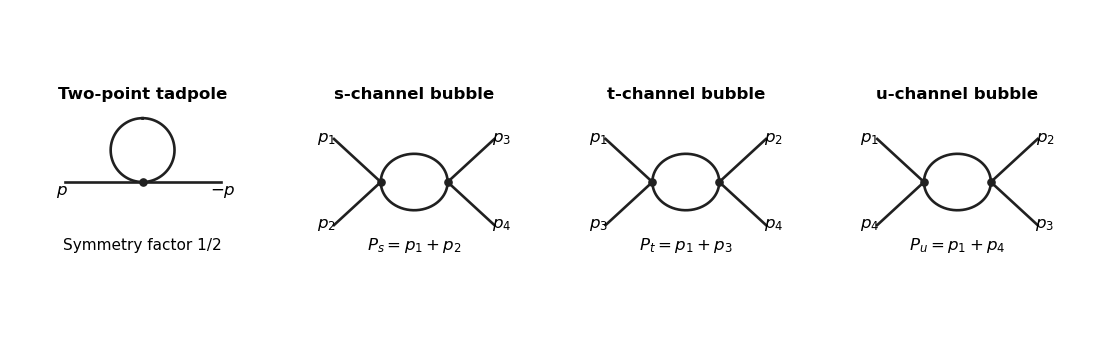

The tadpole insertion obeysIn massless dimensional regularization this scaleless integral is zero. A mass or cutoff regulator exposes the ultraviolet divergence allowed by power counting; its vanishing in the scaleless convention does not remove the need to include this diagram.
For a bubble, the vertex and quantum field theory propagator factors give . The PDF defines with the factor outside the Minkowski integral, so the integral itself is . ThereforeThe converted TeX misplaces this as though it were part of the exponent of ; keeping the printed is essential to this real pole coefficient.
For nonexceptional Euclidean external momentum, Wick rotation cancels that factor . Use a Feynman parameter and translate the integration variable:For example, represent the inverse square as , do the Gaussian momentum integral, and then use the Gamma function. This also derives the formula rather than assuming a loop-integration table. At , and the parameter integral tends to one, givingTake before continuation back to Minkowski momenta. At , a massless scaleless integral mixes ultraviolet and infrared issues, so it cannot be used to read off this pole.
Introduce a renormalization scale and a quartic counterterm. With denoting a dimensionless renormalized coupling constant,After factoring out from the vertex, each loop contains . The counterterm contributes to and cancels the pole from all three channels. More explicitly,In modified minimal subtraction, replace the pole-only counterterm bywhich subtracts the first three terms inside the brackets. The finite renormalized quartic scalar vertex is thenAnother renormalization condition can change the finite constant, but not the pole cancellation or the momentum-dependent logarithms. The corresponding timelike expressions follow by the same Feynman continuation.
Articles by others on the same topic
There are currently no matching articles.