Axisymmetry preserves the horizon, so the axial Killing vector field is tangent to it, so its null normal obeys and . Therefore andThus there. A generator has , , making its angular velocity relative to the nonrotating stationary frame at infinity. For Kerr it is the Kerr horizon angular velocity ; the argument itself is not Kerr-specific.
For nonzero , requires , . Oblate Cartesian coordinates satisfy , , so this is the Kerr ring singularity of radius . Curvature components and generic invariants diverge there. The whole surface is not singular: away from the ring it is a disk through which the extension continues to a sheet with . This oblate radial parameter is not a nonnegative Euclidean distance.
In units, . Horizon candidates solve , giving . For , equivalently , there are no real roots. The over-rotating Kerr solution has no event horizon hiding its naked ring singularity. The term black hole in this regime names the Kerr family, not a hidden-singularity black hole.
The periodic axial orbits have norm . On the equator,Thus a neighborhood on the negative sheet has . A fixed- curve running once around periodic is a closed timelike curve: its timelike tangent returns to the same event.
No horizon in the over-rotating solution prevents passage from positive- infinity through the nonsingular disk to this region. Timelike periodic axial orbits provide the time-machine mechanism. This property of the analytic solution does not establish that such a naked geometry can be manufactured stably from generic regular collapse, as envisaged by the weak cosmic censorship conjecture.
An ergoregion of a stationary spacetime is where the stationary Killing vector field, normalized as time translation at infinity, is spacelike; a fixed-coordinate stationary observer cannot remain timelike there. For the Kerr metric, , so the outer stationary-limit surface isFor a subextremal rotating hole , with equality only at the poles. At the equator . The ergosphere touches the horizon on the rotation axis and is outside it elsewhere. Its boundary is not the horizon, whose generator is .
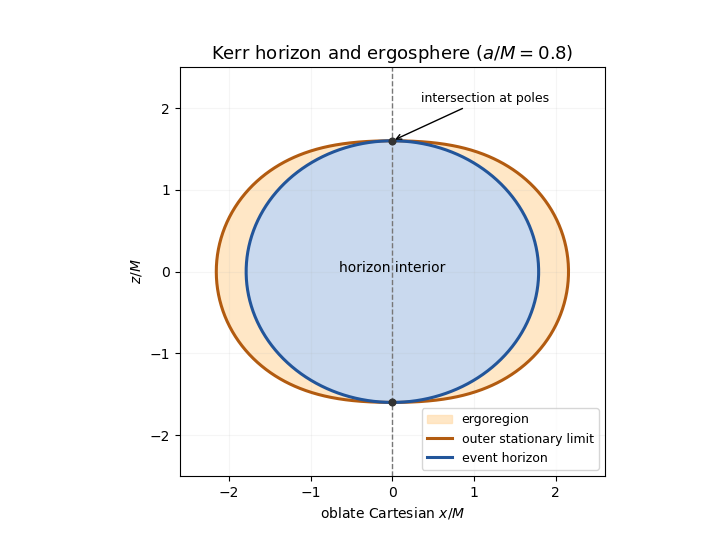
Kerr horizon and outer stationary-limit surface in an oblate-coordinate meridional sketch
. Details. The drawing uses oblate Cartesian coordinates to display the intersection and is not an isometric embedding of the spatial geometry.
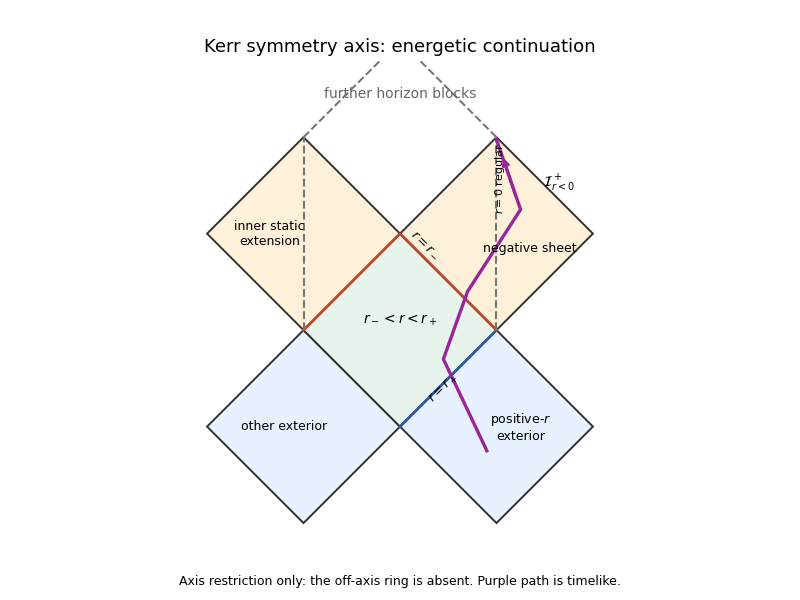
Choose spin orientation so that ; the printed threshold assumes nonzero positive . Put and . The axial metric has components and determinant . Conserved energy and timelike normalization giveEliminating gives the Kerr axial timelike effective potentialIt extends through the zeros of in the regular original coordinates. Since , reaching zero requires . At equality the infalling orbit reaches zero with zero radial velocity and turns back, because the nearby negative sheet is forbidden. Along the axis zero is regular, unlike the off-axis ring.
For , and the global maximum is . If , an inward particle has no negative-sheet turning point. It passes through zero and continues toward , another asymptotically flat end, with and infinite proper time to infinity. It first crosses the outer and inner horizons. Perturbative Cauchy-horizon instability can invalidate this ideal Kerr axial analytic extension physically.


Articles by others on the same topic
There are currently no matching articles.