Let be the hydrogen mass fraction, the gravitating gas fraction, and the total-particle-to-hydrogen ratio. The optically thin gas cooling time and free-fall time of a uniform sphere arewhere . Equating them gives the cooling-to-free-fall equality curve:At fixed composition, its shape is . Gas above this curve cools faster than it falls; gas below it cools more slowly. Strong line cooling produces a deep low-density trough. In the high-temperature free-free regime, gives .
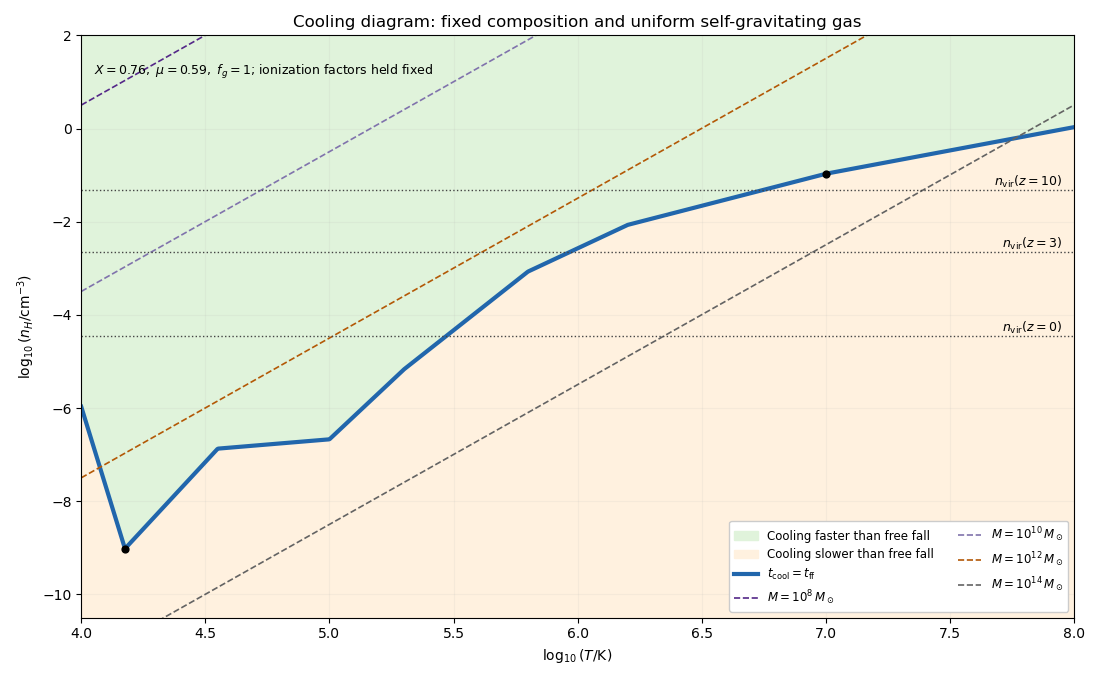
Cooling versus free-fall diagram with uniform-cloud virial mass contours and illustrative virial densities
. Details. 
The displayed uniform self-gravitating-cloud example uses , , and . Holding these ionized-gas factors fixed makes the diagram transparent, but near the atomic threshold their actual temperature dependence changes numerical normalizations. With these conventions the supplied cooling values imply and . For gas supported in a dark-matter-dominated dark matter halo, take : at fixed the free-fall time of a uniform sphere is shorter and the critical curve shifts upward by .
To add virial mass contours in a cooling diagram, use the uniform self-gravitating sphere consistently. Its Newtonian gravitational potential energy is and its thermal kinetic energy is . The virial theorem gives , while . Eliminating givesThus constant total gravitating mass gives slope three in the logarithmic density-temperature plane, with larger mass contours lying at smaller density. A different density profile changes the structural coefficient; the customary halo temperature scale shifts the mass contours but preserves their slopes. The horizontal illustrative formation-density lines are , using . They show why increasing formation cosmological redshift helps gas reach the rapid-cooling region.
At the low-mass end, a dark matter halo's virial temperature may not reach the atomic threshold. The atomic and molecular cooling thresholds for galaxy formation therefore favor an atomic-cooling mass of order at early formation epochs, with its precise value varying as approximately . Smaller primordial systems require molecules; photoheating and stellar feedback further suppress their luminous output.
At the high-mass end, the virial temperature at a fixed assembly density scales as . Beyond the line-cooling interval the gas becomes increasingly hot, while thermal bremsstrahlung improves only as . Hence at fixed assembly density in that regime. Large systems can remain pressure-supported hot atmospheres for many dynamical times, instead of promptly fragmenting into one stellar object. This is the upper galaxy mass from gas cooling: it associates efficient condensation with roughly galactic, rather than group or cluster, masses and motivates the broad – interval.
The diagram gives characteristic cooling scales, not exact universal mass bounds. Density profiles, gas fraction, enrichment and formation epoch move the boundaries; the two supplied values alone do not determine a complete numerical cutoff. Some gas can cool in dense cores of larger dark-matter haloes, early smaller progenitors can form stars before merging, and subsequent galaxy mergers can assemble more massive galaxies. Long-lived hot atmospheres also require heating to prevent excessive late-time cooling. These qualifications explain why the cooling criterion for galaxy formation is useful without equating each dark dark matter halo to one galaxy.
Articles by others on the same topic
There are currently no matching articles.