Put and prepare control qubits in and the target in the supplied eigenstate . Apply a Hadamard gate to every control qubit. Let denote the integer encoded in that quantum register.
For every , apply a controlled unitary gate with control and the same target. The quantum phase kickback yieldsApplying to the controls therefore produces exactly. A computational-basis measurement returns with certainty, and the algorithm outputsThis is exact quantum phase estimation; exactness uses the finite dyadic phase promise, not a rounding argument.
Only a controlled-U gate is supplied as a primitive. Its repetitions implement controlled-, so the total number of black-box uses is . Access to powers as unit-cost primitives would be a different quantum query complexity model. This distinction is the cost of exact phase estimation on a dyadic spectrum.
The quantum circuit has one control wire per binary digit and one target quantum register. Every control starts in , receives a Hadamard gate, controls the corresponding power , and then enters the collective inverse quantum Fourier transform. Only the control register is measured; the target stays in .
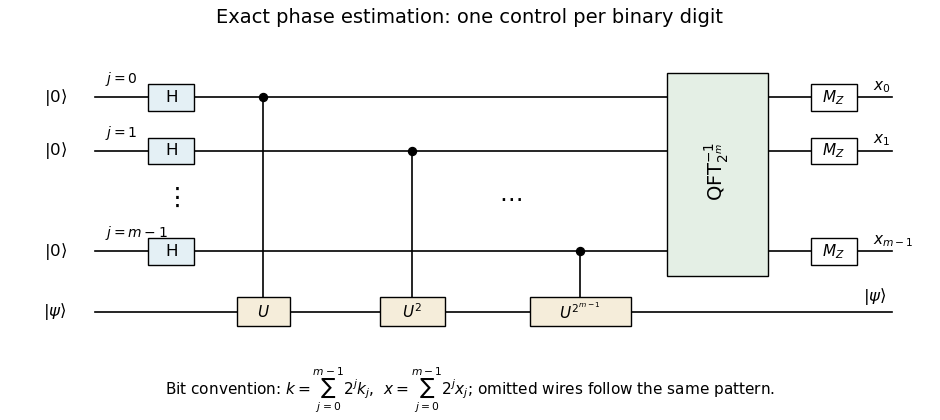
Exact dyadic phase-estimation circuit with controlled powers, inverse Fourier transform, and little-endian output bits
. Details. 
The omitted intermediate wires continue the pattern . The inverse quantum Fourier transform black box is defined on the integer basis with , so the displayed ordering introduces no hidden bit reversal. The measured bits satisfyEach controlled power box represents sequential controlled- uses when only that primitive is available.
Let . In terms of the Pauli X gate, the given unitary operator is , with and . Since and ,Thus the normalized eigenvectors are , with eigenvalues and respectively. At they coincide as eigenvalues, and the whole two-dimensional Hilbert space is the eigenspace; the same chosen eigenbasis remains valid.
Prepare independently of and use the exact quantum phase estimation circuit of the preceding parts on the controlled- black box. It returns exactly usingThe chosen eigenstate contains all the unknown phase information, unlike , whose eigenvalue is independent of .
Again put , . If computational strings differ in places, the matrix element of between them is : an unchanged bit contributes , and a flipped bit contributes . Hence the given operator isThe printed factored expression is undefined at , namely . Its polynomial form gives the natural continuous extension there, . For the strict promise avoids that singular value; for the extension is needed to include the allowed phase . This is a removable defect of the formula, not a failure of unitarity of the tensor-product operator.
Prepare . Its eigenvalue is , giving tensor-product eigenphase amplification. Write . If , thenwhere the upper bound is exactly the promise . Thus the amplified phase has only unknown binary digits and no modulo-one aliasing. Run exact quantum phase estimation with controls on the controlled- black box. It returns exactly, after which division by the original recovers .
The number of joint black-box uses isIf , the dyadic promise and force , so output without querying the oracle. This covers the zero-control edge case without an invalid negative number of phase bits. The improvement counts one supplied controlled- call as one query. Implementing such a joint call from individual controlled- calls would remove the claimed factor- primitive-query saving, and preparing the target qubits is a separate gate cost.
Articles by others on the same topic
There are currently no matching articles.