Let and introduce positions relative to the centre of mass, . The definition gives , and differentiation gives . Expand the total kinetic energy:The cross term vanishes. This proves the kinetic energy decomposition about the center of mass:The decomposition itself holds without rigidity.
For a rigid body rotating about its centre of mass, . With unit axis vector , the moment of inertia about that axis iswhere is the perpendicular distance from the axis. Therefore
Use the arch geometry of two hinged rods sliding on a floor, with and on the other side of . As long as remains in contact with the floor,The centres of mass of the two rods are and . Their squared speeds are respectively and . Each uniform rod has moment of inertia about its midpoint, and their angular velocities are and . Applying the kinetic energy decomposition about the center of mass to each rod givesThe gravitational potential energy is . The fixed pivot does no work; neither does the frictionless floor reaction while slides horizontally. Conservation of energy from rest therefore givesOn the falling branch is the negative square root. Just before the hinge reaches the floor, , and its speed is . Thus, under the maintained-contact interpretation,
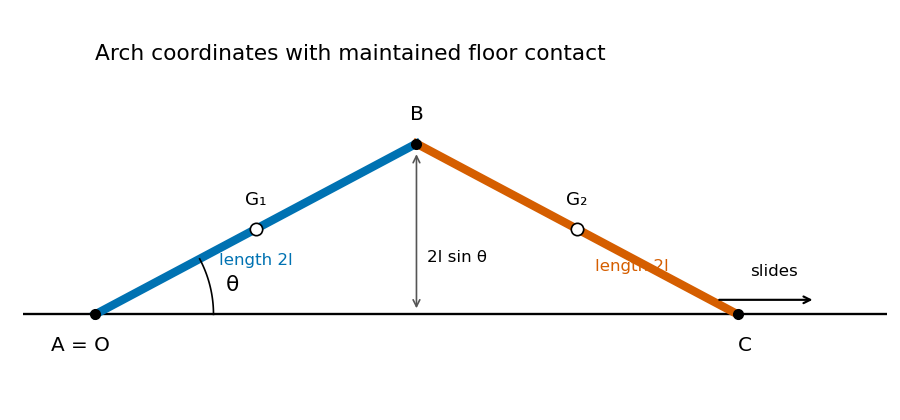
There is a contact hypothesis behind this calculation. A floor can push upward but cannot pull downward. For and , the required normal reaction at , found from the second rod's linear and angular equations, isFor the usual acute arch, this stays nonnegative throughout exactly when . Indeed, for , its nonnegativity is , whose minimum is at . For larger initial angles, the endpoint lifts before the hinge hits the floor, and the one-coordinate formula no longer governs the whole motion. The displayed impact speed is the intended floor-constrained answer; for unrestricted initial angles, maintained contact is an additional assumption. Subsequent free motion and possible reimpact would require a different model and contact/impact conditions.
Articles by others on the same topic
There are currently no matching articles.