If , the family of proper containing half-spaces is empty and its intersection is, by convention, . If , every closed half-space contains it and their intersection is empty. Now suppose is a nonempty proper closed convex set. Take and let be its Euclidean projection onto a convex set. This projection exists: a minimizing sequence can be restricted to a bounded ball, and closedness gives attainment. It is unique by convexity and strict convexity of squared distance.
For , the segment remains in for . Minimality at impliesThus the closed half-space contains but excludes , since . Every point outside is excluded by at least one containing half-space. The reverse inclusion is immediate, givingThis is the half-space representation of a closed convex set. The argument gives an explicit separating hyperplane rather than just citing a Hahn-Banach separation theorem.
For an extended-real function define its Fenchel conjugate by and its biconjugate by . The Fenchel-Moreau theorem states, in the standard proper-envelope setting,Here the right side is the largest lower semicontinuous convex function below , equivalently the function whose epigraph is the closed convex hull of . It is enough to assume is proper and has an affine minorant, ensuring this envelope is proper. In particular, for a proper convex function that is lower semicontinuous, .
First, by the definition of the convex conjugate. The biconjugate is a supremum of continuous affine functions, so it is convex, lower semicontinuous and no greater than . Second, the best intercept for an affine minorant with slope is : for all precisely when . Thus is the supremum of all affine minorants.
To prove that no part of the closed convex envelope is missed, set . The half-space representation of a closed convex set from part (a), applied in , separates any from by an inequality . Because is upward closed, . If , division by gives an affine minorant with .
A vertical separator has . Let be an existing affine minorant. Combine with to obtainSince , a sufficiently small positive makes this affine function exceed . Thus vertical half-spaces can be approximated by nonvertical epigraph supports. Every point below the envelope is excluded by an affine minorant, so the supremum of these minorants is exactly the envelope. This is the decisive use of part (a).
Properness and the minorant convention matter for unrestricted extended-real functions. For example, on has no affine minorant; and . With the corresponding improper-envelope convention its closed convex envelope is also . The theorem should not silently describe such an envelope as proper. The identically function is another degenerate case, handled separately by extended-real conventions.
The conjugate of an infimal convolution is the sum of the conjugates:Here , and , the indicator functional of the unit infinity-norm ball. ThusThe infimal convolution is finite convex and continuous, so the Fenchel-Moreau theorem applies without a closure defect. By equality in the Fenchel–Young inequality and the subdifferential sum rule,This is precisely the variational characterization of projecting onto the cube. ConsequentlyFor the primal split, and . These directly minimize the two scalar terms. The Huber loss is continuously differentiable, including at , but its second derivative changes there. The one-dimensional sketch shows a quadratic center joined tangentially to linear tails:
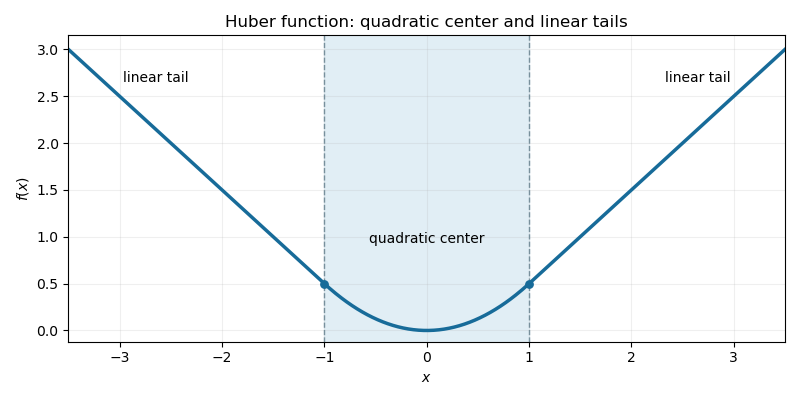

Applied to a discrete gradient, the Huber gradient regularizer penalizes small slopes quadratically and large slopes linearly. Compared with pure squared-gradient smoothing it preserves large edges better; compared with pure total variation denoising it encourages small smooth variations and reduces the strong preference for piecewise-constant plateaus. It can therefore be useful for denoising signals or images containing both smooth regions and sharp transitions. It still penalizes edges and can bias their amplitude, and it does not guarantee complete elimination of staircasing in total variation denoising. The unit threshold must be scaled appropriately for data units and grid spacing.
Articles by others on the same topic
There are currently no matching articles.