Let the actual dimensional thickness be , and let increase downward. The leading curvature of the outer free surface isThe Young–Laplace equation gives . In the lubrication approximation, the downward velocity at distance from the wall is , from no slip and zero free-surface shear. Integrating this profile givesCircumferential corrections are higher order in , so volume conservation is at leading order. DefineThen the thin liquid film on a vertical cylinder satisfiesThe circumferential-curvature term is retained along with axial curvature.
The perturbation calculation givesLong waves with grow, while decay; the fastest growth is at . Disturbances drift downward at speed . The dimensional unstable wavelengths exceed , with most unstable wavelength . This is the thin-film version of the Rayleigh–Plateau instability driven by circumferential curvature and opposed by short-wave axial curvature.
For a travelling wave, one integration fixed by givesor . In the large positive-speed core, substitute the expansion using the supplied assumptions. The left side at order is , while the gravity term is order one and is only order . Thus . Its general solution is a constant plus a sine and cosine. The vanishing leading height and slope at both endpoints selectThe core length is in the axial coordinate; its amplitude is fixed by transition matching.
At either edge set , with at the trailing edge and at the leading edge. Keeping the height of order one, the exact wave equation becomesThus the transition equation is . Its linearization about has exponents and . Behind the pulse, approaching the uniform film as permits only the positive real exponent. The positive-growing, nontrivial branch has one amplitude that is removed by translation, giving the relevant unique . In front, decay as permits the two real oscillatory amplitudes; translation removes one parameter and leaves a one-parameter family . These are the unstable manifold and stable manifold dimensions for the transition system. The literal boundary condition also admits the constant solution and an opposite departing branch, so uniqueness here is specifically for the branch matching a raised positive pulse.
Match the supplied trailing quadratic asymptotic to the core near zero. It gives , because . The leading maximum occurs at , soThe front tail has the form . Its capillary waves occur ahead of the descending pulse, not behind it; the trailing tail is monotone to leading order. Converting its frequency to physical distance gives
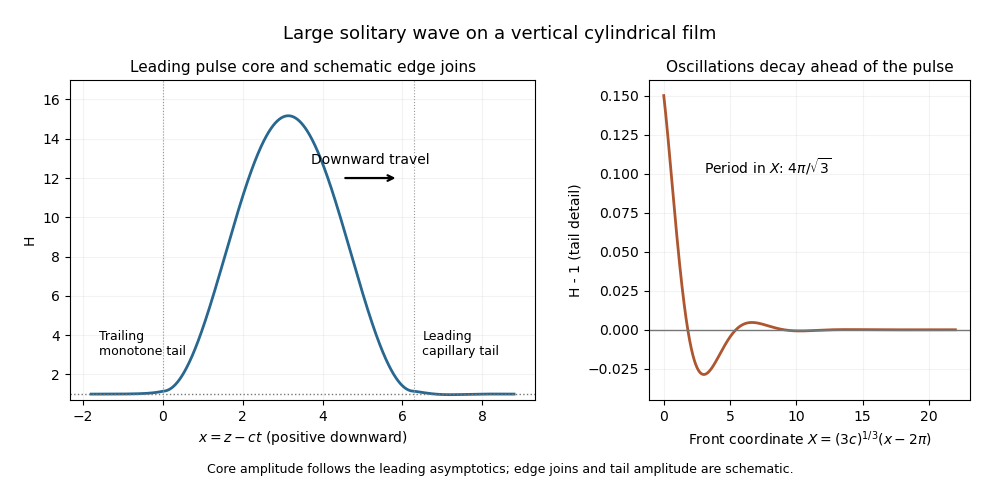
Large solitary pulse on a vertical cylindrical film, with a monotone trailing approach and damped capillary waves ahead
. Details. 
This large solitary pulse on a cylindrical film sketch shows the leading core and the front-tail eigenmodes; the edge transitions are schematic and the ringing is enlarged for visibility. The thin-film asymptotics require both and , rather than taking speed to infinity at fixed film slenderness.
At the next core order, . Integrating and imposing zero at both endpoints givesThe constants in the two quadratic transition asymptotics match the core endpoint heights: and . Hence , and the dimensional uniform thickness selected by matching isWith the supplied constants this fixes ; is not separately fixed by these height conditions. The thickness selection and capillary wavelength follow from matched asymptotic expansion, not from the linear instability calculation.
Articles by others on the same topic
There are currently no matching articles.