The Young–Laplace equation relates the pressure jump across a stationary interface to its curvature and surface tension. Choose a unit normal vector pointing from the inside region to the outside region, and define to be positive for a convex sphere. In mechanical equilibrium, with constant surface tension and no additional normal viscous stresses,Here are the signed principal curvatures in this convention. Their sum is twice the corresponding signed mean curvature; stating the convention prevents a factor-of-two ambiguity. The Young–Laplace equation is a local normal stress balance for one interface. [ref]
https://arxiv.org/html/2011.11403v2. Tomas Bohr and Bernhard Scheichl, Surface Tension and Energy Conservation in a Moving Fluid, equations (8)–(9)
A spherical liquid droplet of radius in a gas has one interface, with . An ideal thin soap bubble has two liquid–gas interfaces. Adding their pressure jumps givesFor the soap bubble, now means the inner gas pressure minus the outer gas pressure. The second formula assumes equal surface tensions on both faces and film thickness negligible relative to , so their radii can be identified. Retaining distinct radii gives . A gas bubble inside bulk liquid has only one interface and therefore uses . [ref]
With the assumed constant toy surface tension , a droplet with has excess pressure ; at it has . A thin soap bubble assigned the same and has excess pressure . These are differences from the surrounding pressure, rather than absolute pressures. Halving the radius doubles the capillary pressure; doubling the interface count also doubles it at fixed radius and surface tension.
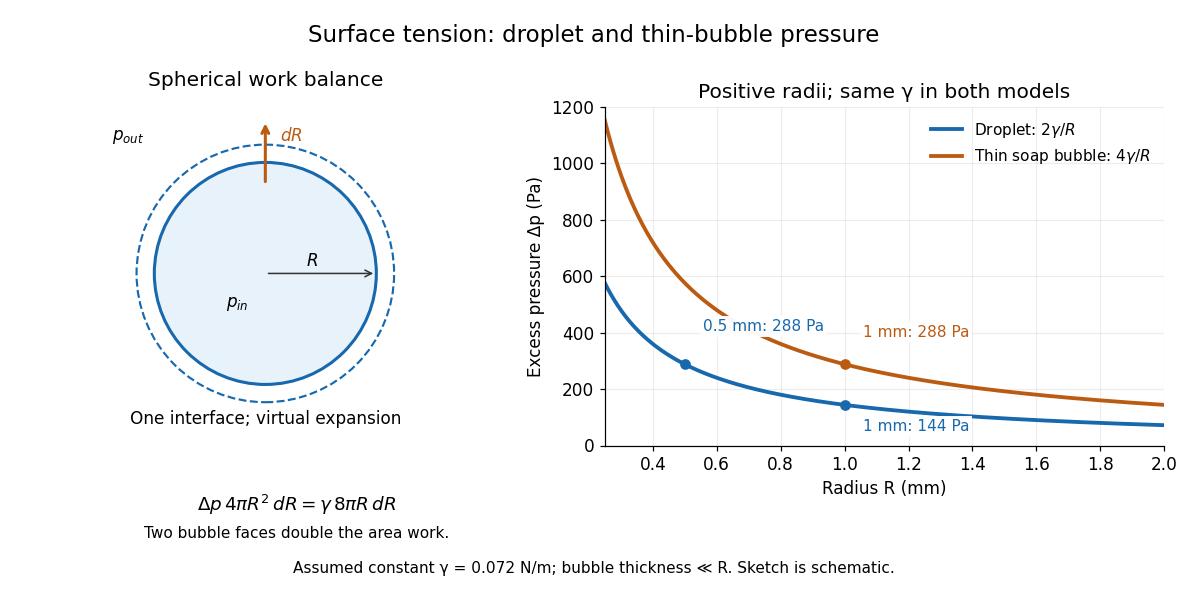
Smaller droplets need larger excess pressure; two bubble interfaces double it
. Left: a virtual outward displacement of a sphere balances pressure work against increased surface energy. Right: excess pressure in pascals versus positive radius in millimetres for one and two interfaces, using the assumed constant toy . Details.The spherical case has a short work argument. A virtual increase in radius gives and . At mechanical equilibrium, the net pressure work balances the increase in surface energy:For a thin soap bubble, both interfaces gain approximately the same surface area, doubling the right-hand side and giving . This is a virtual work balance between neighboring spherical configurations, rather than an assumption that a fixed-volume droplet actually expands. The general Young–Laplace equation replaces the spherical area-to-volume ratio by local curvature, making geometry directly measurable through pressure.
The Gibbs--Thomson relation shifts the equilibrium chemical potential or composition at a curved interface by an amount proportional to its mean curvature. Small droplets therefore have a larger equilibrium solubility than flat interfaces.
Curvature depresses the equilibrium melting temperature of solid convex into liquid. Here is the sum of principal curvatures, equal to twice a common convention for mean curvature, and is absolute temperature. The coefficient uses solid-liquid surface energy, mass density and latent heat. This stabilizes fine corrugations of a solidification front.
Articles by others on the same topic


The Young–Laplace equation describes the pressure difference across the interface of a curved liquid surface due to surface tension. It is a fundamental equation in fluid mechanics that quantifies how curvature affects the pressure inside and outside a liquid droplet or bubble.