The strong law for Brownian motion says almost surely. For sufficiently large , therefore , givingThus has finite terminal quadratic variation. Stopping when its bracket reaches each integer makes it an -bounded martingale, which converges by the martingale convergence theorem. Patching these limits shows thatis a well-defined finite almost sure limit. This construction uses local square integrability; a global bound is not required.
Conditional on the entire path, the independent Brownian motion still supplies a centered Gaussian stochastic integral, with variance . The conditionally Gaussian stochastic integral with an independent integrator therefore has no atoms, even after averaging over .
Also almost surely. For each fixed , the relation then gives, outside the null event ,Part (b) identifies the cumulative distribution:Hence has the Standard Cauchy distribution. This establishes the Cauchy law of an infinite-horizon Brownian exponential integral.
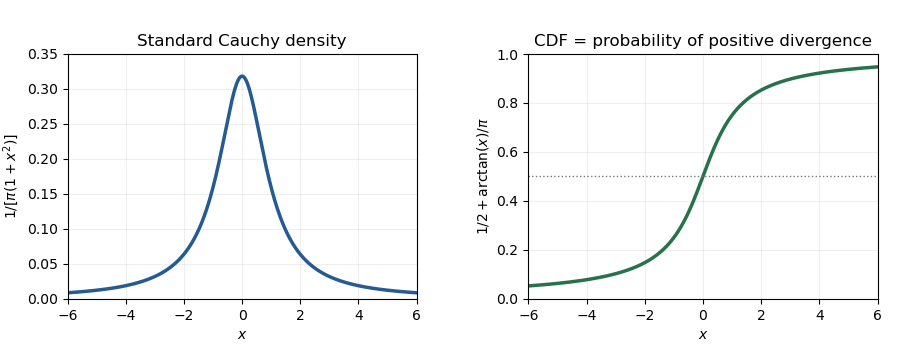
Standard Cauchy density and cumulative distribution, with the latter equal to the positive-divergence probability
. Details. 
Articles by others on the same topic
There are currently no matching articles.