Put and . The Itô formula gives . The independence of the two Brownian motions gives , so the product formula yieldsFor , and . The drift terms cancel in the Itô formula:Define the rotated stochastic integralIt is a continuous local martingale withThe Lévy characterization of Brownian motion makes a Brownian motion. Since and ,This is the arctangent transform of a two-noise affine diffusion.
The angle is a bounded local martingale, hence a uniformly integrable martingale. The martingale convergence theorem gives an almost sure and limit withIt must lie at an endpoint. Indeed, the Itô isometry and boundedness giveThus the bracket integral is finite almost surely. If the angle converged to an interior point, its squared cosine would eventually be bounded below by a positive constant, forcing this integral to be infinite. ConsequentlyThis proves endpoint convergence of a bounded angle diffusion.
The strong law for Brownian motion says almost surely. For sufficiently large , therefore , givingThus has finite terminal quadratic variation. Stopping when its bracket reaches each integer makes it an -bounded martingale, which converges by the martingale convergence theorem. Patching these limits shows thatis a well-defined finite almost sure limit. This construction uses local square integrability; a global bound is not required.
Conditional on the entire path, the independent Brownian motion still supplies a centered Gaussian stochastic integral, with variance . The conditionally Gaussian stochastic integral with an independent integrator therefore has no atoms, even after averaging over .
Also almost surely. For each fixed , the relation then gives, outside the null event ,Part (b) identifies the cumulative distribution:Hence has the Standard Cauchy distribution. This establishes the Cauchy law of an infinite-horizon Brownian exponential integral.
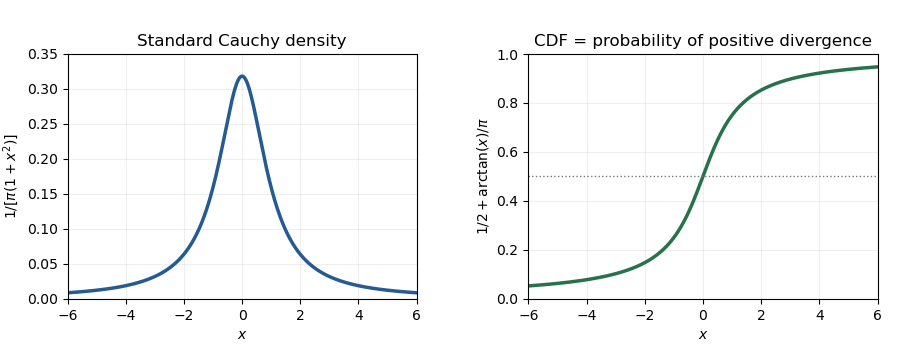
Standard Cauchy density and cumulative distribution, with the latter equal to the positive-divergence probability
. Details. 
Articles by others on the same topic
There are currently no matching articles.