Write for the quadratic variation and setThe Hölder factorization of stochastic exponentials follows by adding exponents:ThusThe subtraction inside the numerator is , outside the square root.
The stochastic exponential starts at one and is a nonnegative local martingale, hence a supermartingale. The optional sampling theorem for a supermartingale gives expectation at most one at bounded stopping times. For a finite, possibly unbounded, stopping time , apply this to , then use continuity and the Fatou lemma:The Holder inequality with exponents and now givesThe inequality also holds when the right side is infinite.
The increasing quadratic variation has a limit in . Since has a finite limit, the exponentials have limits too, with value zero when the bracket is infinite. Expanding exponents provesbecause the coefficient of on the right isand the bracket coefficient is . Taking limits preserves the identity, including the zero case.
Let , , and . The Holder inequality first yieldsWhen is finite, apply the Jensen inequality to the concave function :Since , rearrangement gives the terminal scaling inequality for stochastic exponentialsHere . If the last exponential moment is infinite, the bound has no positive content; the finite-moment form is the one used below.
Let , with ranging over finite stopping times. To locate the half-threshold for the exponential-martingale Hölder bound, put . Since is increasing for ,On the other hand, taking and gives as . Hence
Fix . Choose with , and put . Part (a) and the Jensen inequality give, for every finite stopping time,Thus the entire stopped family has a uniform bound for some . By uniform integrability from an Lp bound, it is uniformly integrable.
To check that this local martingale is a true martingale, stop it by a localizing sequence. At each fixed time the stopped variables are uniformly integrable by the same bound; taking limits in their conditional martingale identities proves the unstopped identity. The uniform bound over all finite stopping times then makes it a uniformly integrable martingale, with terminal expectation one. Therefore
Use deterministic times tending to infinity and the Fatou lemma:Apply the terminal scaling inequality for stochastic exponentials to and . Part (c) gives , soLetting shows that the terminal expectation is at least one. The nonnegative local martingale starts at one and is a supermartingale, so the Fatou lemma gives the opposite inequality. Consequently
The terminal expectation criterion for a nonnegative local martingale now closes the argument. Conditional Fatou lemma applied to the supermartingale at times tending to infinity givesThe left side has expectation one and the right side at most one, so equality holds almost surely. Thusand uniform integrability of conditional expectations proves that is a uniformly integrable martingale. This establishes the required stopped-moment form of the Kazamaki criterion.
Fix the initial state , or a prescribed initial distribution. A weak stochastic solution consists of a filtered probability space, a Brownian motion in that filtration, and a continuous adapted process , with the prescribed initial law, such that the integrals exist andalmost surely for every . The integrability conditions on each finite interval are and almost surely. The probability space and driving Brownian motion are part of what may be chosen.
A strong stochastic solution is constructed on a space carrying a specified driving Brownian motion and specified initial variable. It satisfies the same equation and is adapted to the completed filtration generated by that initial variable and the Brownian motion. Equivalently, it is a nonanticipating measurable function of those data, requiring no additional randomness. For a random initial variable, it is independent of future Brownian increments, as required by the Brownian property of the enlarged filtration.
Uniqueness in law means that any two weak stochastic solutions with the same prescribed initial distribution have the same distribution as random elements of the continuous-path space. Their probability spaces and driving Brownian motions may differ.
Pathwise uniqueness means that if two solutions are defined on the same filtered probability space, driven by the same Brownian motion, and have the same initial variable almost surely, thenThis is indistinguishability of stochastic processes, a statement about coupled sample paths. It is stronger than requiring only equality of their distributions.
Let and define the scale function of a one-dimensional diffusionSince is continuous, , andThus is strictly increasing. The Itô formula for the additive-noise equation givesThe integrand is locally square-integrable: a continuous path has compact range on every finite interval, where is bounded. HenceThis is the scale transform for an additive-noise diffusion. Its range is the open interval , which need not be all of .
On define . Differentiation givesThe mean value theorem proves Lipschitz continuity of on , with constant .
If an endpoint of is finite, the Lipschitz bound gives a finite limiting value of there. That value must be zero. Otherwise would be bounded below by a positive number near the endpoint, andwould make approach a finite limit, contradicting its tending to or . The zero extension of a scale diffusion coefficient at finite endpoints therefore gives a globally Lipschitz function on : set it to zero beyond each finite endpoint and retain on .
Use the following standard global existence theorem for stochastic differential equations with Lipschitz coefficients: globally Lipschitz drift and diffusion coefficients give a nonexplosive, pathwise unique strong stochastic solution for every prescribed initial state and driving Brownian motion. Global Lipschitz continuity also gives the required linear-growth bound. Apply it toIt remains to check that stays in , so the inverse transform is defined.
Before the first boundary time, put . Since and , the Itô formula, stopped inside compact subintervals of , yieldsFor each finite , up to that boundary time,A finite endpoint of would require to diverge, which this bound excludes. Therefore stays in at every finite time, and is a global strong stochastic solution.
Finally, any two solutions driven by the same transform into solutions of the globally Lipschitz equation. Its pathwise uniqueness makes the transforms, and hence their inverses, indistinguishable. Thus
A scalar process is a Brownian motion in when it is adapted, has continuous sample paths, starts at zero almost surely, and, for every ,Independence from the whole past sigma-field is the essential filtration requirement. It implies independent increments over disjoint intervals; the variance fixes the standard Brownian time scale.
Fix and an event . Multiplying the conditional characteristic function identity by and taking expectation givesThe left side is the Fourier transform of the finite measureBy the uniqueness theorem for characteristic functions, this measure equals times the distribution. Thus, for every Borel set ,Taking to be the whole sample space identifies the increment's law, and the full identity proves independence from . Together with the assumed adaptation, continuity, and initial value, these are exactly the defining Brownian properties. This proves the conditional characteristic-function criterion for Brownian increments.
The scalar Lévy characterization of Brownian motion states that an adapted process starting at zero is a Brownian motion if and only if it is a continuous local martingale with
For necessity, the centered independent increments make a Brownian motion a martingale. Their conditional second moments show that is also a martingale. The defining uniqueness of the quadratic variation compensator gives .
For sufficiency, fix and apply the Itô formula toThe time drift cancels the second-order Itô term, leaving . Its real and imaginary parts are local martingales. On any deterministic interval , , so the bounded local martingale criterion makes them true martingales. ThereforePart (b) proves the Brownian property. This also supplies a proof of Lévy's characterization of Brownian motion through conditional Fourier transforms.
Because is continuous, adapted, and strictly positive, is predictable and locally integrable against . DefineThe quadratic variation of a stochastic integral isThus starts at zero and is a continuous local martingale with bracket . The Lévy characterization of Brownian motion makes it a Brownian motion in the original filtration.
The process is continuous and adapted, and almost surely. The associativity of stochastic integration givesThis is the stochastic-integral representation from absolutely continuous quadratic variation.
Write and let denote the printed squared-increment sum for a process , on grid times . We construct its limit first for bounded martingales, then use localizing sequences and the finite variation part of a semimartingale.
Continuity and monotonicity of the bounded-martingale limit. Let be a uniformly bounded continuous martingale. The given result supplies a limit in uniform convergence on compacts in probability. Each is continuous and adapted. A subsequence converges almost surely uniformly on each compact time interval, by choosing summable error probabilities and diagonalizing. Its limit therefore has a continuous version; in the usual completed filtration this version is adapted.
The sums themselves can decrease between grid points, because the last partial increment is being squared. To establish monotonicity, use instead the quadratic variation from completed grid incrementsThese step processes are nondecreasing, and pathwise uniform continuity giveswhere . Thus the same almost surely uniform subsequence of converges to , proving that is nondecreasing. Also .
Localization of a continuous local martingale. Subtract the initial value, which does not affect increments, so that . SetContinuity gives almost surely and makes bounded. The bounded local martingale criterion makes it a true martingale. Let be its continuous, adapted, nondecreasing limit.
The discrete sums commute exactly with stopping:For , uniqueness of the probability limit and stability of uniform convergence on compacts in probability under stopping giveup to indistinguishability. Taking a common null set for the countably many pairs, patch these processes into by setting when . Compatibility makes this definition independent of . It is continuous, adapted, and nondecreasing. For each ,Let and then . This proves the localization and patching of quadratic variation.
Adding finite variation. Decompose the continuous semimartingale as , where is a continuous local martingale starting at zero and is continuous, adapted, and locally of finite variation. For every compact interval, the sum of the absolute increments of is at most its total variation of a function. Hence, pathwise,The Cauchy-Schwarz inequality bounds the mixed increment sum byThe first factor is bounded in probability, since uniformly on compacts in probability; the second tends to zero almost surely. Thus the mixed term tends to zero in probability. Expanding the square provesThe constructed is continuous, nondecreasing, and adapted. This is the quadratic variation of , and expresses the fact that finite-variation terms do not change quadratic variation.
Put and . The Itô formula gives . The independence of the two Brownian motions gives , so the product formula yieldsFor , and . The drift terms cancel in the Itô formula:Define the rotated stochastic integralIt is a continuous local martingale withThe Lévy characterization of Brownian motion makes a Brownian motion. Since and ,This is the arctangent transform of a two-noise affine diffusion.
The angle is a bounded local martingale, hence a uniformly integrable martingale. The martingale convergence theorem gives an almost sure and limit withIt must lie at an endpoint. Indeed, the Itô isometry and boundedness giveThus the bracket integral is finite almost surely. If the angle converged to an interior point, its squared cosine would eventually be bounded below by a positive constant, forcing this integral to be infinite. ConsequentlyThis proves endpoint convergence of a bounded angle diffusion.
The strong law for Brownian motion says almost surely. For sufficiently large , therefore , givingThus has finite terminal quadratic variation. Stopping when its bracket reaches each integer makes it an -bounded martingale, which converges by the martingale convergence theorem. Patching these limits shows thatis a well-defined finite almost sure limit. This construction uses local square integrability; a global bound is not required.
Conditional on the entire path, the independent Brownian motion still supplies a centered Gaussian stochastic integral, with variance . The conditionally Gaussian stochastic integral with an independent integrator therefore has no atoms, even after averaging over .
Also almost surely. For each fixed , the relation then gives, outside the null event ,Part (b) identifies the cumulative distribution:Hence has the Standard Cauchy distribution. This establishes the Cauchy law of an infinite-horizon Brownian exponential integral.
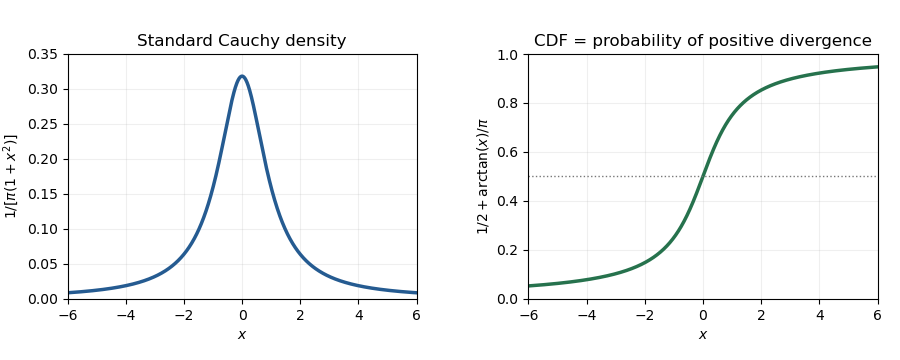
Standard Cauchy density and cumulative distribution, with the latter equal to the positive-divergence probability
. Details. 
Choose independent random variables on a countable product probability space. For each fixed , the diagonal assumption givesThe partial sums are therefore Cauchy in . DefineChoose a representative of this limit for each . No path continuity or simultaneous series convergence over all uncountably many times is being asserted.
For any finite list and real coefficients , the linear combination is the limit of centered Gaussian variablesTheir variances converge, so their characteristic functions converge to that of a centered normal distribution. This proves that every finite-dimensional vector is Gaussian and hence that is a Gaussian process. Taking limits also givesThis is the Gaussian process construction from square-summable features.
In the real Hilbert space , let . Then . The Parseval identity for a Hilbertian basis givesThe series is absolutely convergent by the Cauchy-Schwarz inequality, since and . Thusthe Brownian covariance kernel. This is the Brownian covariance from an integrated orthonormal basis.
The variance at zero is zero, so almost surely. For , the increment is Gaussian with mean zero and varianceFor every ,The increment and any finite vector of past values are jointly Gaussian. Zero cross-covariances imply their independence, by the factorization of the joint Gaussian characteristic function. The Monotone class theorem extends this independence to the sigma-field generated by all past values, .
Together with the assumed continuity, these proveThis is the Gaussian-process characterization of Brownian motion. Completion of the natural filtration preserves the independence assertion.
For , write . Deterministic integrals of the Gaussian process are Gaussian, as follows by taking limits of Riemann sums, so is jointly Gaussian. For , integrating the Brownian covariance kernel givesFor the last equality, integrate over and divide by . ConsequentlyThe only nonzero choice giving Brownian covariance is ; even the variance condition at requires .
Define . Since almost surely as , the transformed process is continuous at zero, as well as at positive times. It is centered Gaussian and has covariance , so part (c) provesThe transformed process is Brownian in its own natural filtration. This is the Brownian motion transform by three times its running average. The filtration qualification matters: for ,which is not identically zero. The Gaussian covariance calculation identifies the Brownian filtration generated by ; it does not make the transformed process a martingale in the larger original Brownian filtration.
Articles by others on the same topic
There are currently no matching articles.