Choose the oriented incidence matrix convention with at an edge's tail and at its head. Let be net supply, so . The uncapacitated minimum-cost flow problem on a finite directed graph isor . Negative denotes net demand. Costs may have either sign; the problem can be infeasible or unbounded.
For vertex network dual potentials , the optimization Lagrangian isThe infimum over is finite exactly when every network reduced cost is nonnegative. Thus the Lagrangian dual problem and complementary slackness areA feasible flow and feasible network dual potentials satisfying these equalities have equal costs and are optimal by weak duality.
If the underlying undirected graph is connected, deleting one redundant balance row makes the oriented incidence matrix have rank . A set of independent edge columns is exactly a spanning tree. Set all non-tree flows to zero, solve the tree balances, and check nonnegativity to obtain a basic feasible solution. Basic tree edges may have zero flow, which is degeneracy in linear programming. Requiring on tree edges determines network dual potentials up to a common additive constant. If every non-tree network reduced cost is nonnegative, the tree flow is optimal. This is the basis of the network simplex algorithm. If the graph is disconnected, solve the balances separately in each component; each component must have total net supply zero and uses its own spanning tree.
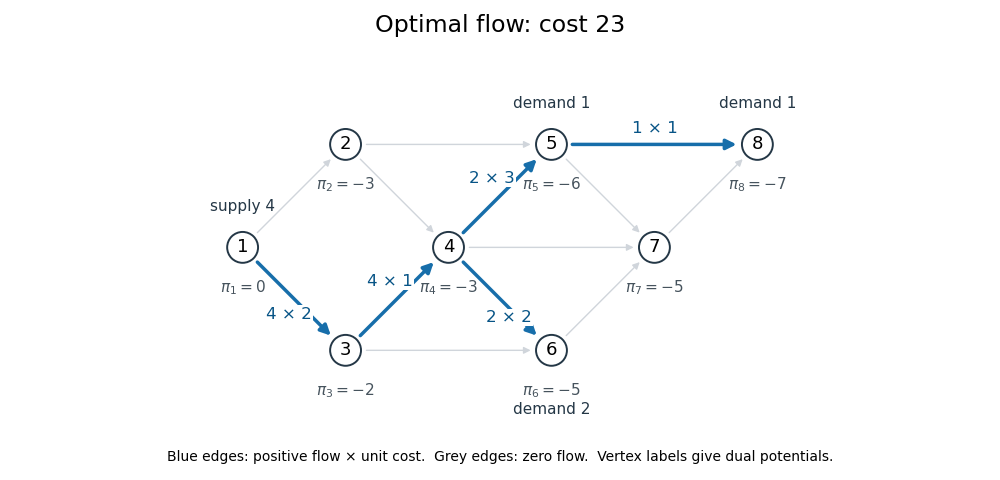
On the dashed spanning tree, the nonzero flows arewith and all non-tree flows zero. The tree balances give supply four at vertex , demands one at and , and demand two at . Its cost is .
Choose and make the tree network reduced costs zero. The resulting network dual potentials areFor the non-tree edges, in the order , the network reduced costs areOnly has negative network reduced cost, so it enters the basis.
Adding this edge to the tree creates the graph cycle . Increasing its flow by adds on and subtracts on . These signed changes preserve every flow balance. The simplex ratio test allows , and the objective decreases by because the cycle's signed cost is .
Take and remove from the basis. The other tied edge remains a zero-flow basic edge; this is a legitimate degenerate tree basis and requires no extra pivot. The new flow isIts cost is . For the new tree, chooseEvery network reduced cost is nonnegative: the new non-tree costs for are . All positive-flow edges have zero network reduced cost, and the dual objective is . Thus complementary slackness gives

Articles by others on the same topic
There are currently no matching articles.