Write the deterministic drift of the Adler phase equation as . Its minimum is and its maximum is . For , the zero condition has exactly two solutions in the specified interval:The linearization of a dynamical system at an equilibrium point gives , with . Defining gives , so is stable; , so is unstable. For , is positive everywhere and there are no equilibrium points: the phase runs continuously. This is the distinction between phase locking and running phase dynamics.
With mobility scaled to one, the effective force is . Therefore the tilted washboard potential isFor , its alternating local minima and maxima trap noise-free trajectories in wells. Minima coincide with , and maxima with . For , everywhere: there are no wells and the particle slides down the tilt. The potential is defined on the unwrapped phase and obeys ; it is not a single-valued periodic equilibrium potential on the circle.
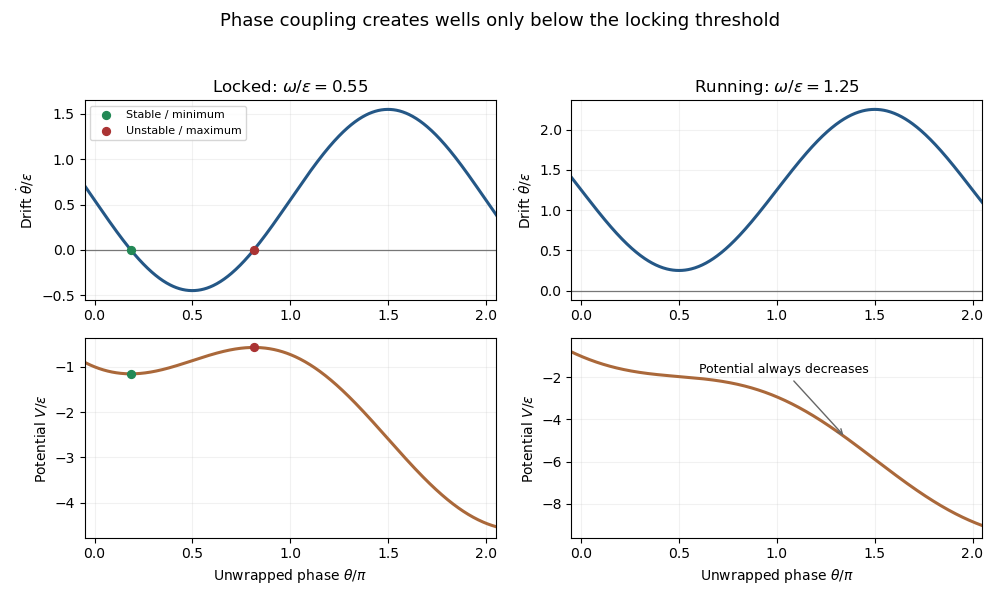
Locked and running Adler phase dynamics, with drift zeros and the corresponding tilted potentials
. At the transition , the two equilibrium points merge at in a saddle-node bifurcation. There , so the point is attracting from the left and repelling from the right; a zero linear derivative alone does not establish stable trapping.
For , let and . In a single well, sufficiently small fluctuations obey the linear Overdamped Langevin dynamicsThis is an Ornstein-Uhlenbeck process. Its solution isThe mean decays, while the noise integral gives . For , the future-noise contribution is independent of , so . The intrawell phase autocorrelation is thereforeThe connected unnormalized time autocorrelation is just the exponentially decaying second term. The constant first term is necessary because the requested raw correlation is not centered at the equilibrium point. This is the harmonic-well approximation. If a full first-order expansion in is wanted, the quadratic term in the drift is . Local stationarity gives , so the raw correlation gains a constant at that order. The connected correlation is unchanged to first order; the boxed formula is the conventional linearized result rather than a complete nonlinear first-order raw-correlation expansion.
The required time window is long compared with but short compared with the escape time, with the lag also short compared with escape. Fluctuations of size must be small compared with the distance to a neighboring maximum, and the relevant barriers must greatly exceed . For a fixed nonzero noise strength, the unwrapped phase eventually makes phase slips; its raw correlation does not have this stationary infinite-time limit. Thus “large time” here refers to local relaxation within the occupied well, not to the limit after arbitrarily many barrier crossings.
For thermally activated phase slips, the forward saddle is at and the backward saddle at . Their barriers above the same minimum areIn the Kramers escape rate approximation, both saddles have curvature and the minimum has curvature , so the prefactors agree:This is the forward-backward bias of phase slips. It favors forward motion because each forward step lowers the tilted potential by . For , , which gives the same ratio; the exact barrier difference is independent of . These probabilities may be read as rates in a common short observation interval, or as normalized competing exit probabilities. The in the exponent is the noise scale as defined in the Langevin equation; no additional factor is inserted.
Articles by others on the same topic
There are currently no matching articles.