For the Hamiltonian , the real-time configuration-space path integral iswith its measure defined by time slicing. Wick rotation gives the Euclidean path integral and the thermal trace.
For the infinite square well on , the Dirichlet boundary conditions select the normalized energy eigenstatesThere is no state: the corresponding sine is identically zero. Taking the trace in this orthonormal basis gives the canonical partition function
Use unfolding a reflected interval trajectory: reflect the interval across each wall so that a bouncing trajectory becomes a free trajectory in an image interval. A return path starting at ends at after an even number of reflections, or at after an odd number. Each hard-wall reflection contributes phase , giving the positive direct images and negative reflected images of the Dirichlet heat kernel on an interval.
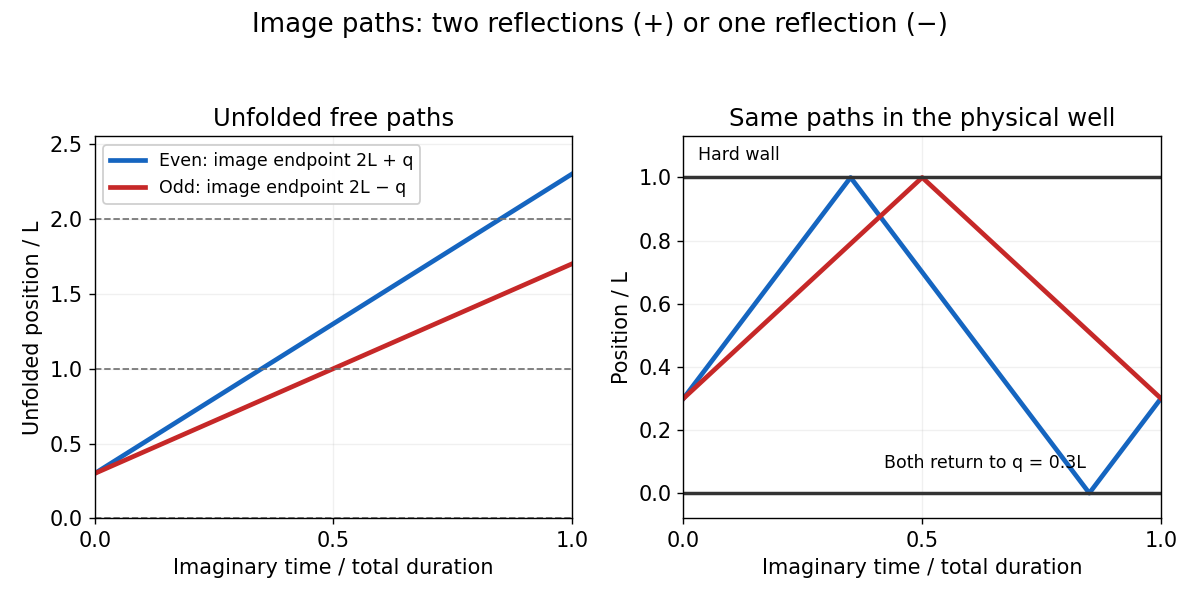
Even and odd reflection paths unfolded across an infinite square well
. The method of images therefore givesHere has inverse-energy units, since . In physical imaginary time , the same dimensionless action is , with . Thus the question's convention has exactly the weight .
Analytically continuing the free-particle propagator to imaginary time gives the Gaussian heat kernelThe two image endpoints have displacements and from the starting point. Inserting their kernels into the thermal trace of an interval image kernel givesThe prefactor comes from the normalization of the free-particle propagator; it cannot be dropped from a thermal trace.
Set and . For the reflected images, the intervals , , tile the real line once. A Gaussian integral givesConsequently . The Poisson summation formula applied to the Gaussian yieldsThe zero dual mode cancels the reflected contribution, while the positive and negative modes pair:This proves equality with the energy eigenstate calculation. The image expansion converges rapidly at small ; the spectral expansion converges rapidly at large .
Articles by others on the same topic
There are currently no matching articles.