Each bond of the classical Heisenberg antiferromagnet is minimized when its two spins are antiparallel. Since the periodic chain has an even number of sites, all bonds can be minimized simultaneously:The ground-state degeneracy is a continuous sphere of orientations . Choose the Néel state with even sites in and odd sites in .
This product state is not an energy eigenstate. The spin ladder operators inproduce states with both neighboring magnetic quantum numbers changed. On an up-down bond, has a nonzero matrix element , hence coefficient in the Hamiltonian. These orthogonal spin configurations show explicitly why the classical minimum is not an exact quantum eigenstate for .
Make a bipartite spin rotation: rotate every odd site's spin through about the axis, using . This unitary conjugation preserves the spin commutation relations. At an odd site it sends to and exchanges the spin raising operator and spin lowering operator.
Each bond joins one rotated and one unrotated site. In the transformed operators,ThusThe selected Néel state becomes an all-up reference state, so a single Holstein–Primakoff transformation convention works on both sublattices.
Use the Holstein–Primakoff transformation on the physical occupation number subspace . With the canonical commutation relation , the ordered square root givesBoth endpoints are respected: and . Consequently,Since these Fock states form a basis of the physical spin space, there. Similarly . The Holstein–Primakoff occupation constraint is essential: unrestricted bosonic occupation would not represent a spin- Hilbert space.
The linear spin-wave approximation expands about the rotated all-up state, with :In the longitudinal product, . Each site belongs to two bonds, so the resulting quadratic Hamiltonian isThe omitted terms are of order at fixed small occupation number. The pair terms describe the quantum fluctuations that were missing from the classical Néel state.
Apply a discrete Fourier transform, with lattice spacing one:The wavevectors lie in a Brillouin zone, which we choose as . Pairing with makes the quadratic HamiltonianA bosonic Bogoliubov diagonalization uses . The canonical commutation relations hold because . The anomalous terms vanish when , givingNear and , the dispersion relation is linear: . These are the low-energy antiferromagnetic spin waves; the two zeroes are related by the two-sublattice description. The transformation is singular at the exact zero modes, which require an infrared regulator or separate treatment of the collective rotation.
Under the bipartite spin rotation, the staggered magnetization becomes the uniform transformed . In the Bogoliubov transformation vacuum ,The quantum depletion of Néel order therefore gives, with the zero modes regulated,Near each zero of , the integrand behaves as , producing a logarithmic divergence. With a finite-size cutoff of order , the depletion grows as . Thus the large- expansion about a state with finite Néel order is not self-consistent in the infinite one-dimensional chain. The divergent expression is not a negative physical magnetization; it signals breakdown of that ordered approximation. It does not determine whether the exact excitation spectrum is gapped.
Write . The mean-field approximation drops the quadratic product of the fluctuations:For a Hermitian pairing interaction, the two linear terms are Hermitian conjugates. Defining the BCS anomalous average and pairing field by , and writing , givesThe final constant corrects the double counting in the reduced BCS pairing Hamiltonian.
The canonical anticommutation relations are preserved precisely when the real matrix acting on is orthogonal. Directly,The other relations are identical or vanish between disjoint pairs. Hence , and one may write , . This fermionic Bogoliubov transformation uses an ordinary rotation; bosonic mixing instead preserves a difference of squared coefficients.
For real and , introduce the particle-hole column . Its quadratic block is the Bogoliubov--de Gennes HamiltonianThe BCS coherence factors can be chosen to obeyWith , choose the sign of to match . The rotation diagonalizes the matrix to . Reordering and restoring the mean-field constant givesThe inverse transformation is and . Both annihilate . Since every positive-energy quasiparticle mode is empty, the normalized BCS ground state isEach momentum label refers to the pair once; distinct labels use disjoint single-particle spin states.
In each factor of the BCS ground state, the BCS anomalous average is . Self-consistency therefore gives the zero-temperature BCS gap equationPut . The specified constant attractive interaction makes independent of inside the energy shell and zero outside it:The printed is incompatible with this interaction: labels relative pair momentum, not the total momentum of a Cooper pair. Every pair here has zero total momentum, while many relative momenta contribute.
For the nonzero solution, the constant-shell BCS gap equation becomes . Let denote the approximately constant single-spin density of states per unit volume at the Fermi level. ThenIn weak coupling, . The displayed answer in the question uses . If “total electronic density of states” includes both spin species, , the argument instead reads . If the density counts the whole box rather than unit volume, divide it by before using this formula.
For the Hamiltonian , the real-time configuration-space path integral iswith its measure defined by time slicing. Wick rotation gives the Euclidean path integral and the thermal trace.
For the infinite square well on , the Dirichlet boundary conditions select the normalized energy eigenstatesThere is no state: the corresponding sine is identically zero. Taking the trace in this orthonormal basis gives the canonical partition function
Use unfolding a reflected interval trajectory: reflect the interval across each wall so that a bouncing trajectory becomes a free trajectory in an image interval. A return path starting at ends at after an even number of reflections, or at after an odd number. Each hard-wall reflection contributes phase , giving the positive direct images and negative reflected images of the Dirichlet heat kernel on an interval.
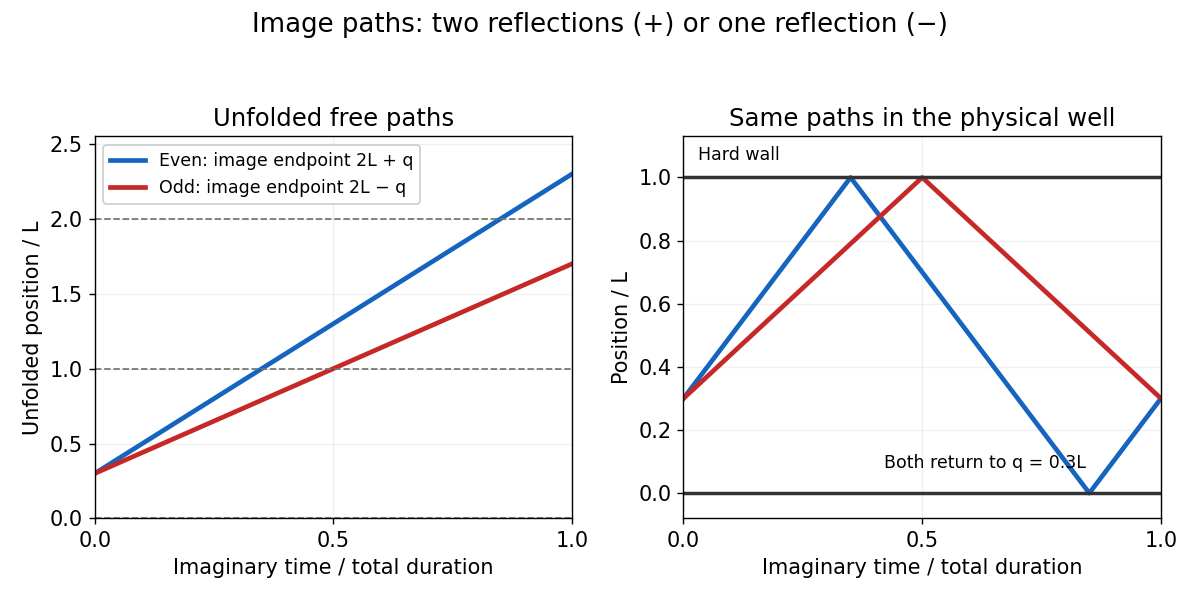
Even and odd reflection paths unfolded across an infinite square well
. Details. 
The method of images therefore givesHere has inverse-energy units, since . In physical imaginary time , the same dimensionless action is , with . Thus the question's convention has exactly the weight .
Analytically continuing the free-particle propagator to imaginary time gives the Gaussian heat kernelThe two image endpoints have displacements and from the starting point. Inserting their kernels into the thermal trace of an interval image kernel givesThe prefactor comes from the normalization of the free-particle propagator; it cannot be dropped from a thermal trace.
Set and . For the reflected images, the intervals , , tile the real line once. A Gaussian integral givesConsequently . The Poisson summation formula applied to the Gaussian yieldsThe zero dual mode cancels the reflected contribution, while the positive and negative modes pair:This proves equality with the energy eigenstate calculation. The image expansion converges rapidly at small ; the spectral expansion converges rapidly at large .
The exponential acts on the Fock vacuum: . For bosons, are commuting complex numbers. Since , commuting through the exponential gives . These are unnormalized bosonic coherent states.
For fermions, the labels are independent odd Grassmann variables, which anticommute with one another and with the fermionic operators. For one mode, the fermionic coherent state is . The canonical anticommutation relations give , using . The even factors commute between modes, so the same argument applies to every . A Grassmann eigenvalue is a formal extension of the state space, not an ordinary complex eigenvalue of the nilpotent annihilation operator.
With dual state , both cases obey .
Write . For bosons the measure is over in each mode, with . For fermions it is an ordered Berezin integral over independent ; choose , so .
For one bosonic mode, and . Integration by parts in the Gaussian measure gives ; the conjugate argument gives . Boundary terms vanish because of the Gaussian weight.
For one fermionic mode, put and move Grassmann coefficients to the left. The weighted projector isIts ordinary commutators are and . Their Berezin integrals vanish, so again . Equivalently the sole surviving coefficient in is , giving directly.
The modes factorize. In the irreducible Fock space representation, commuting with every creation and annihilation operator makes a scalar multiple of the identity. Its vacuum matrix element is the normalized Gaussian integral, equal to one. Thus the coherent-state resolution of identity isFor infinitely many modes, this argument first uses a finite-mode regulator.
The bosonic coherent-state resolution of identity gives the ordinary trace by insertion into a number-state basis. For fermions, the fermionic coherent-state trace requires a sign in the bra. In one mode, for an even operator ,Without that sign the result would be the supertrace . Applying this identity mode by mode to the even operator gives the grand canonical partition function
Let , take slices of width , and insert the coherent-state resolution of identity between factors of . If is in normal ordering, each short-time matrix element isCombining the overlap with the Gaussian weight leaves in the action. The coherent-state time slicing prescription fixes which adjacent labels appear in , rather than allowing an arbitrary ordering change after taking the continuum limit.
The twist in the thermal trace closes the path with the coherent-state thermal boundary conditions: periodic for bosons, antiperiodic for fermions. Taking the regulated continuum limit givesThe action is dimensionless because has inverse-energy units. For fermions, and remain independent Grassmann fields. If the original Hamiltonian is not normally ordered, first express it in normal order, retaining all constants.
For the quantum harmonic oscillator, set and . The normal symbol is , so the thermal coherent-state time slicing givesThe connection with a phase-space path integral uses the canonical real coordinatesTheir derivative term satisfies up to total derivatives that vanish for periodic paths. The normal and Weyl symbols of a harmonic oscillator must be distinguished: in midpoint phase-space time slicing, the Weyl ordering symbol of is . Thus the appropriate midpoint Hamiltonian is , with no additional constant. The change from the adjacent-label normal prescription to the midpoint prescription includes this ordering correction.
In physical imaginary time , the resulting phase-space path integral isGaussian momentum integration in a phase-space path integral produces the usual oscillator configuration-space path integral. An exact check follows directly from the coherent kernel :This is the thermal partition function of a quantum harmonic oscillator. Keeping the normal-ordering constant a second time after switching to the Weyl symbol would double count the zero-point energy.
Articles by others on the same topic
There are currently no matching articles.