For , the Heaviside step function vanishes before and is one afterwards. For ,The value assigned at the single jump point does not affect this Laplace transform. The positive real part ensures convergence at infinity.
Write . Assume and have right limits at zero and sufficient regularity and exponential-order bounds for the following integration by parts; take large enough to kill the boundary terms at infinity. First,Apply the same calculation to :This is the Laplace transform of a derivative formula with both initial-data terms retained.
Transform in time and use the zero interior initial conditions. The Laplace transform of a derivative formula turns the wave equation into . Its transformed endpoint conditions are and . A homogeneous solution satisfying the right condition is a multiple of ; the left condition fixes that multiple. Thus, for ,Here and the denominator has no zeros in this half-plane. The initial-boundary corner at is deliberately discontinuous: the applied step launches propagating fronts, so one should not demand a globally smooth solution across them.
Rewrite the ratio of hyperbolic sines asFor , expand the denominator by the geometric series. Part (a) inverts each delayed exponential:At each finite time only finitely many terms are nonzero, so this reflected-step solution of the wave equation is locally a finite sum. The first front travels from ; the second is its sign-reversed reflection from the fixed endpoint, with repeated round trips. At the delays coincide and cancel. At the sum telescopes to for .
An equivalent standing-wave Fourier series isIts static ramp has exactly the sine coefficients , so cancellation gives the zero initial displacement in the interior. Both representations solve the equation away from the fronts and in the distributional sense across them; the convention agrees with Fourier midpoint values.
Introduce . At the midpoint, the positive fronts arrive at and the negative fronts at . HenceThe midpoint displacement is a square wave, initially zero, with period and a phase delay . At a front, choosing gives value . The dotted vertical segments below denote jumps; they are not continuous changes through intermediate displacements.
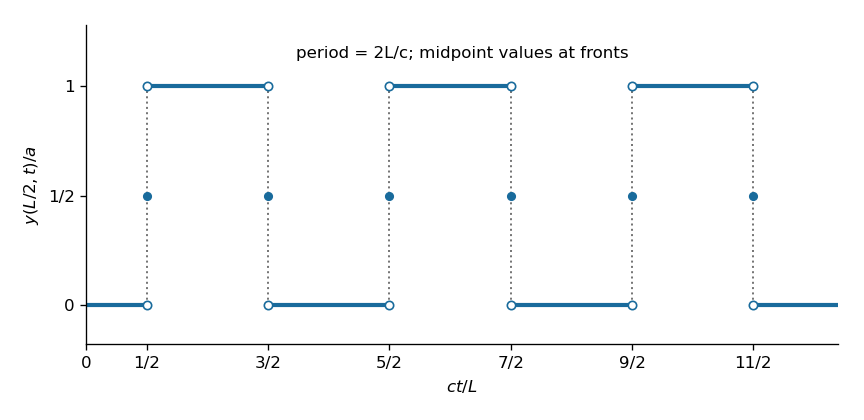
Midpoint displacement under repeated reflections of an applied step
. Articles by others on the same topic
There are currently no matching articles.