Put and arrange the four vectors as the columns of . On the one-dimensional vector subspace spanned by , the eigenvalue is . On the three-dimensional orthogonal complement , the eigenvalue is . Thusand the vectors fail to be a basis exactly when or .
For , all four columns equal . The matrix rank is , a basis of their span is , and an extension to a basis of isThe last coordinate first forces the coefficient of to vanish in any linear dependence, after which the other coefficients vanish.
For , the matrix rank is and the span is exactly . A basis consists of the first three original columns,Indeed, writing them as , a vanishing linear combination has coefficient sum zero by its fourth coordinate, and then each coefficient is zero by the first three coordinates. Adjoin to extend this basis to , since .
Eisenstein's criterion. Let be a nonconstant primitive polynomial. If a prime number satisfies , for , and , then is an irreducible polynomial over .
To prove the Eisenstein criterion, suppose a nontrivial factorization exists over . Gauss lemma for polynomials gives with of positive degree. Their leading coefficients are not divisible by , because their product is . Reduction modulo therefore preserves both degrees, andSince the only irreducible factor of the right side is , both reduced factors are nonzero monomials of positive degree. Their constant coefficients are consequently divisible by . This would make , a contradiction.
For the requested polynomial, shift the variable by one. The binomial theorem givesIt is monic, all coefficients below the leading one are divisible by , and the constant coefficient is , not divisible by . The Eisenstein criterion proves irreducibility of this shifted polynomial. The substitution is an automorphism of , with inverse , so it preserves nontrivial factorizations. HenceThis is the cyclotomic polynomial for a prime index.
A contraction mapping on a metric space is a map for which there is a single constant with such thatThe same must work for every pair. Merely decreasing each nonzero distance strictly does not suffice for this definition.
The contraction mapping theorem states that a contraction mapping of a nonempty complete metric space into itself has a unique fixed point . For any starting point , the iterates converge to , with the quantitative estimateCompleteness and the self-map condition are essential: the geometric estimate makes the iterates a Cauchy sequence, completeness supplies their limit in , and continuity of the contraction mapping makes that limit a fixed point. If two fixed points existed, their distance would be at most times itself, forcing equality of the points.
Define . Solving the system is equivalent to finding a fixed point of . The mean value theorem implies . In the specified metric,Each coordinate difference occurs exactly twice. This metric makes a nonempty complete metric space, because a Cauchy sequence in it is Cauchy in each real coordinate, and coordinate convergence implies convergence in the sum metric. Thus is a contraction mapping with constant .
There is exactly one solution for every choice of , by the contraction mapping theorem. Iteration of from any starting vector also constructs it.
Rouché's theorem. Suppose are holomorphic functions on a neighbourhood of the closure of a bounded domain enclosed by a simple, positively oriented, piecewise smooth curve. If on the boundary, then and have the same number of zeros inside, counted with multiplicity.
Apply Rouche theorem with and on the first-quadrant quarter-disc of radius . On the two radial segments, is nonnegative real, so , whereas . On the circular arc,At every arc point with positive imaginary part, , giving the strict inequality; at the remaining endpoint , . Thus the strict boundary inequality holds everywhere, including the origin.
The four zeros of have modulus and arguments . Exactly one lies inside the chosen domain. Rouche theorem gives exactly one zero of there, counted with multiplicity, so that zero is simple. Finally any zero in the open first quadrant satisfiesThere can be no additional zero outside the quarter-disc. Hence
The function is even, so its Fourier series has . In the convention ,Twice applying integration by parts gives, for ,Therefore the periodic Fourier representation iswith periodic continuation. The periodic extension is continuous, including the identified endpoints, and piecewise smooth, so the Fourier series converges to it. The coefficients also give absolute convergence and uniform convergence by comparison with .
At , the cosine cancels the alternating coefficient sign; at , it is identically one. These evaluations yieldThe first identity solves the Basel problem.
The orbital angular momentum linear operator is the cross product of the position operator and the momentum operator:In position space, , so . The Levi-Civita symbol gives and its cyclic analogues.
Use the canonical commutation relations and . For compactness write products without hats in the calculation, on a common domain such as smooth compactly supported wavefunctions. Expanding the commutator givesThe middle two commutators vanish because all the relevant indices differ. The first is , since ; the last is , since . ThusThis is one of the orbital angular momentum commutation relations.
The product rule for a commutator gives . Using the permitted cyclic angular momentum commutation relations,The first two expressions cancel, even though the factors need not commute. HenceThe squared angular momentum operator commutes with each of its components by the same cyclic calculation.
Distinct eigenvalues of the self-adjoint angular momentum operator imply . The given combination is not normalized: its squared norm is , which is always positive. Therefore its properly normalized expectation value isIt vanishes when . The first positive solution has , soNormalization changes the value of the expectation value away from zero, but not its zero times.
In a charge-free and current-free vacuum, Maxwell equations giveTake the curl of Faraday's law and use the curl of the curl identity . The divergence term vanishes by Gauss's law, while the time derivative of the magnetic curl supplies . ThusThis is the transverse electromagnetic wave equation.
The phase has wavevector . The electric field has fixed direction , so it has linear polarization at to the and axes, perpendicular to the wavevector. Substitution into the electromagnetic wave equation givesFor the usual positive-frequency convention, and propagation is in the direction . If , this reduces to . The following wave formulas assume the nonconstant case .
For the oscillatory magnetic field, Faraday's law gives . Indeed its time derivative equals , and the dispersion relation makes it satisfy the remaining Maxwell equations. ThusFor , its amplitude is . The magnetic field, electric field and direction of propagation are mutually perpendicular. A constant background magnetic field could be added; the expression above is the wave-associated field.
Since , the vector triple product yields . Consequently the Poynting vector isIts average over a full period uses :This is the mean electromagnetic energy flux per unit area. For positive frequency it points in the propagation direction and has magnitude .
Apply the numerical method to the scalar test equation , with . Its linear stability domain consists of those for which the discrete solution stays bounded as the step count tends to infinity. For a one-step method with stability function , this isIf asymptotic decay is required, use instead; this only changes the boundary conventions in part (b). A method is A-stable if its stability domain contains the left half-plane, so every decaying linear test equation is stable for every positive step size. For a multistep method, the corresponding definition uses the root condition for a multistep method for every characteristic root, including simplicity of unit-modulus roots.
Expand the second stage by the Taylor theorem, writing and for the derivative in the state variable:The update therefore agrees with the exact solution's Taylor series:Thus the one-step local truncation error is , and the method has order at least two under the usual smoothness and Lipschitz continuity assumptions.
For , the two-stage Runge-Kutta method givesOn the real axis, , so is equivalent to . HenceThe decay convention gives . Since negative real values such as lie outside the linear stability domain, the method is not A-stable. Its order is exactly two, since lacks the cubic term of .
If there are balls in box A, a ball currently in B is selected with probability , increasing the count, and a ball in A is selected with probability , decreasing it. For ,with every other transition zero. This is the Ehrenfest urn model.
The stationary distribution isIt is normalized by the binomial theorem, and it obeys the detailed balance:All other pairs have zero flux in both directions. These identities prove stationarity and show that this is a reversible Markov chain in equilibrium. The finite chain is irreducible and has period two; reversibility does not require aperiodicity.
A finite irreducible Markov chain is positive recurrent. Its mean recurrence time to state , starting at and counting the first positive return, is . This identity comes from the long-run fraction of time spent at that state: successive return cycles each contain one visit at their start, so the fraction is the reciprocal of the mean cycle length. It remains valid for a periodic chain.
The algebraic dual map is , defined by . The annihilator of a vector subspace isEvery functional vanishes on , so . Conversely, let . Define a functional on by . It is well defined because two preimages differ by an element of . Extend a basis of to one of and extend the functional arbitrarily, for instance by zero on the extra basis vectors. The resulting satisfies .
This is the dual image and kernel annihilator identity. ThereforeThe basis extension theorem also gives . By the rank-nullity theorem,Apply rank-nullity theorem to both maps, using , to obtainOver , this is the algebraic dual, without complex conjugation; the adjoint operator in part (b) uses the inner products instead.
The adjoint operator is uniquely characterized byLet . Its quadratic form is nonnegative:If , both norms vanish. In particular , while means is orthogonal to , by the defining adjoint operator identity. A vector belonging to a vector subspace and its orthogonal complement must be zero. Hence is injective, and finite dimensionality makes it surjective.
Work with the usual commutative unital Noetherian ring convention. First prove that every submodule of is a finitely generated module. For , a submodule is an ideal, hence finitely generated by Noetherianity. For the induction step, project a submodule onto its last coordinate. Its image is a finitely generated ideal; choose lifts in of its generators. The projection kernel lies in and is finitely generated by induction. The kernel generators together with the chosen lifts generate , since subtracting a combination of the lifts leaves an element of the kernel.
Now choose a surjection from a finite generating set of the module . For any submodule , its inverse image in is finitely generated by the result just proved. The images of those generators generate .
Every submodule of is finitely generated. In particular is a Noetherian module: the union of an ascending chain is a submodule, and its finite generators all belong to a single member of the chain, forcing eventual stabilization.
Let be maximal among annihilators of nonzero elements of . It is a proper ideal, since . Suppose and . Then andThe inclusion holds because every satisfies . Maximality in the stated set forces , so . This proves the defining implication for a prime ideal:This is a maximal annihilator of a module element is prime argument. Maximality among element annihilators is sufficient; need not be a maximal ideal of .
If , take the empty filtration. Otherwise a nonzero quotient is a finitely generated module. Because has the ascending chain condition on ideals, the nonempty collection of annihilators of nonzero elements of has a maximal element. Part (b), applied to , supplies with a prime ideal .
The map , , is surjective with kernel . The first isomorphism theorem gives . Let be the inverse image of under . ThenRepeat whenever the quotient remains nonzero. An infinite repetition would give a strictly ascending chain of submodules of the Noetherian module , contradicting part (a). Thus the process stops after finitely many steps, necessarily at .
Two norms on the same vector space are equivalent norms, or Lipschitz equivalent, if there are constants such that for every . The constants are uniform over the whole space.
Let be any norm on . The triangle inequality and the Cauchy-Schwarz inequality giveThe reverse triangle inequality then gives , so is Euclidean-continuous; this continuity was derived, rather than assumed. On the compact Euclidean unit sphere, attains a strictly positive minimum , because it vanishes only at zero. Homogeneity yieldsFinally a linear map satisfies , again by Cauchy-Schwarz inequality. The equivalence just proved transfers this bound to any norms on the source and target. Hence every such linear map is continuous.
If is a bounded linear operator, linearity gives . It is therefore Lipschitz and continuous everywhere.
Conversely, suppose is continuous at zero. There is such that implies . For , apply this to and use homogeneity:The value at is zero by linearity. ConsequentlyThus boundedness and continuity are equivalent for linear maps between normed spaces. No finite dimensionality or completeness is needed for this equivalence.
First , since . Any finite linear dependence among and the has the form for a finite index set . At an index outside , its coordinate equals , so . Each remaining coordinate then gives . Therefore the set is linearly independent, and the prescribed values define a unique linear map on its algebraic span.
Take the tailsThey belong to , satisfy , and haveThus while does not approach . The map is not continuous, and part (b) also shows it is unbounded. This is a discontinuous functional detected by vanishing sequence tails, illustrating why the finite-dimensional conclusion in part (a) cannot be extended to arbitrary normed spaces.
A quotient topological space of a topological space is obtained by an equivalence relation : its points are the classes , and the canonical surjection is . The quotient topology declares a subset of the quotient open exactly when is open in . More generally a surjection onto a set specifies the same topology by this condition.
For a Hausdorff source with a non-Hausdorff quotient, use and when . Any nonempty open inverse image is a nonempty open subset of invariant under rational translations. It contains an interval , and for every real there is a rational with ; hence it contains every . Thus has the indiscrete topology.
It has distinct points, for instance the classes of and , but neither has a proper nonempty open neighbourhood. The quotient is not Hausdorff, even though is a Hausdorff space.
For the torus quotient, a point has the same image as a point of precisely when they differ by an integer lattice vector. ThereforeThis union is open in , so is open by the quotient topology. Distinct integer lattice vectors are at least distance one apart, whereas . Thus these open balls are disjoint, with a positive gap between any two.
Each ball is connected, since it is convex. It is both open and closed relative to the displayed union: its complement there is the union of all the other open balls. No connected component can meet two such relatively separated pieces. Consequently the components are exactly the infinitely many balls . Translation by is a homeomorphism from each component onto . The statement uses the intended positive radius .
Use the elementary irrational-rotation density fact: if is irrational, is dense in the circle. One proof uses the pigeonhole principle on fractional parts of . Two lie within ; taking their difference and, if needed, its negative yields an integer multiple of with fractional part . The multiples form a -net of the circle and are themselves integer multiples of modulo one. Taking arbitrarily large proves density.
For any target coordinates modulo one, points of the line with parameter have first coordinate exactly modulo one and second coordinate modulo one. The density fact approximates arbitrarily well. Since products of small coordinate intervals form a neighbourhood basis of the torus,Nevertheless the point does not lie in . Such an equality would require a line parameter and , contradicting irrationality. HenceThis is the irrational winding of the torus: dense need not mean surjective.
For , the Heaviside step function vanishes before and is one afterwards. For ,The value assigned at the single jump point does not affect this Laplace transform. The positive real part ensures convergence at infinity.
Write . Assume and have right limits at zero and sufficient regularity and exponential-order bounds for the following integration by parts; take large enough to kill the boundary terms at infinity. First,Apply the same calculation to :This is the Laplace transform of a derivative formula with both initial-data terms retained.
Transform in time and use the zero interior initial conditions. The Laplace transform of a derivative formula turns the wave equation into . Its transformed endpoint conditions are and . A homogeneous solution satisfying the right condition is a multiple of ; the left condition fixes that multiple. Thus, for ,Here and the denominator has no zeros in this half-plane. The initial-boundary corner at is deliberately discontinuous: the applied step launches propagating fronts, so one should not demand a globally smooth solution across them.
Rewrite the ratio of hyperbolic sines asFor , expand the denominator by the geometric series. Part (a) inverts each delayed exponential:At each finite time only finitely many terms are nonzero, so this reflected-step solution of the wave equation is locally a finite sum. The first front travels from ; the second is its sign-reversed reflection from the fixed endpoint, with repeated round trips. At the delays coincide and cancel. At the sum telescopes to for .
An equivalent standing-wave Fourier series isIts static ramp has exactly the sine coefficients , so cancellation gives the zero initial displacement in the interior. Both representations solve the equation away from the fronts and in the distributional sense across them; the convention agrees with Fourier midpoint values.
Introduce . At the midpoint, the positive fronts arrive at and the negative fronts at . HenceThe midpoint displacement is a square wave, initially zero, with period and a phase delay . At a front, choosing gives value . The dotted vertical segments below denote jumps; they are not continuous changes through intermediate displacements.
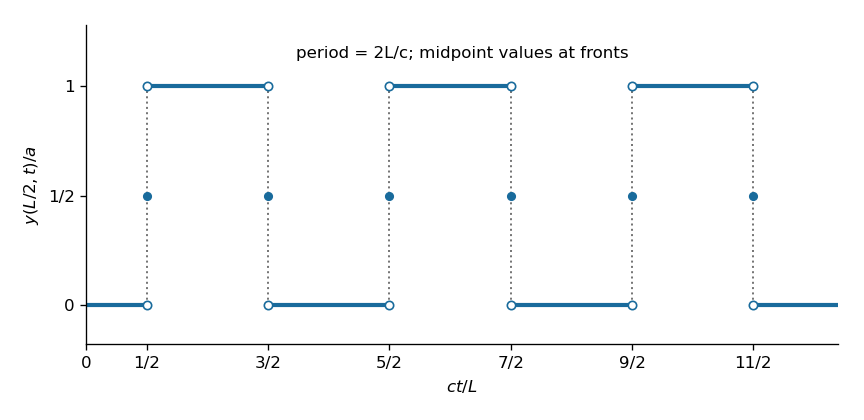
Midpoint displacement under repeated reflections of an applied step
. Write derivatives with respect to . The arc-length condition is . The tangent vectors areTheir scalar products give the first fundamental formChoose the unit normal vector , since and . Scalar products of with the second partial derivatives giveThe mixed coefficient is zero. Reversing reverses the second fundamental form but not the Gaussian curvature. Its formula isDifferentiating the arc-length identity gives . Substitute it directly, without dividing by (which may vanish), to obtain
The generating circle has , and its revolution is a torus. From part (a), and the area element of a surface is . ThereforeThe positive Gaussian curvature on the outer side exactly cancels the negative curvature on the inner side. Equivalently, the Gauss-Bonnet theorem gives because the Euler characteristic of the torus is zero.
Constant Gaussian curvature one gives , so, after a shift of the arc-length parameter, with on an interval contained in . To close the surface by adding only two points, the limiting parallels at both ends must collapse to points on the axis. If an end had limiting radius , it would contribute a whole missing circle, which two added points cannot supply. Thus the parameter interval is the full interval between consecutive zeros, and its two ends are .
At a smooth axis point the tangent plane of a surface of revolution is invariant under all rotations about the axis, so it must be horizontal. The unit meridian tangent must consequently have and there. But , so smoothness forces . The arc-length identity also illustrates the alternatives: prevents reaching either zero with real , while gives a nonhorizontal limiting meridian and a conical singularity.
Now . On the connected interior, has one fixed sign because . Therefore , andThe revolved surface is the unit sphere centered at , with only its two poles omitted. Those points are antipodal. This proves the claim using smooth endpoint criterion for a surface of revolution, without integrating a general square root.
Take and a positive prescribed distance ; if , the zero-speed journey has zero cost. Minimize subject to and the isoperimetric constraint . Introduce a constant Lagrange multiplier and the integrand . For a variation with , integration by parts givesThe interior Euler-Lagrange equation isWhen terminal speed is free, the same calculation also imposes the natural boundary conditions for a free endpoint:One cannot drop this boundary term when interpreting an extremal as a genuine minimum. If , the interior condition makes constant; with a continuous zero initial speed and it cannot be attained. In that case Cauchy-Schwarz inequality gives the infimum , approached by speeds nearly constant except in a short initial layer. For , the derivative cost controls such layers and the natural terminal condition matters in parts (b) and (c).
Put . Solving the interior Euler-Lagrange equation and imposing both and yields , with . The distance constraint fixesThe denominator is positive because for . This is the requested solution of the differential equation with the stated initial conditions.
As a minimum-energy problem with free terminal speed, the printed conditions do not admit a smooth minimizer. The formal profile has , violating the natural terminal condition from part (a). Fixing the initial acceleration restricts , but it does not restrict the independently variable and therefore does not remove that condition.
For clarity, without the extra initial-acceleration restriction the actual unique minimizing profile isIt satisfies , , the distance constraint and the interior equation, but . For any perturbation preserving the distance and initial speed, the first variation about is zero, andwith equality only for . Its energy is .
This same energy is the unattained infimum under the extra condition . Indeed multiply by and rescale by a factor tending to one to restore total distance . These smooth nonnegative profiles have both initial values zero and converge to in value and derivative square integrals as . Their energies tend to , but uniqueness of precludes attaining it with zero initial acceleration. This is nonattainment under an initial derivative constraint.
Here because and the two cost coefficients are not both zero. The interior Euler-Lagrange equation makes quadratic. Imposing each displayed pair of endpoint data and the distance constraint gives the following formal profiles and their costs:Thus choice (3) is the best strategy, and its true minimum cost isThe qualification from part (b) applies to row (1): its formal quadratic is not a minimizer with free terminal speed, since . Row (2) is a genuine minimizer for its fixed zero terminal speed, and row (3) is the genuine free-terminal-speed minimizer, satisfying its natural condition .
A direct lower bound makes the comparison rigorous. For every admissible speed with ,by integration by parts. The Cauchy-Schwarz inequality gives . Equality requires to be proportional to , giving exactly row (3). Row (1)'s zero initial acceleration excludes equality; however short initial layers, as in part (b), approach that same infimum. Hence choice (1) has infimum but does not attain it, while choice (3) does. This distinction resolves the boundary-condition issue in the printed minimization request.
With the positive logarithmic fundamental solution used here, a Dirichlet Green function for an interior pole satisfiesEquivalently, is harmonic near the pole, is harmonic away from it, and it has the specified logarithmic singularity. Regularity up to the remaining boundary is understood; on an unbounded domain impose the appropriate condition at infinity as well.
Apply Green second identity with and . Since is a harmonic function, the volume integral is . The term vanishes on the boundary by the Dirichlet boundary condition. ThereforeOne may equivalently excise a small disc around the pole and take its radius to zero. The sign is positive because this question uses , not the alternative negative-Laplacian convention.
Articles were limited to the first 100 out of 121 total.
Articles by others on the same topic
There are currently no matching articles.