First take finite endpoints and a starting point . For the Brownian exit time , the stopped path stays in . The process is a martingale. Bounded-time optional stopping theorem givesBy the monotone convergence theorem, , so exit from every bounded interval is almost sure:For completeness, a proper unbounded interval also has almost sure exit. Applying optional stopping theorem to and then bounded convergence theorem gives the endpoint probabilitiesFor a fixed lower level , let . Hitting before is a subset of ever hitting , and its probability tends to one. Similarly every fixed higher level is hit almost surely. After a level is reached, the same argument from that level shows that a level strictly outside a given proper interval is eventually reached. This proves exit even when endpoints are included. A starting point already outside needs no argument. The whole real line has no exit, so the phrase “every interval” is understood to exclude that trivial exception. Countably many rational levels make the exit conclusion simultaneous for all proper intervals. The bounded-interval assertion is the one used below.
Translate the centre of the ball to zero. Choose an inner radius strictly smaller than the ball's radius. If the starting point already lies in the ball there is nothing to prove; otherwise write and choose . Let be the first hits of the two circles.
The Brownian exit time from the annulus is finite almost surely: it is no later than exit of the first coordinate from , which is finite by part (a). The function is harmonic on this annulus. The Itô formula and optional stopping theorem apply to its bounded stopped values, yieldingSolving gives the planar Brownian annulus hitting probabilityAs this tends to one, while the event in the formula is contained in . Thus the inner circle is hit almost surely. That circle lies strictly inside the original open ball, proving the recurrence of planar Brownian motion in the form requested:A probability-one intersection over balls with rational centres and positive rational radii makes this conclusion simultaneous for all nonempty open balls, since every such ball contains one from that countable family.
Using a smaller inner circle ensures an actual visit to the open ball, rather than only a hit of its boundary.
The domain is the union of the horizontal and vertical strips. The four connected components of its boundary carry the constants in the northeast, northwest, southwest and southeast, respectively.
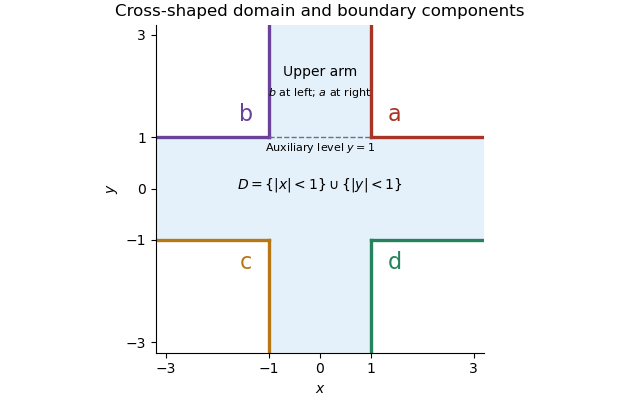
The cross-shaped domain, its four boundary values, and the auxiliary upper strip used for the limit at infinity
. Details. 
First justify finiteness of . A small open ball around lies outside the domain. By part (b), planar Brownian motion visits that ball almost surely in finite time. A continuous path from to that ball must meet first. Hence almost surely, and by continuity.
The harmonic function is smooth inside . The Itô formula, localized on relatively compact subdomains, makes a local martingale. Its boundary definition uses the continuous extension of . Since is bounded, this stopped process is a true martingale with uniform integrability: pass through the compact exhaustion using bounded convergence theorem. In particular .
Now almost surely as . The dominated convergence theorem, boundedness of , and its continuous boundary values give the bounded harmonic representation with almost sure Brownian exit:Almost sure exit and boundedness of the harmonic function are both used. The domain's unboundedness causes no loss of expectation here because the stopped function values are uniformly bounded.
Fix and start at with . Write the independent Brownian coordinates as and . LetOn the path has stayed in the upper strip and first exits the cross-shaped domain at its right or left side. The boundary value is or , respectively. Let if and if . The Brownian exit from an interval probabilities giveCouple all heights using the same two Brownian paths. By part (a), almost surely, and continuity makes finite. ThusLet . On the complement of this exceptional event, ; on the event itself, . The representation in part (c) therefore yieldsThis proves the harmonic limit along an infinite strip arm:Far up the arm, the bottom is reached with vanishing probability before the horizontal coordinate exits. The limit is consequently determined by the two side values alone.
Articles by others on the same topic
There are currently no matching articles.