Locally write a smooth hypersurface as with . It is a null hypersurface when on it. Then is both normal and tangent, and the induced metric is degenerate along .
Because covariant derivatives commute on a scalar,The scalar vanishes on the hypersurface, so its derivative annihilates every tangent direction there. Its derivative is consequently proportional to : locally for a smooth function , givingThus the normal generates null pregeodesics. Rescale , choosing , to get . These are the affinely parametrized generators of the null hypersurface. The proportionality need not vanish: setting only on the hypersurface does not set its full transverse derivative to zero.
A future trapped surface is a smooth compact spacelike two-surface without boundary whose two future-directed orthogonal null expansions are strictly negative. In four-dimensional general relativity, the Penrose singularity theorem states: a time-oriented globally hyperbolic spacetime with a noncompact Cauchy hypersurface, a trapped surface, and the null convergence condition for every null vector is future null-geodesically incomplete. With the Einstein field equations, the null energy condition implies this null convergence condition; a cosmological constant drops out of the null contraction.
The Kruskal spacetime is an example. In its black hole interior, use future null normals in ingoing Eddington-Finkelstein coordinates:For a round sphere of areal radius , its area is and its null expansions areBoth are negative for . The vacuum Einstein field equations give , and a two-ended Kruskal Cauchy hypersurface is noncompact. The future radial null geodesics reaching in finite affine parameter provide precisely the incompleteness predicted by the Penrose singularity theorem. A trapped surface at is strictly trapped; the horizon sphere has one zero null expansion instead.
Use the subextremal four-dimensional Reissner-Nordstrom spacetime, with . Its static radial function isTake the time-symmetric two-ended bridge through the outer bifurcation surface. Its initial data have andon each end. The bridge is smooth: in proper radial distance , . Each asymptotically flat end is an infinite Riemannian distance away. Hence the spatial Riemannian manifold is complete and admits no proper same-dimensional smooth isometric extension as a connected spatial manifold.
Its maximal Cauchy development includes the two exteriors and the adjacent future and past regions between and . It ends at inner Cauchy horizons, not at a curvature singularity. Since the simple root at is removable in horizon-penetrating coordinates and all curvature invariants are finite there, the exact solution extends across these Cauchy horizons. The extension is no longer globally determined by the given initial data.
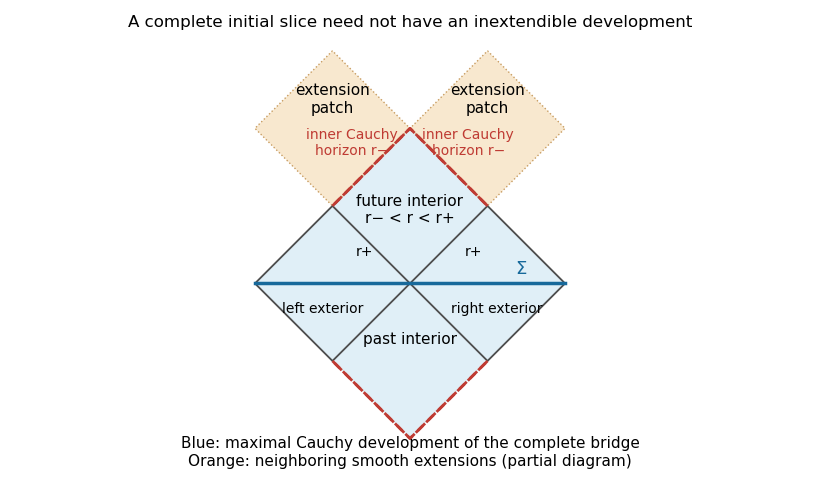
The maximal Cauchy development of a complete Reissner-Nordstrom bridge ends at extendible inner Cauchy horizons
. Details. 
The shaded region is the maximal Cauchy development; dashed upper and lower null edges are inner Cauchy horizons. The displayed neighboring diamonds illustrate smooth continuation, rather than the entire infinite extension.
The strong cosmic censorship conjecture concerns generic admissible initial data, in a specified extension regularity. Exact charged spherical data are exceptional. Perturbations can produce mass inflation at the inner Cauchy horizon, obstructing suitably regular extensions; the precise conjecture depends on the matter model and whether extensions are required to be , , or another regularity. Thus this exact extendible example does not refute a generic strong cosmic censorship conjecture.
For an Einstein-Maxwell example the gravitational triple must be accompanied by electromagnetic initial data. One may take zero magnetic field and the smooth radial electric flux through the bridge. The charges at the two ends have opposite signs when measured with outward normals. This is an example in the electrovacuum theory, not vacuum initial data.
The dominant energy condition says that, for every future timelike vector , the energy current is future causal or zero. Choose normal coordinates whose future unit time vector at is . With metric signature and symmetric stress-energy tensor,A vector with these components is future causal or zero exactly whenThis proves necessity. Conversely, every future unit timelike vector can be made the time axis of an orthonormal frame by a proper orthochronous Lorentz transformation, and that frame can be extended to normal coordinates at . Requiring the displayed inequality in every such chart therefore gives the dominant energy condition for every future timelike vector; positive rescaling handles nonunit vectors. Future null vectors follow by continuity if they are included in the definition. The condition must hold in every local Lorentz frame; one chart alone is insufficient.
In an orthonormal frame, and . The electromagnetic stress-energy tensor givesThe sign of follows directly from . Thusand . These formulas hold in every local Lorentz frame, so the criterion just proved establishes the dominant energy condition. Equality occurs for a nonzero null Maxwell field with and , whose energy current is null vector.
For the P(X, phi) scalar field theory specialized to , vary the inverse metric tensor while holding fixed. With ,Using yieldsIn any local Lorentz frame, set , , , and . ThenA direct calculation givesHence in every local Lorentz frame, proving the dominant energy condition. This proof covers timelike, null, spacelike, and zero alike; it does not assume or use a perfect fluid in general relativity rest frame. The hypotheses need only hold at every attained value of ; the stated all- assumptions are sufficient. For example, , , satisfies them.
Articles by others on the same topic
There are currently no matching articles.