Use geometrized units and metric signature . Put in the Schwarzschild metric. The Schwarzschild tortoise coordinate satisfies , soSubstituting gives the ingoing Eddington-Finkelstein coordinates:The radial metric tensor has determinant and inverse components , , . Thus it is nondegenerate and analytic at . The same expression defines a Lorentzian metric for every , extending the exterior across the future Schwarzschild event horizon into the black hole. It does not include the other exterior or the white hole of the full Kruskal spacetime. At , the Kretschmann scalar diverges, so this is a curvature singularity, not a removable coordinate singularity.
The radial null geodesics satisfyThe ingoing family has , with decreasing toward the future; its tangent is affinely parametrized because . The outgoing family hasAway from the Schwarzschild event horizon, integration gives . These are null geodesics up to reparametrization: a null direction in the two-dimensional radial geometry is automatically pregeodesic, and the angular geodesic equations are satisfied by constant angles. On the Schwarzschild event horizon the outgoing family instead has , with tangent proportional to .
In a Finkelstein diagram, plot vertically and horizontally. Ingoing rays obey ; outgoing rays obeyOutside the Schwarzschild event horizon, outgoing rays increase ; on it they remain at ; inside it they decrease even though increases. Thus both radial future null directions point toward smaller inside the black hole. Every future timelike direction lies between these null directions, so it also moves toward smaller there.
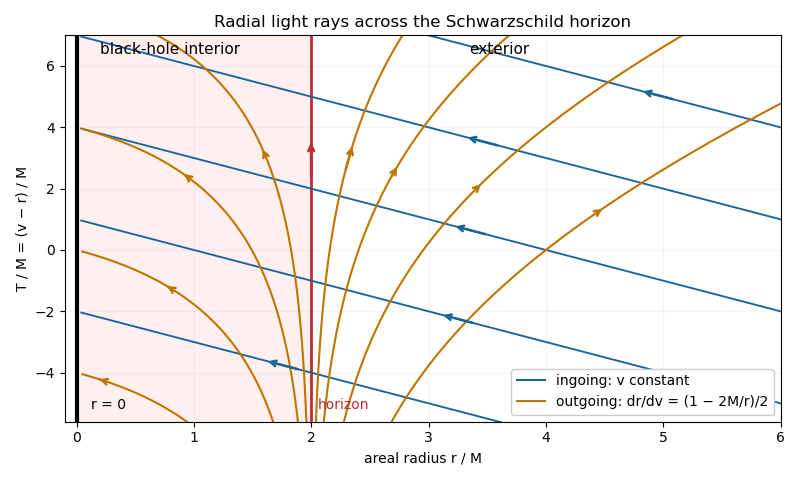
Radial light rays in ingoing Eddington-Finkelstein coordinates across the Schwarzschild horizon
. Details. 
Arrows show future propagation. The vertical red line is the Schwarzschild event horizon; the black boundary at is the Schwarzschild singularity.
A spacetime is geodesically complete if every maximal geodesic has an affine parameter ranging over all of . For timelike geodesics this is equivalent to unbounded proper time in both directions. An extendible geodesic segment can be prolonged in the same spacetime; an inextendible geodesic cannot. A finite coordinate endpoint need not imply finite affine parameter.
For the Kruskal spacetime, use withIn the right exterior . A truncated ray , is an extendible geodesic of radial null type: neither artificial endpoint is a spacetime boundary. A future ray in the black hole reaches , hence , and is inextendible geodesic and future null-geodesically incomplete. Its Killing energy gives , so the Schwarzschild singularity occurs at finite affine parameter. The maximal continuation toward the past supplies the other half of this same null geodesic.
There is no inextendible, complete radial timelike geodesic in positive-mass Kruskal spacetime. This requested example is impossible as printed. For a radial timelike geodesic, the conserved Killing energy and normalization giveIf , has at most one turning point, a maximum ; a maximal trajectory runs from the white hole Schwarzschild singularity to the Schwarzschild singularity. If , there is no finite turning point; one end can lie at infinity but the other reaches . The exceptional trajectory through the bifurcation surface also reaches in both time directions. Near ,whose integral is finite. Constant- radial timelike curves are accelerated, not geodesics.
Two plausible repairs have different meanings. Removing “radial” permits a complete circular timelike geodesic at , with nonzero angular momentum and proper time ranging over . Replacing “timelike” by “null” permits a complete horizon null geodesic: , , with an affine parameter. The Penrose diagram shows both repairs explicitly, together with the two valid requested examples; the circular trajectory is only a radial projection and is labelled as nonradial.
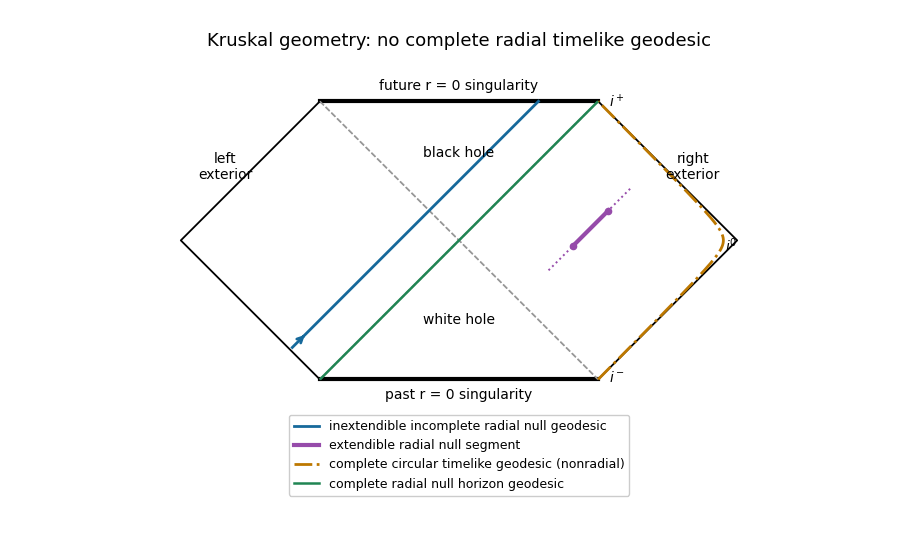
Kruskal causal diagram with extendible and incomplete null rays and explicitly labelled repairs to the impossible radial timelike example
. Details. 
The horizontal boundaries are the Schwarzschild singularities, diagonal dashed lines are the Killing horizons, and outer diagonal edges are null infinity.
Define outgoing Eddington-Finkelstein coordinates by . The radial Schwarzschild metric becomesOutgoing radio rays have constant . Two nearby wave crests emitted at Alice's proper times and have separation . At Bob's fixed radius , and , where . Thus the exact local redshift isHere the wavelength ratio equals the proper time period ratio in geometric optics. Equivalently, the phase gradient gives Alice's measured frequency and Bob's .
In the asymptotically distant-observer limit , this becomes . “Far away” is the approximation behind the printed formula; at finite the factor remains.
For radial free fall, let be Alice's conserved Killing energy. The inward branch of the timelike geodesic has , henceWith , the near-horizon geodesic equations giveThe constants in the logarithms are understood to make their arguments dimensionless. Therefore . For an outgoing signal reaching the fixed-radius Bob, , so . The redshift consequently behaves asThis is the answer when is Bob's Schwarzschild time, as appropriate to the stated observation. It is the Schwarzschild surface gravity . If instead means the emission Schwarzschild time , the same redshift is proportional to and gives . The two answers use different clocks, not different dynamics. If the measured exponential uses Bob's proper time , its rate is . In SI units the reception-time result is .
The reception-time exponent also holds for smooth radial infall crossing the future Schwarzschild event horizon with finite nonzero : regular ingoing Eddington-Finkelstein coordinates give finite there, . Thus no special value of is needed.
Locally write a smooth hypersurface as with . It is a null hypersurface when on it. Then is both normal and tangent, and the induced metric is degenerate along .
Because covariant derivatives commute on a scalar,The scalar vanishes on the hypersurface, so its derivative annihilates every tangent direction there. Its derivative is consequently proportional to : locally for a smooth function , givingThus the normal generates null pregeodesics. Rescale , choosing , to get . These are the affinely parametrized generators of the null hypersurface. The proportionality need not vanish: setting only on the hypersurface does not set its full transverse derivative to zero.
A future trapped surface is a smooth compact spacelike two-surface without boundary whose two future-directed orthogonal null expansions are strictly negative. In four-dimensional general relativity, the Penrose singularity theorem states: a time-oriented globally hyperbolic spacetime with a noncompact Cauchy hypersurface, a trapped surface, and the null convergence condition for every null vector is future null-geodesically incomplete. With the Einstein field equations, the null energy condition implies this null convergence condition; a cosmological constant drops out of the null contraction.
The Kruskal spacetime is an example. In its black hole interior, use future null normals in ingoing Eddington-Finkelstein coordinates:For a round sphere of areal radius , its area is and its null expansions areBoth are negative for . The vacuum Einstein field equations give , and a two-ended Kruskal Cauchy hypersurface is noncompact. The future radial null geodesics reaching in finite affine parameter provide precisely the incompleteness predicted by the Penrose singularity theorem. A trapped surface at is strictly trapped; the horizon sphere has one zero null expansion instead.
Use the subextremal four-dimensional Reissner-Nordstrom spacetime, with . Its static radial function isTake the time-symmetric two-ended bridge through the outer bifurcation surface. Its initial data have andon each end. The bridge is smooth: in proper radial distance , . Each asymptotically flat end is an infinite Riemannian distance away. Hence the spatial Riemannian manifold is complete and admits no proper same-dimensional smooth isometric extension as a connected spatial manifold.
Its maximal Cauchy development includes the two exteriors and the adjacent future and past regions between and . It ends at inner Cauchy horizons, not at a curvature singularity. Since the simple root at is removable in horizon-penetrating coordinates and all curvature invariants are finite there, the exact solution extends across these Cauchy horizons. The extension is no longer globally determined by the given initial data.
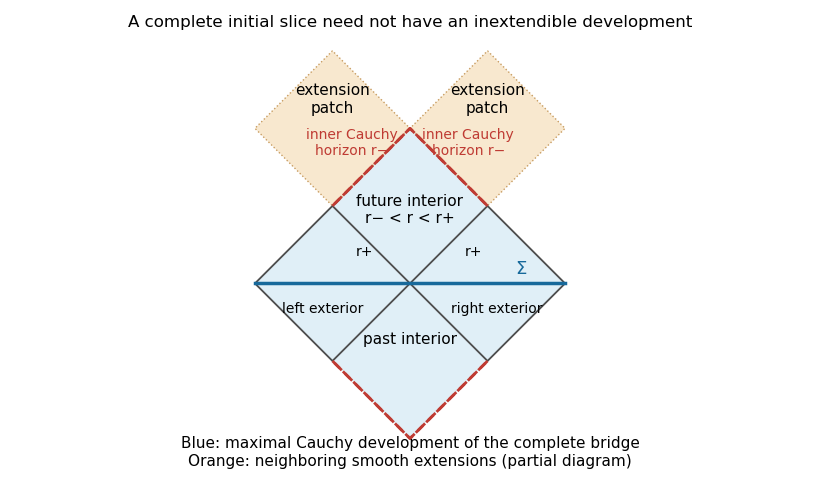
The maximal Cauchy development of a complete Reissner-Nordstrom bridge ends at extendible inner Cauchy horizons
. Details. 
The shaded region is the maximal Cauchy development; dashed upper and lower null edges are inner Cauchy horizons. The displayed neighboring diamonds illustrate smooth continuation, rather than the entire infinite extension.
The strong cosmic censorship conjecture concerns generic admissible initial data, in a specified extension regularity. Exact charged spherical data are exceptional. Perturbations can produce mass inflation at the inner Cauchy horizon, obstructing suitably regular extensions; the precise conjecture depends on the matter model and whether extensions are required to be , , or another regularity. Thus this exact extendible example does not refute a generic strong cosmic censorship conjecture.
For an Einstein-Maxwell example the gravitational triple must be accompanied by electromagnetic initial data. One may take zero magnetic field and the smooth radial electric flux through the bridge. The charges at the two ends have opposite signs when measured with outward normals. This is an example in the electrovacuum theory, not vacuum initial data.
The dominant energy condition says that, for every future timelike vector , the energy current is future causal or zero. Choose normal coordinates whose future unit time vector at is . With metric signature and symmetric stress-energy tensor,A vector with these components is future causal or zero exactly whenThis proves necessity. Conversely, every future unit timelike vector can be made the time axis of an orthonormal frame by a proper orthochronous Lorentz transformation, and that frame can be extended to normal coordinates at . Requiring the displayed inequality in every such chart therefore gives the dominant energy condition for every future timelike vector; positive rescaling handles nonunit vectors. Future null vectors follow by continuity if they are included in the definition. The condition must hold in every local Lorentz frame; one chart alone is insufficient.
In an orthonormal frame, and . The electromagnetic stress-energy tensor givesThe sign of follows directly from . Thusand . These formulas hold in every local Lorentz frame, so the criterion just proved establishes the dominant energy condition. Equality occurs for a nonzero null Maxwell field with and , whose energy current is null vector.
For the P(X, phi) scalar field theory specialized to , vary the inverse metric tensor while holding fixed. With ,Using yieldsIn any local Lorentz frame, set , , , and . ThenA direct calculation givesHence in every local Lorentz frame, proving the dominant energy condition. This proof covers timelike, null, spacelike, and zero alike; it does not assume or use a perfect fluid in general relativity rest frame. The hypotheses need only hold at every attained value of ; the stated all- assumptions are sufficient. For example, , , satisfies them.
There are no or terms in the displayed Einstein-Hilbert action, so the lapse function and shift vector have zero canonical momenta. Their equations impose constraint equations in field theory rather than independent propagation; they are Lagrange multipliers in the Hamiltonian formulation of general relativity.
With the question's positive sign for , vary at fixed . Since ,Thus the canonical momentum of the spatial metric is a weight-one tensor density. Write ; in three spatial dimensions , soThe action has suppressed its overall , and this normalization is retained here. Reversing the sign convention for extrinsic curvature would reverse the momentum relation; the calculation uses exactly the convention supplied in this question.
Perform the Legendre transform in mechanics, using . The trace contraction givesTo avoid differentiating a tensor density as though it were an ordinary tensor, set . Integration by parts with the Levi-Civita connection of givesafter dropping the surface term. AlsoTherefore the requested Hamiltonian isVarying the lapse function and shift vector imposes the Hamiltonian constraint and momentum constraint . The total canonical generator also contains multipliers for the vanishing lapse and shift canonical momenta. With an asymptotic boundary, surface terms must be restored to define the Arnowitt-Deser-Misner energy.
For a closed universe, the spatial Cauchy hypersurface is compact without boundary. There is consequently no asymptotic surface term in the gravitational Hamiltonian. On solutions, the Hamiltonian constraint and momentum constraint giveThis is the vanishing canonical Hamiltonian of a closed universe: evolution generated by lapse and shift is a gauge transformation, and there is no asymptotic time-translation charge. It does not mean the local stress-energy tensor or Riemann curvature tensor is zero. In an asymptotically flat universe the same bulk constraint equations in field theory hold, but a boundary Arnowitt-Deser-Misner energy can be nonzero.
Work in the Boyer-Lindquist coordinates exterior , away from the axes. There , , andInverting the block of the Kerr metric givesThus has , and the smooth nonvanishing timelike vector field defines a time orientation. Choose it future-directed, matching increasing near infinity. For every nonzero future causal vector , the Lorentzian inner product satisfies , henceSo increases strictly along every regular future causal curve in this exterior. Notice that itself can be spacelike in the Kerr ergoregion; the timelike object used here is . Direct substitution also gives .
For a regular causal curve, orient its tangent toward the future; reversing its parametrization does not change . Since , use as parameter and set . The causal inequality givesBoth transverse terms are nonnegative in the exterior, so necessarilyBecause and the discriminant is , this is equivalent toEquality requires and a null tangent. The limiting vectors are the two local azimuthal null directions; a curve following one at constant radius need not be a null geodesic. For a curve with radial or polar motion these angular bounds are necessary, while the full causal inequality can impose stricter bounds.
In the open exterior Kerr ergoregion, andSince ,so even the lower permitted angular velocity is positive. Every regular causal trajectory in the ergoregion has : it must co-rotate with the Kerr black hole. At the outer stationary-limit surface , the lower bound is zero; strict positivity is asserted in the open ergoregion. The sign reverses if the orientation of is reversed.
Use an affine parameter along a generator of a null hypersurface. Its null twist vanishes by hypersurface orthogonality. The screen metric is positive definite, so . The Einstein field equations and null energy condition imply , giving from the Null Raychaudhuri equationStarting with , the null expansion stays negative as long as the congruence remains regular. Set . Then , soA finite negative null expansion cannot persist to . Thus the null focusing theorem givesThis is a focal breakdown of the transverse congruence, provided the generator and regular geometry extend that far; it is not by itself a curvature singularity or a statement that the individual null geodesic terminates there.
The second law of black-hole mechanics says that the total area of future event horizon cross-sections cannot decrease toward the future, assuming the classical Einstein field equations, the null energy condition, suitable global predictability and regularity, and here the stipulated future completeness of its generators.
A future event horizon is an achronal boundary generated by null geodesics. If a smooth generator had , the null focusing theorem would produce a conjugate point to a spacelike surface within finite affine parameter. Future completeness lets the generator reach it, but beyond such a point it could no longer remain on the achronal boundary, a contradiction. Hence wherever the null expansion is defined. A transported area element obeysEvery generator present on an early cut continues to a later cut without decreasing its area contribution. New generators can join at past endpoints, adding area; future endpoints in a regular spacetime are excluded. ThereforeThis argument also covers the sum of initially disconnected event horizons of the black holes in a merger. Nonsmooth crease sets require the standard regularity treatment; they do not provide a classical area-decrease loophole under these hypotheses. Quantum negative-energy flux can violate the classical null energy condition, so this is a classical black-hole area theorem, not an unconditional law for evaporating black holes.
For each initial Kerr black hole, and the horizon area follows by integrating its induced metric:The final Schwarzschild black hole has area . Applying the second law of black-hole mechanics to the sum of the two initial areas givesConsequently the radiated energy fraction satisfiesThe bound is for nonrotating initial holes and tends to as . It is an upper bound from area alone, not a predicted efficiency or an assurance that equality is realizable. A final Schwarzschild black hole has zero angular momentum; any nonzero total initial angular momentum must also be removed or compensated, which can further restrict a physical merger.
Consider a real Klein-Gordon field on a prescribed globally hyperbolic spacetime, obeying with metric signature . A curvature coupling can be included as . A Cauchy hypersurface and compactly supported smooth data determine a unique solution; appropriate falloff can replace compact support. The real solution space has conserved symplectic formConservation follows by integrating the divergence-free current , with no boundary flux. On complex solutions the conserved Klein-Gordon inner product isIt is indefinite on the full complex solution space.
Choose a complete positive-norm mode subspace, with modes satisfyingEquivalently choose a compatible complex structure on the Klein-Gordon solution space. The mode labels may be continuous, in which case sums and Kronecker symbols become integrals and Dirac delta functions. Construct the one-particle Hilbert space from these modes and its bosonic Fock space. Promote the field to the operator-valued distributionFor a foliation with spatial metric determinant , the conjugate momentum density is . Mode completeness gives the equal-time canonical commutation relationsThe Fock vacuum obeys , and counts particles in the chosen mode. For local products and a renormalized stress-energy tensor, physically admissible states are further restricted by the Hadamard condition. The field algebra exists without a preferred Fock vacuum.
A different admissible mode splitting can mix positive and negative norms:Orthonormality imposes the canonical identities for a bosonic Bogoliubov transformationThe same field then hasWithout a preferred notion of positive frequency, a nonstationary spacetime supplies no distinguished mode splitting: particle number and vacuum depend on the choice of modes, although the field equation and field algebra do not. With infinitely many modes the Bogoliubov transformation need not be unitarily implementable; finite total mixing requires a Hilbert-Schmidt operator .
For a stable strictly stationary spacetime, a chosen future globally timelike Killing vector field gives a preferred time translation. Choose modes withWhen the corresponding conserved Killing energy is positive and the spectral problem has suitable boundary conditions and no problematic zero modes, this gives the preferred vacuum state in a stationary spacetime and particles relative to . Positive-frequency mode mixing within that same subspace leaves the Fock vacuum unchanged. Rescaling by a positive constant changes the frequency units but not their sign.
Stationarity alone, if it only means a Killing field timelike near infinity, is insufficient for a global unique particle interpretation. In the Kerr ergoregion, is spacelike, so positive frequency relative to does not automatically select a positive-norm subspace throughout the geometry; superradiance illustrates the difficulty. Additional vacuum and boundary choices remain necessary. The customary stationary answer therefore assumes a suitable timelike stationary flow and a stable positive-energy quantization; it does not assert that every stationary black-hole extension has one globally preferred vacuum.
Articles by others on the same topic
There are currently no matching articles.