The distance on a connected Riemannian manifold is the infimum of the arc lengths of piecewise smooth curves joining the endpoints:It answers “how far must I travel while staying in this geometry?” The Riemannian metric measures an instantaneous tangent vector, whereas Riemannian distance is the global result of comparing complete routes.
In Euclidean space the straight segment achieves this infimum, giving . On a round sphere it gives great-circle distance, for positions with unit vectors . For and a central angle , the surface distance is , while the chord length is . On a circular cylinder, routes with different winding lead to the minimum in Riemannian distance on a circular cylinder.
The word infimum matters: a shortest route need not exist. In the Euclidean plane with the origin removed, the points and still have Riemannian distance , approached by paths detouring around an arbitrarily small circle. Every allowed route has length strictly greater than , since the only Euclidean straight segment passes through the missing point. The Hopf-Rinow theorem guarantees a minimizing geodesic between any two points when a connected Riemannian manifold is complete.
On the lateral surface of an infinite circular cylinder of radius , the induced metric is . Lifting a curve to the unrolled plane preserves its arc length. If the endpoints differ by angular coordinate and height , the possible lifted endpoint displacements are for integers . Each straight segment gives a geodesic, and the shortest of their lengths isChoose the representative of with smallest absolute value modulo ; if its absolute value is , the two angular directions tie. This minimum is attained because the candidate lengths tend to infinity as . The formula concerns travel on the lateral surface; it does not allow a shortcut through the cylinder's interior or across end caps.
For , take and in surrounding Euclidean space. The angular difference is and height difference is . The route has length . The route goes the other way around and has length . Both are among the geodesics on a circular cylinder, but only the first is a minimizing geodesic between these endpoints.
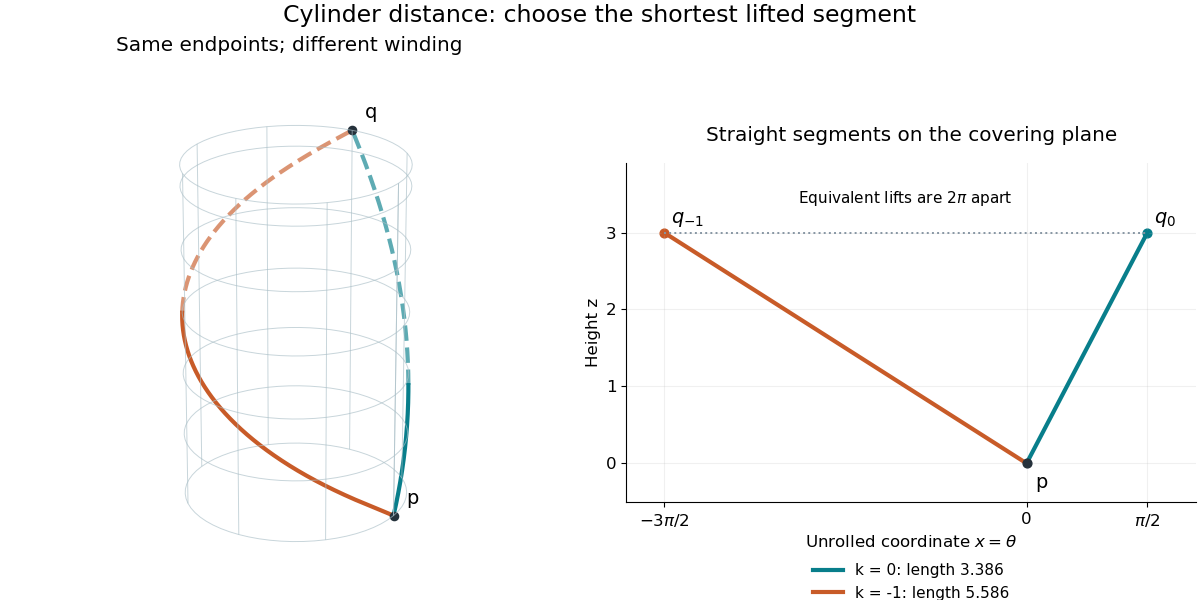

This is a global consequence of intrinsic flatness of a circular cylinder: locally everything is Euclidean, yet the periodic angular coordinate leaves several competing routes. A shortest-route problem on the curved surface becomes a family of ordinary planar distance calculations.
In a relatively compact coordinate ball the Riemannian metric norm is bounded above and below by positive multiples of the Euclidean norm. A coordinate segment gives the upper distance bound. A path leaving the ball has a positive lower length bound before its first exit; paths staying in it have the Euclidean displacement lower bound. Consequently distinct points have positive Riemannian distance, and the resulting metric topology equals the manifold topology. Connectedness makes the distance finite because smooth manifolds are locally path connected.
In a connected Riemannian manifold, choose a small compact geodesic sphere around with . Minimize on this sphere. Every path from to crosses it, so an almost-minimizing path has length at least . The triangle inequality gives the reverse bound, yielding the displayed equality. No global completeness is needed.
A minimizing geodesic realizes the Riemannian distance between its endpoints. A geodesic segment is locally minimizing, but need not remain globally minimizing beyond a cut point.
At an interior junction of two unit-speed geodesic segments, let be the incoming and the outgoing tangent. Choose points close to the junction in a common convex normal neighbourhood. Moving the junction with velocity changes the sum of the two segment lengths by , using the first variation of geodesic energy or the Gauss lemma. If , choose to reduce length. Hence a length-minimizing broken geodesic has matching tangents and is one smooth geodesic.
// Target: riemannian-geometry.bigb
On a complete connected Riemannian manifold, let for a unit tangent vector be the supremum of times for which minimizes Riemannian distance from . The cut locus consists of the endpoints with . Radial minimization fails beyond this first cut time; distance spheres can cease to be smooth there.
For a unit-speed geodesic , a finite cut time is the last time to which its segment from minimizes Riemannian distance. Its endpoint is the Riemannian cut point along that geodesic. It lies in the cut locus; it need not be a cut point in the topological sense. The segment up to the cut time still minimizes by continuity of distance.
In unit-curvature Real projective space of dimension at least two, Riemannian distance is for unit lifts. A unit-speed geodesic has lift , with unit and perpendicular to , and therefore ceases to minimize after . Its normal Jacobi fields with zero initial value are times parallel vector fields along a curve, giving first conjugate point at time . The two times differ in every direction.
A Riemannian cut point along a geodesic in a complete Riemannian manifold is either its first conjugate point or the endpoint of another minimizing geodesic from the initial point. To prove this, approach the cut time from above and choose minimizing geodesics to the later endpoints using the Hopf-Rinow theorem. A subsequence of their initial unit vectors converges. If its limit is the original initial vector and the cut endpoint is not conjugate, the inverse function theorem for the Riemannian exponential map identifies the two geodesics locally and contradicts the shorter length of the chosen minimizers. A conjugate point earlier than the cut time is excluded by the negative Riemannian index form direction obtained by extending an endpoint-vanishing Jacobi field by zero and perturbing its endpoint corner.
Articles by others on the same topic
There are currently no matching articles.