Use the subextremal four-dimensional Reissner-Nordstrom spacetime, with . Its static radial function isTake the time-symmetric two-ended bridge through the outer bifurcation surface. Its initial data have andon each end. The bridge is smooth: in proper radial distance , . Each asymptotically flat end is an infinite Riemannian distance away. Hence the spatial Riemannian manifold is complete and admits no proper same-dimensional smooth isometric extension as a connected spatial manifold.
Its maximal Cauchy development includes the two exteriors and the adjacent future and past regions between and . It ends at inner Cauchy horizons, not at a curvature singularity. Since the simple root at is removable in horizon-penetrating coordinates and all curvature invariants are finite there, the exact solution extends across these Cauchy horizons. The extension is no longer globally determined by the given initial data.
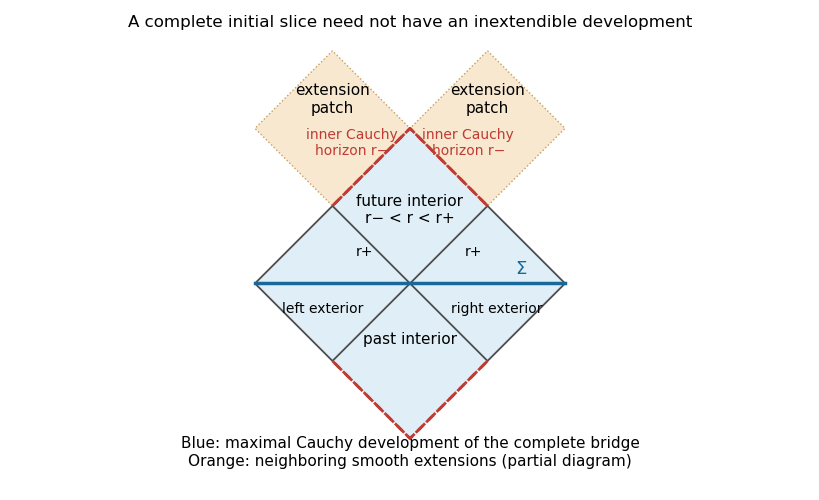
The maximal Cauchy development of a complete Reissner-Nordstrom bridge ends at extendible inner Cauchy horizons
. Details. 
The shaded region is the maximal Cauchy development; dashed upper and lower null edges are inner Cauchy horizons. The displayed neighboring diamonds illustrate smooth continuation, rather than the entire infinite extension.
The strong cosmic censorship conjecture concerns generic admissible initial data, in a specified extension regularity. Exact charged spherical data are exceptional. Perturbations can produce mass inflation at the inner Cauchy horizon, obstructing suitably regular extensions; the precise conjecture depends on the matter model and whether extensions are required to be , , or another regularity. Thus this exact extendible example does not refute a generic strong cosmic censorship conjecture.
For an Einstein-Maxwell example the gravitational triple must be accompanied by electromagnetic initial data. One may take zero magnetic field and the smooth radial electric flux through the bridge. The charges at the two ends have opposite signs when measured with outward normals. This is an example in the electrovacuum theory, not vacuum initial data.
Articles by others on the same topic
There are currently no matching articles.