For an old, approximately solar-composition H/He object with no strong irradiation or ongoing heat input, the cold mass-radius relation reaches a broad maximum of order one Jupiter radius, nominally about --, at a few Jupiter masses. This is a property of that composition and low-entropy sequence, not a composition-independent theorem from hydrostatic equilibrium alone. Young isolated substellar objects can be larger while cooling; strict thermal steady state of a non-burning isolated body would require its internal luminosity to vanish.
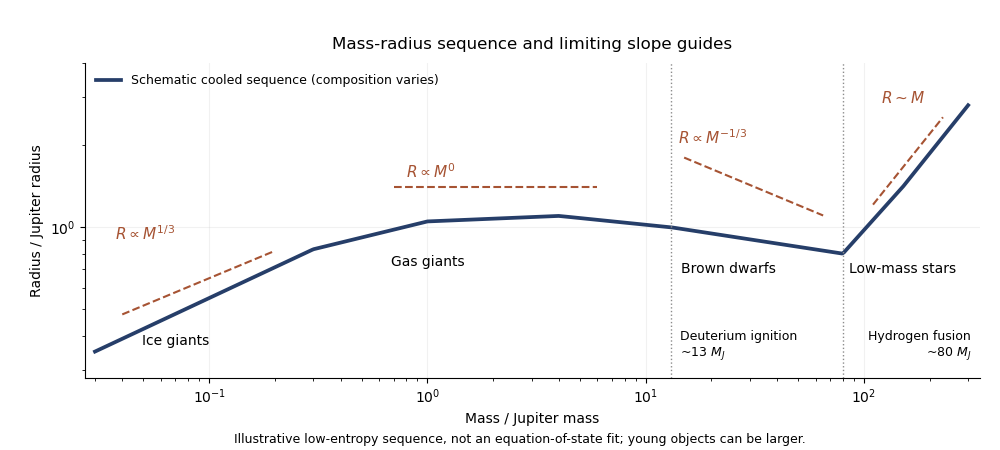
Schematic mass-radius sequence from ice giants to low-mass stars with composition and degeneracy slope guides
. Details. 
At low mass, an incompressible fixed-composition approximation gives , so . Ice giants contain dense heavy material and modest H/He envelopes, so real radii depend strongly on composition and are not obtained by extending a pure-hydrogen curve through them.
Gas giants approach a regime in which Coulomb interactions, compression and partial electron degeneracy pressure compete. An approximate index-one stellar polytrope, , gives at fixed , explaining the broad Jupiter-sized plateau. In the nonrelativistic degenerate limit, is an index- stellar polytrope, giving at fixed composition. This is a limiting slope; finite-temperature brown dwarfs do not follow that exact power law over their entire observed mass range.
The general polytropic mass-radius relation displays both limits:At roughly , deuterium burning becomes possible, with a composition-dependent threshold. This is a conventional planet/brown-dwarf division rather than a unique formation definition. At roughly --, about --, sustained hydrogen burning can support a low-mass star. Its nuclear energy supply maintains a specific entropy that prevents indefinite cooling onto the cold substellar sequence; its approximate main-sequence relation is over a limited low-mass interval.
Ice giants chiefly lose formation heat and some gravitational/radiogenic energy, with convection in fluid regions and thermal conduction or inhibited convection where composition stratifies the interior. Gas giants and non-burning brown dwarfs radiate stored heat and contraction energy; their deep interiors are largely convective, with radiative photospheres. Helium separation can supply extra gravitational energy in mature giant planets, while brown dwarfs above the deuterium threshold have a temporary nuclear contribution. Low-mass stars are powered primarily by hydrogen fusion and are largely or fully convective at the lowest stellar masses. The transition to sustained fusion is the essential change from a cooling body to a long-lived thermal balance.
Articles by others on the same topic
There are currently no matching articles.