The two relevant categories are strongly irradiated, often transiting hot Jupiters, and young directly imaged exoplanets with large residual-entropy radii. The young objects are inflated relative to an old cold mass-radius sequence; a large young radius is not automatically anomalous relative to an age-appropriate formation model.
For a transit, the depth gives after geometric and limb darkening corrections; an independently estimated stellar radius sets . A measured planet mass then tests its location on the planetary mass-radius relation. For a directly imaged object, distance and integrated spectral flux give luminosity; a fitted effective temperature suppliesThe imaged radius is model-dependent because temperature, gravity and exoplanet clouds are inferred from its spectrum; its mass may also depend on age and evolutionary models unless dynamically measured.
Two broad explanatory classes are slower loss of existing heat and addition of heat to the deep interior. Specific delayed-cooling proposals are enhanced atmospheric opacity, which restricts radiative loss, and composition gradients producing layered convection in a giant planet. Specific heating proposals are tidal heating and Ohmic heating from currents induced by magnetized atmospheric winds, the proposed Ohmic heating of a giant planet. Heating must reach or influence sufficiently deep layers to maintain the interior specific entropy; merely heating the optically thin upper atmosphere is not equivalent. For young distant objects, retention of formation heat, described by hot and cold starts of a giant planet, itself explains much of the large radius without requiring the hot-Jupiter heating mechanisms.
For an old, approximately solar-composition H/He object with no strong irradiation or ongoing heat input, the cold mass-radius relation reaches a broad maximum of order one Jupiter radius, nominally about --, at a few Jupiter masses. This is a property of that composition and low-entropy sequence, not a composition-independent theorem from hydrostatic equilibrium alone. Young isolated substellar objects can be larger while cooling; strict thermal steady state of a non-burning isolated body would require its internal luminosity to vanish.
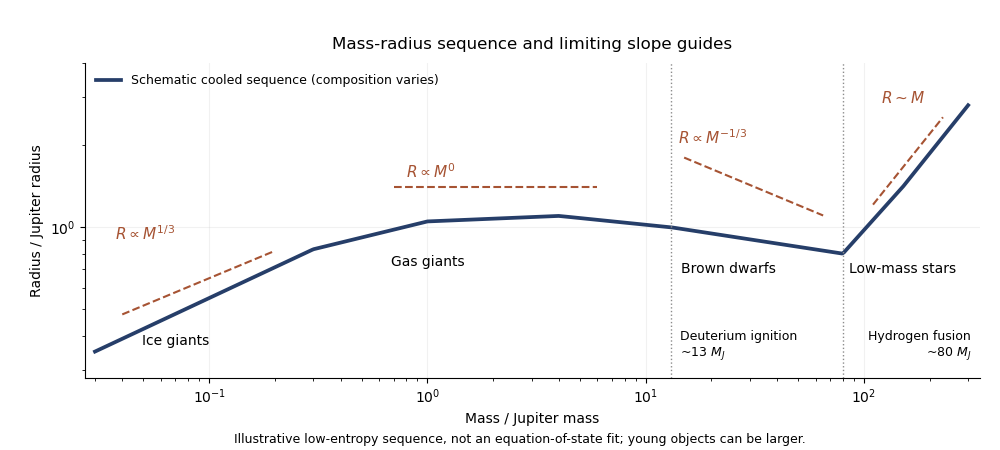
Schematic mass-radius sequence from ice giants to low-mass stars with composition and degeneracy slope guides
. Details. 
At low mass, an incompressible fixed-composition approximation gives , so . Ice giants contain dense heavy material and modest H/He envelopes, so real radii depend strongly on composition and are not obtained by extending a pure-hydrogen curve through them.
Gas giants approach a regime in which Coulomb interactions, compression and partial electron degeneracy pressure compete. An approximate index-one stellar polytrope, , gives at fixed , explaining the broad Jupiter-sized plateau. In the nonrelativistic degenerate limit, is an index- stellar polytrope, giving at fixed composition. This is a limiting slope; finite-temperature brown dwarfs do not follow that exact power law over their entire observed mass range.
The general polytropic mass-radius relation displays both limits:At roughly , deuterium burning becomes possible, with a composition-dependent threshold. This is a conventional planet/brown-dwarf division rather than a unique formation definition. At roughly --, about --, sustained hydrogen burning can support a low-mass star. Its nuclear energy supply maintains a specific entropy that prevents indefinite cooling onto the cold substellar sequence; its approximate main-sequence relation is over a limited low-mass interval.
Ice giants chiefly lose formation heat and some gravitational/radiogenic energy, with convection in fluid regions and thermal conduction or inhibited convection where composition stratifies the interior. Gas giants and non-burning brown dwarfs radiate stored heat and contraction energy; their deep interiors are largely convective, with radiative photospheres. Helium separation can supply extra gravitational energy in mature giant planets, while brown dwarfs above the deuterium threshold have a temporary nuclear contribution. Low-mass stars are powered primarily by hydrogen fusion and are largely or fully convective at the lowest stellar masses. The transition to sustained fusion is the essential change from a cooling body to a long-lived thermal balance.
The spherical stellar structure equations apply to a planet as well, with its appropriate equation of state:The last equation is the local first law, including gravitational contraction through the specific entropy change. For an isolated non-burning planet, , soIf the convective interior has nearly uniform specific entropy , positive outgoing luminosity gives . This entropy loss of an isolated convective planet describes its secular cooling.
During assembly, the gravitational energy scale provides a source of heat. Integrating hydrostatic equilibrium gives the virial theorem, , neglecting the surface-pressure term. For a monatomic ideal gas this becomes , hence . Contraction makes more negative, releases radiation, and heats part of the gas. A characteristic formation temperature has scale up to structure factors. The retained fraction depends on the accretion shock, producing hot and cold starts of a giant planet.
Formation releases heat, and an isolated planet subsequently loses specific entropy and intrinsic luminosity as it approaches a cooler, more degenerate state. The structure equations alone do not fix one initial temperature, and the early contraction of an ideal gas can increase its central temperature while its total energy decreases. “Cools” therefore need not mean that every depth becomes colder at every instant. Once degeneracy limits contraction, the thermal reservoir declines more directly; the emergent effective temperature usually falls along a fixed-mass cooling track.
This makes young giant planets attractive for exoplanet direct imaging: their thermal near/mid-infrared emission can be far brighter than that of old planets of the same mass. Imaging and spectroscopy measure projected separation, astrometry, luminosity, an exoplanet emission spectrum, temperatures and atmospheric molecular and exoplanet cloud signatures. Radius follows from luminosity and fitted temperature; mass and initial specific entropy generally require age/evolutionary information, or an independent dynamical mass measurement. A detected luminosity alone is not a model-independent planet mass.
The stellar luminosity is . At separation , the planet intercepts a disk of area . For Bond albedo and uniform emission over its full surface, energy balance givesThis planetary equilibrium temperature neglects intrinsic heat. Dayside-only or nonuniform emission changes the redistribution factor.
For the single-layer greenhouse model, assume a black infrared surface, an atmosphere transparent to incoming stellar radiation, and infrared absorptivity/emissivity . Let be surface temperature and layer temperature. Kirchhoff's law makes the layer's emission in each direction . Its balance isso for . Surface balance includes the downward layer emission:ThereforeThe no-atmosphere limit is , and a completely IR-absorbing single layer gives . The outgoing flux remains . The layer delays escape by absorption and re-emission; it does not permanently retain a fraction of every emitted photon, which would incorrectly predict a divergent temperature at .
Articles by others on the same topic
There are currently no matching articles.