Write because the prescribed kinematic viscosity is . Substituting and into the viscous evolution of an accretion disk givesHence the dimensionless diffusion equation isFor the useful inverse-radius coordinate , this becomes simply . The positive factor in makes increasing correspond to increasing physical time.
There is a distinction between the named torque variable and the physical viscous torque in an accretion disk. For Keplerian rotation, the outward torque magnitude isHere denotes the central mass. The zero-torque inner boundary condition therefore requires as . Requiring is stronger. The nontrivial finite-mass profile used below satisfies both; this distinction matters when counting integration constants.
Let with . The derivatives of this similarity solution areThe first-derivative terms cancel in the dimensionless diffusion equation, leaving for . ThusAt the inner boundary , . Interpreting the named variable as vanishing there sets . Even if only the true viscous torque in an accretion disk is required to vanish, a nonzero would give infinite total mass near ; finite mass again selects . With nonnegative surface density, choose ; its value fixes the initial mass normalization. ThereforeThe surface density vanishes exponentially at the origin and has an tail at infinity. Its peak occurs at , with . The peak moves inward and grows as time increases.
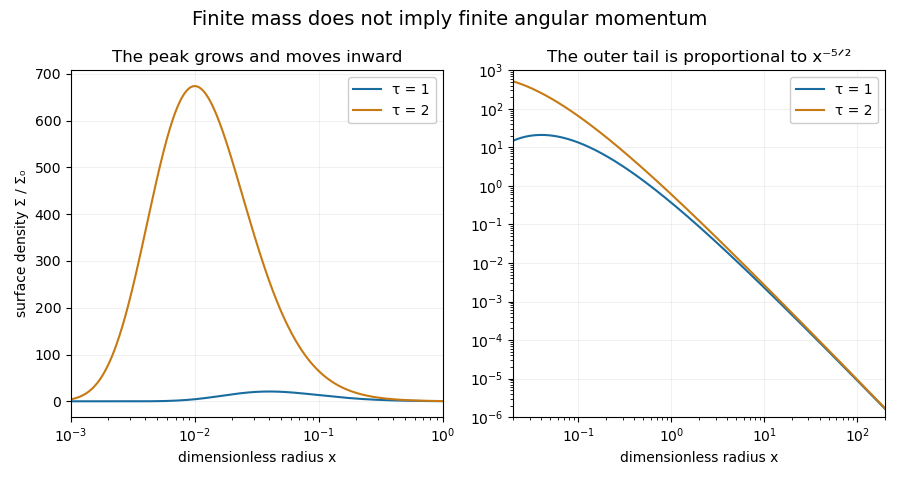
Surface-density profiles of the printed similarity solution at two times, showing an inward-moving growing peak and the outer power-law tail
. Details. 
The plot uses and shows the actual surface density, with logarithmic radius to resolve both peaks. The later profile is larger at every fixed radius. Its total mass is finite; its total angular momentum is not, as the next calculation establishes.
For the finite-mass similarity solution above, the total disk mass isSubstitute , so and . This givesThe requested linear increase of mass is therefore correct. It is supplied by the infinite-radius boundary, rather than by a source-free isolated finite disk. The inward mass accretion rate iswhich tends to zero at the origin and to at infinity.
For Keplerian rotation, the specific angular momentum is . The total disk angular momentum would beThis integral diverges at , corresponding to infinite radius. There is no finite constant total angular momentum for the nonzero printed similarity solution. The seemingly time-independent last expression is an infinite quantity; it cannot prove a finite conservation law.
The problem remains visible under a cutoff. With , write , where and is the exponential integral. ThenEven the finite change after subtracting a common logarithmic divergence is not zero. Direct integration of the disk diffusion equation gives the boundary identityfor this profile the outer expression has a nonzero limit, giving the same finite change rate. An inner zero torque alone does not impose zero outer angular-momentum flux.
More generally, the printed family can have finite angular momentum at both ends only if and , hence it is trivial. Thus the request for a nonzero finite constant is incompatible with the stated viscosity exponent, similarity ansatz and infinite radial domain. A physical finite-domain or altered similarity problem would need different boundary data or assumptions; silently assigning a finite value to the divergent integral does not repair it.
Articles by others on the same topic
There are currently no matching articles.