Write because the prescribed kinematic viscosity is . Substituting and into the viscous evolution of an accretion disk givesHence the dimensionless diffusion equation isFor the useful inverse-radius coordinate , this becomes simply . The positive factor in makes increasing correspond to increasing physical time.
There is a distinction between the named torque variable and the physical viscous torque in an accretion disk. For Keplerian rotation, the outward torque magnitude isHere denotes the central mass. The zero-torque inner boundary condition therefore requires as . Requiring is stronger. The nontrivial finite-mass profile used below satisfies both; this distinction matters when counting integration constants.
Let with . The derivatives of this similarity solution areThe first-derivative terms cancel in the dimensionless diffusion equation, leaving for . ThusAt the inner boundary , . Interpreting the named variable as vanishing there sets . Even if only the true viscous torque in an accretion disk is required to vanish, a nonzero would give infinite total mass near ; finite mass again selects . With nonnegative surface density, choose ; its value fixes the initial mass normalization. ThereforeThe surface density vanishes exponentially at the origin and has an tail at infinity. Its peak occurs at , with . The peak moves inward and grows as time increases.
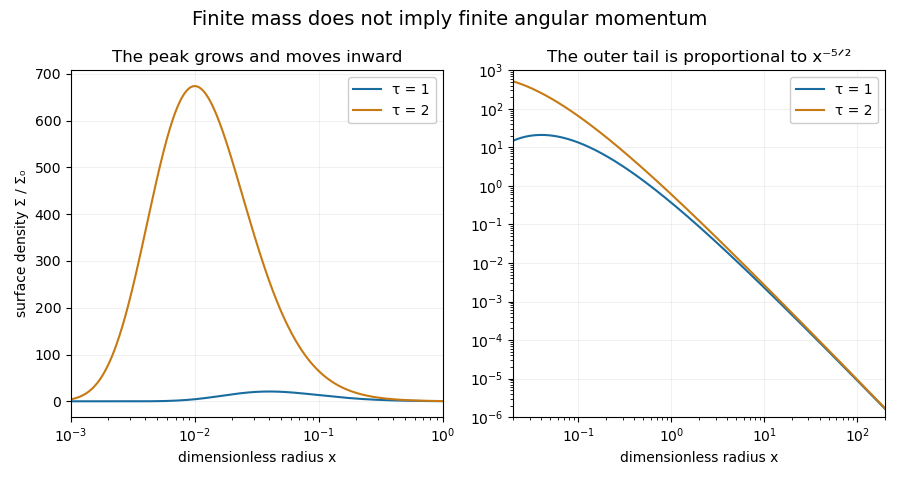
Surface-density profiles of the printed similarity solution at two times, showing an inward-moving growing peak and the outer power-law tail
. Details. 
The plot uses and shows the actual surface density, with logarithmic radius to resolve both peaks. The later profile is larger at every fixed radius. Its total mass is finite; its total angular momentum is not, as the next calculation establishes.
For the finite-mass similarity solution above, the total disk mass isSubstitute , so and . This givesThe requested linear increase of mass is therefore correct. It is supplied by the infinite-radius boundary, rather than by a source-free isolated finite disk. The inward mass accretion rate iswhich tends to zero at the origin and to at infinity.
For Keplerian rotation, the specific angular momentum is . The total disk angular momentum would beThis integral diverges at , corresponding to infinite radius. There is no finite constant total angular momentum for the nonzero printed similarity solution. The seemingly time-independent last expression is an infinite quantity; it cannot prove a finite conservation law.
The problem remains visible under a cutoff. With , write , where and is the exponential integral. ThenEven the finite change after subtracting a common logarithmic divergence is not zero. Direct integration of the disk diffusion equation gives the boundary identityfor this profile the outer expression has a nonzero limit, giving the same finite change rate. An inner zero torque alone does not impose zero outer angular-momentum flux.
More generally, the printed family can have finite angular momentum at both ends only if and , hence it is trivial. Thus the request for a nonzero finite constant is incompatible with the stated viscosity exponent, similarity ansatz and infinite radial domain. A physical finite-domain or altered similarity problem would need different boundary data or assumptions; silently assigning a finite value to the divergent integral does not repair it.
The four equations describe, respectively, vertical hydrostatic equilibrium in the central object's gravity, the vertical divergence of radiative flux balancing viscous dissipation, optically thick radiative diffusion, and the equation of state combining ideal gas gas pressure with radiation pressure. Here is dynamic viscosity, not the mean molecular weight ; is the opacity, the Stefan-Boltzmann constant, and the local orbital frequency.
In the radiation-pressure limit, , so radiative diffusion givesCompare this with vertical hydrostatic equilibrium. Wherever ,At fixed radius, constant opacity makes . The viscous dissipation equation therefore yieldsindependent of height within the optically thick radiation-supported layer. The result assumes the supplied gravity, heating and diffusion equations; optically thin surface corrections are outside that approximation.
Use characteristic, vertically averaged quantities at fixed radius. Let be a disk thickness, , and let the alpha disk prescription give , up to a convention-dependent constant. From the preceding radiation pressure and constant-opacity balance, is independent of ; thusVertical hydrostatic equilibrium gives , henceThe vertically averaged kinematic viscosity satisfies . ConsequentlyAt fixed radius the omitted factors are independent of , so this is the requested inverse-density scaling of the viscous torque in an accretion disk.
This is an order-of-magnitude vertical model, as requested. Imposing both exact pointwise and exact pointwise would force to be constant, contrary to nontrivial vertical hydrostatic equilibrium. The characteristic-pressure prescription supplies a scaling, not an exact simultaneous vertical solution to all those idealized equations.
Write . In a small radial patch with disturbance scale much smaller than , the leading disk diffusion equation is . Taking the linearization around a uniform surface density givesFor a local Fourier mode ,because has . Thus the effective density diffusion coefficient is negative and the disk has a viscous instability of an accretion disk.
A localized overdensity is a maximum of but a minimum of . At its center , so : it grows. The local radial mass flux is proportional to , directing matter toward that minimum from both sides. This is the physical feedback: an overdense patch has a smaller viscous torque in an accretion disk and attracts further accumulation. The arbitrarily rapid growth in this ideal negative-diffusion model is not a resolved prediction below the validity scale of the thin-disk and local viscous closure.
Articles by others on the same topic
There are currently no matching articles.