The expansion is singular near the moving lower limit, so expanding throughout the original integral would lose its constant term. Introduce the symmetric exponential integralUnder , the discarded piece becomesThis is a uniform Taylor expansion because . To derive the logarithmic expansion of a symmetric exponential integral without needing another special function, first exploit the same substitution to writeThe estimate follows from . Here is Euler's constant and the small-argument expansion of the exponential integral fixes the constant as well as the logarithm.
Differentiate under the integral and integrate the derivative of over ; the exponentially small endpoint terms vanish. This gives the ordinary differential equationFor the Frobenius method at its regular singular point, write . Substitution gives and . The preceding leading calculation sets , , henceSubtracting the moving-cutoff correction to a symmetric exponential integral yields the requested answer, including the logarithmically enhanced first-order term:Thus the switchback term must be retained when asking for all contributions through order .
Set . At the positive real endpoint the contour is real and crosses the saddle point at zero. The Gaussian integral givesBoth omitted tails are exponentially small. At the negative real endpoint the contour is oriented leftward and does not cross the saddle point:The endpoint contribution in steepest descent, or one integration by parts, gives . The upper-end correction is and is much smaller. ThereforeThe sign comes from contour orientation, not from a different Gaussian convention.
Let and use the method of steepest descents with phase . For , and . The simple saddle point is : the real axis is its descending path and the imaginary axis its ascending path. The quadratic complex endpoint descent path from satisfies and can be parametrized bywith the square-root branch chosen continuously from . Increasing reduces the real part of the exponent by .
For , that endpoint path goes to positive real infinity. Deform the original contour into the real path from through the saddle point towards , followed backwards along the endpoint descent path to . The integrand is an entire function, so finite contour deformations are legitimate; connecting arcs in the far decaying sector vanish. If denotes the oriented integral from to that infinity, this givesThe last expression follows by setting : , so the endpoint integral is . This derives its phase and orientation directly.
For , the descent path from goes to negative real infinity. Deform from towards that infinity and then backwards along this endpoint path to . There is no saddle point segment, anduses the same formula with the negative square-root branch. At the contour can run from to zero and then up the imaginary axis. It gives a half-Gaussian contribution and the dominant imaginary endpoint term . The change in the subdominant saddle point contribution is a Stokes phenomenon; it does not change the leading endpoint term on either side of that angle.
The Gaussian saddle and endpoint dominance by angle follows by comparing exponential sizes and gives all fixed-angle leading behaviours:At , the endpoint term has magnitude , so the saddle point term of order still dominates. In the middle interval the endpoint term grows exponentially for , is oscillatory of order at , and decays exponentially for . On the latter interval it nevertheless decays more slowly than the fixed-endpoint term. Equality of their exponential rates means on the left half-plane, hence . At that angle both terms are required; their coefficient magnitudes are unequal, so their sum has no complete destructive cancellation.
These fixed-angle asymptotic expansions are not uniform if is allowed to vary with near a dominance transition. The endpoint/saddle balance near involves ; the two-endpoint competition near has an angular scale .
The following sketches show the contour orientations, the saddle point and both endpoints. The hyperbolic endpoint paths are followed backwards when returning from infinity to ; the dotted far-end connectors indicate the vanishing connecting arc.
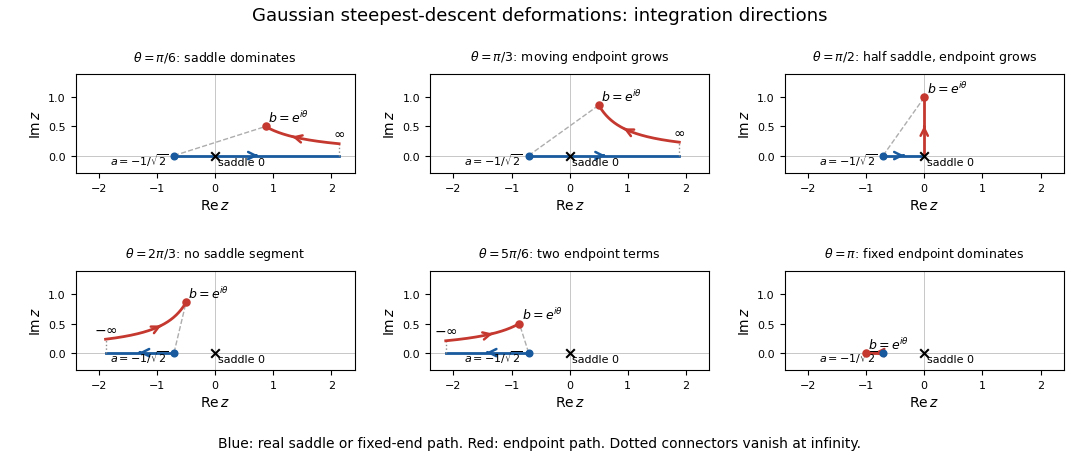
Steepest-descent contour deformations for the Gaussian integral at six endpoint angles, with saddle and endpoint paths and integration directions
. Details. 
Articles by others on the same topic
There are currently no matching articles.