The pushout of groups isIts maps from agree on , and every other pair of group homomorphisms agreeing on factors through one unique homomorphism from . This is the universal property. When the are injective, it is the amalgamated free product, and the two factors and the identified copy of embed in it. Some conventions use this name for the quotient even without injectivity; the embedding assertion requires injectivity.
The Seifert-van Kampen theorem states: if , where are open and path connected, is path connected and contains a basepoint , then is the pushout of groups of and over . Thus the fundamental group is obtained by amalgamating the overlap relations. Openness can be replaced by standard neighborhood hypotheses, as in the wedge calculation.
The real projective plane has fundamental group , while the circle has fundamental group . Apply the Seifert-van Kampen theorem to open neighborhoods of the two wedge summands whose overlap is contractible. This givesChanging the basepoint within this path-connected space gives an isomorphic group.
Define . The relation is respected, so the group presentation gives a homomorphism to . These permutations generate : conjugating by powers of produces the other transpositions. Hence is surjective.
The kernel is a normal subgroup of index , so the corresponding connected covering space is regular with six sheets labeled by . Write , and use right multiplication for path lifting. Above the real projective plane, right multiplication by pairs the labels, giving three copies of its two-sheeted covering space . Each sphere has two marked antipodal points corresponding to its pair , . Above the circle, right multiplication by gives two cycles of length three. Attach their six marked points to the identically labeled points of these three spheres.
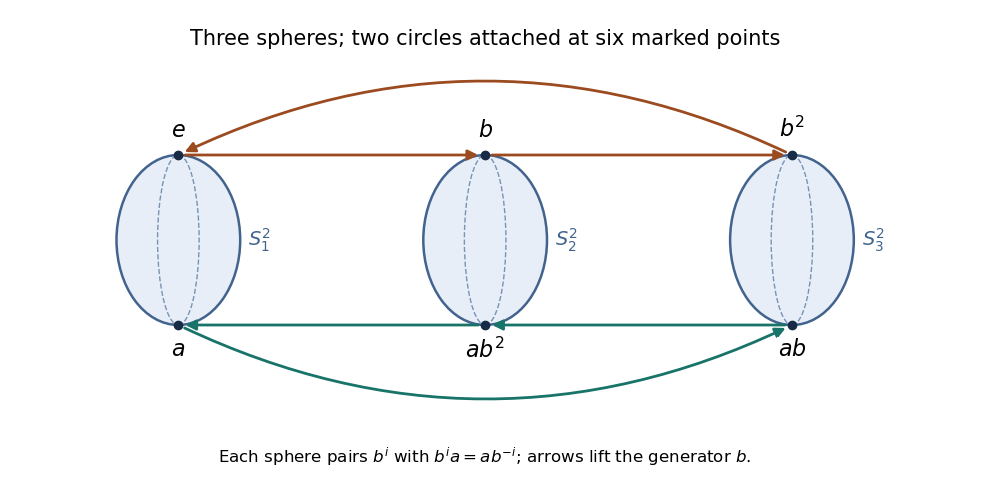
The six-sheeted cover: three spheres joined by two lifted circles
. The upper circle follows ; the lower follows . The point paired with is , explaining the reversed lower labeling in the figure. On each summand these are genuine covering maps, and the attachment matches the six lifts of the wedge point. A small neighborhood of that point lifts to six disjoint copies of its neighborhood in the wedge. This verifies the covering space locally, and the action of is transitive, so it is connected. Its stabilizer is , identifying this kernel cover of a real projective plane wedged with a circle.
Yes, it retracts onto a graph. On each of the three spheres, choose an arc joining the two marked points. A sphere retracts onto this arc: identify it with the vertical meridian parameterized by the height coordinate, and send every point of a given height to the meridian point at that height. This map is continuous and fixes the meridian. Apply these three retractions and fix the lifted circles pointwise; the maps agree at all attachment points. The resulting connected graph has six vertices and nine edges, so its fundamental group is free of rank .
No, it cannot deformation retract onto a graph. Each sphere contributes a degree- homology class independent of the other two. Attaching circles at points introduces only vertices and edges, soFor example, the cellular chain complex obtained by giving each sphere one -cell and a tree of arcs has three zero-boundary -cells and no -cells. Every graph has zero degree- homology. A deformation retraction would induce a homotopy equivalence and an isomorphism on homology, which is impossible. An ordinary retraction has no such requirement.
Articles by others on the same topic
There are currently no matching articles.